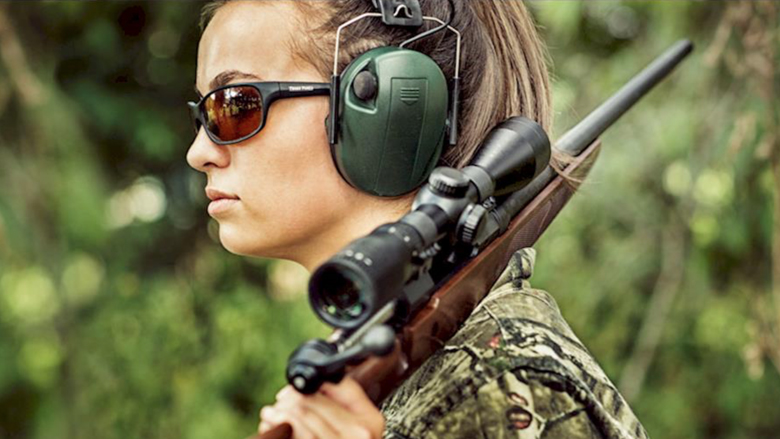

Try as one might, it's a challenge to overstate the popularity of the .22 LR cartridge. Launched in 1887, this little rimfire represents roughly 19 percent of the ammunition market with between 1.5 to 2.5 billion rounds sold annually. Its soft shooting characteristics and low price make it a popular option for casual plinking, training, formal target shooting competitions and small game hunting.
Over the years, the ammunition industry has worked diligently to improve or update popular calibers with new gunpowder blends and bullet designs. But despite its popularity, the .22 LR has remained essentially unchanged. That is until in September of 2024, when Winchester Ammunition launched the .21 Sharp, taking this nearly 140-year-old rifle round in a fresh direction. Now in production for more than a year, let's take a look at why it was developed and how it performs down range.
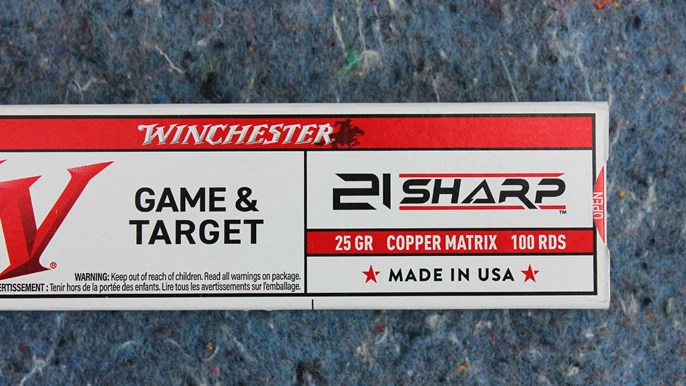
Winchester’s .21 Sharp is a new take on the venerable .22 LR rimfire cartridge.
What is the .21 Sharp Cartridge?
The .21 Sharp is a small caliber cartridge built around the same rimfire cartridge case used for making .22 LR ammunition. The key difference between the two rounds lies in the bullet configuration. The .22 LR is topped off with a 19th century style .223" diameter “heeled” bullet. In short, the base of the externally lubricated lead bullet is the same diameter as the brass cartridge case. At the time it was developed, it made gun and ammunition production simpler and less expensive.
As time has marched on, most heeled bullet cartridges have been supplanted by calibers that launch bullets with narrower diameters than the cartridge case mouth. The .21 sharp is topped with a .2105" diameter bullet which allows for the use of a broad variety of bullet materials and configurations including the copper-plated lead, copper composite, full metal jacket and jacketed hollow points Winchester offers in this caliber. Although typical .22 LR bullets weigh between 32- to 40-gr., the four .21 Sharp bullets currently in production weigh 25- to 42-gr., depending on bullet type.
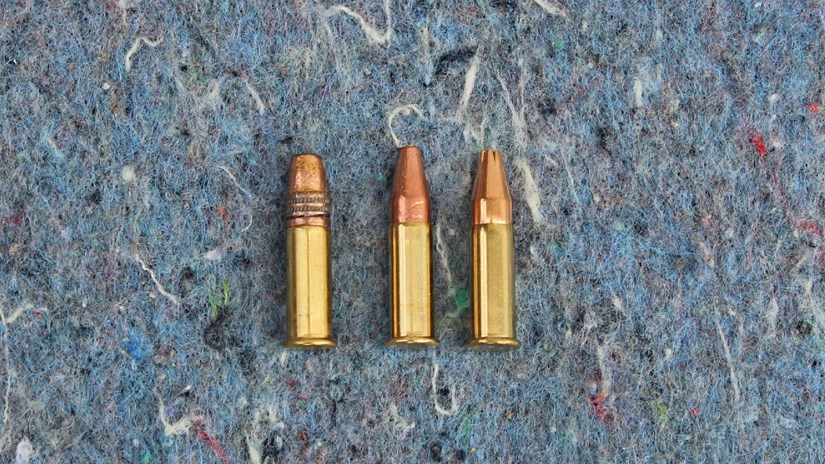
A .22 LR round (left) next to .21 Sharp full-metal jacket (center) and jacketed hollow point (right) loads.
Why Did Winchester Develop It?
With .22 LR dominating the rimfire market for many years, it's reasonable to wonder why Winchester would invest the resources in offering an alternative. They had several reasons to give it a go with future needs for non-toxic ammo at the top of the list. More municipalities, especially the state of California, are pushing for the use of lead-free bullets, which will result in the restriction or banning of most .22 LR ammunition in those regions. The .21 Sharp cartridge keeps most of the benefits of .22 LR ammunition while offering lead-free projectiles in the lineup.
The usefulness of the .21 Sharp does not stop there. The .21 Sharp, much like the .22 WMR and .17 HMR, can be fitted with modern jacketed hollow points. Hunters are finding the 34-gr. hollow point from Winchester to be an effective option for potting small game including rabbits and squirrels. The hollow point expands rapidly upon impact for quick, decisive hits.
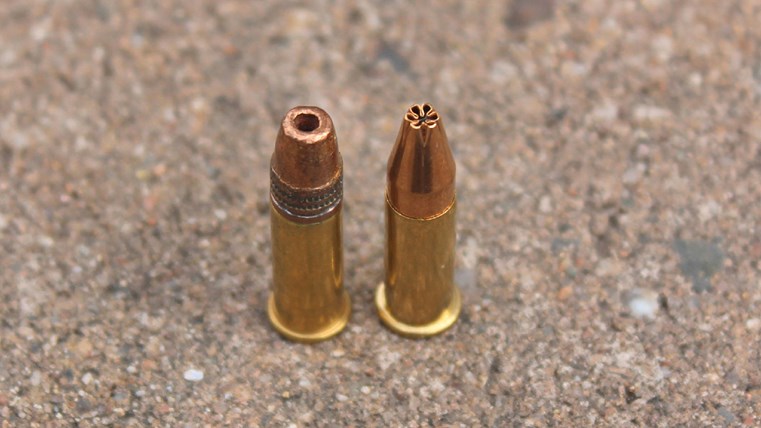
A .22 LR copper-plated lead hollow point (left) compared to a .21 Sharp jacketed hollow point (right).
Last, but not least, Winchester is saying that the cartridge updates the .21 Sharp offers should provide better performance, including improved accuracy and energy transfer. It is a relatively easy cartridge for Winchester to offer since its manufacturing process and components are so similar to the .22 LR. And as for chambering long guns in .21 Sharp, many existing rifles and carbines can be converted to this caliber with a barrel swap.
What about ammunition costs? As of this writing, .22 LR practice-grade loads are available for as little as $0.06 per round. However, the mid-grade and hunting loads run between $0.15 to $0.25 with the high-end competition-grade loads costing as much as $0.54 per round. The .21 Sharp loads are listing for between $0.17 to $0.26 per round, or, dead center of the .22 LR price range. Although this will not make the .21 Sharp particularly attractive to more casual plinking fans, it fits right into the budgets of more formal target shooters and small-game hunters.
The .21 Sharp and the Savage Arms B21 Bolt-Action Rifle
In production for over a year now, the only two companies making rifles chambered for .21 Sharp are the two original adopters, namely, Winchester Repeating Arms and Savage Arms. On the Winchester side, the company offers the Xpert series bolt-action carbine in nine different configurations with suggested retail prices ranging from $349.99 to $609.99. Savage has adapted the polymer-stocked, bolt-action B Series F model, stamped the B21, and offers the Mark II bolt-action in three configurations with price tags from $349 to $409.
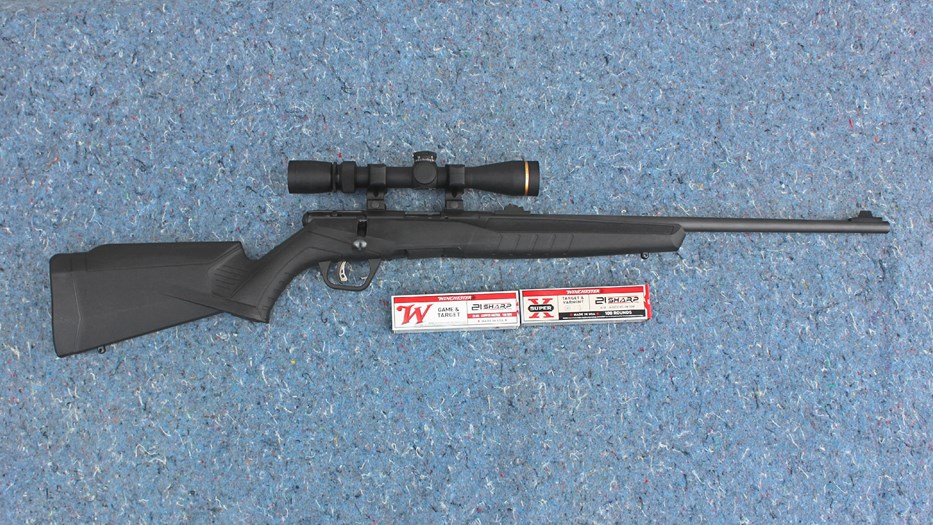
The author tested the .21 Sharp cartridge using the Savage B21 bolt-action rifle.
For this evaluation, I went with the top-notch B21 bolt-action rifle (#70242; $349). I've worked with this company's rimfire rifles in the past and found that they balance price, features and function quite nicely. The 21" long Sporter profile barrel is made from a carbon-steel alloy, button-rifled and treated with a matte-black blued finish, just like the receiver. The barreled action is supported by a lightweight, black synthetic shoulder stock.
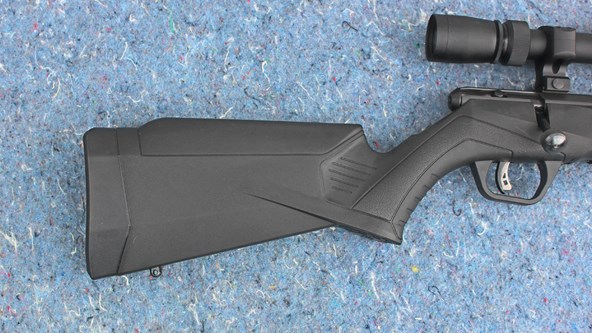
The shoulder stock is shaped and styled for shooter comfort.
The rifle arrives topped off with a set of iron sights consisting of a post front and a fully adjustable V-notch rear. Savage thoughtfully includes a pair of scope bases, which are installed at the factory, that do not block the view of the iron sights. The bolt assembly is outfitted with a knurled bolt handle knob and a cocked striker indicator which is visible just above the tang mounted safety slider.
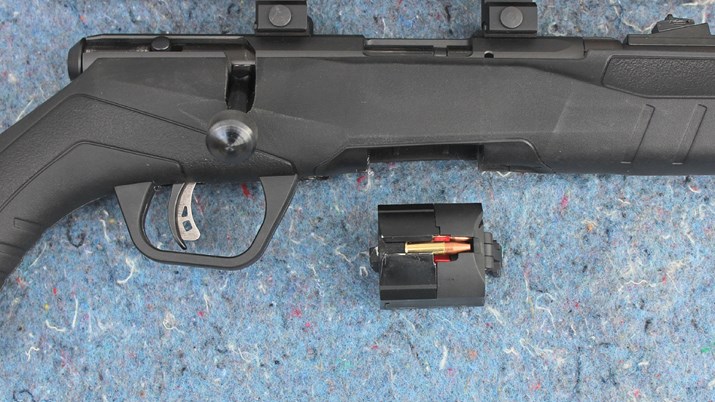
Features include an adjustable AccuTrigger and a flush-fit rotary magazine.
One of the reasons to choose a Savage rimfire is for the company's smooth, clean AccuTrigger system. With a user adjustable trigger pull weight between 2 lbs. 8 oz. to 6 lbs., it’s the same trigger configuration installed in the company's centerfire models. A safety lever located in the trigger must be fully depressed in order for the gun to fire. This prevents the rifle from firing if it is jarred or dropped, even with the trigger at its lightest setting. In this case, the B21 arrived with the trigger set to 2 lbs. 11 oz. and I saw no reason to adjust it.
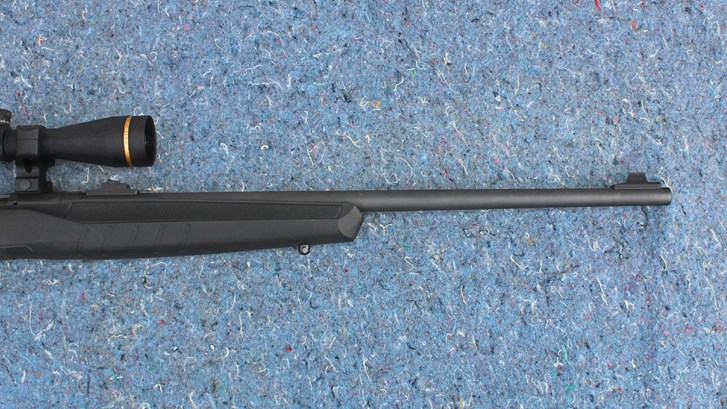
The Sporter profile barrel is topped with an adjustable rear sight and a fixed blade front sight.
The B21 uses an in-house, 10-round rotary magazine. Savage worked carefully to ensure that the company could not be accused of cloning Ruger's BX-10 magazine. However, the “adjustments” make it a bit more difficult to load. It's not a deal breaker but it is worth noting. The polymer stock provides a pair of sling swivel studs, a comfortable target shooting style vertical pistol grip and a 13.5" length-of-pull (LOP).
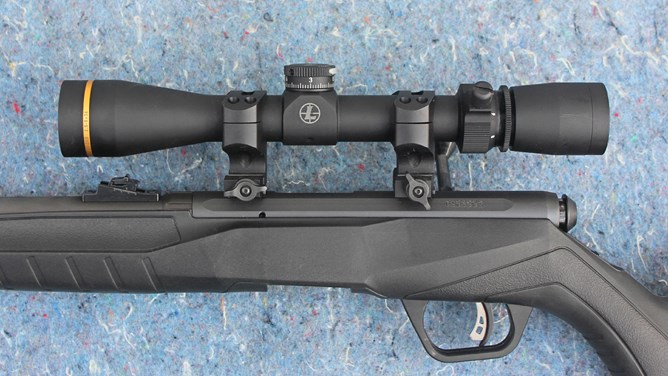
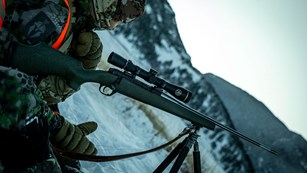
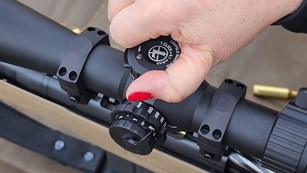
The Leupold VX-3DH 2.5-8x36 CDS ZL rifle scope paired nicely with this platform.
For the shooting range evaluation, the bases were used to mount a top notch Leupold VX-3DH 2.5-8x36 CDS ZL rifle scope using a pair of Warne rings. The taller rings were required to clear the rear iron sight. I was able to lay hands on two of the four Winchester loads currently in production for this caliber, both of which are fairly fast when compared to typical .22 LR loads.
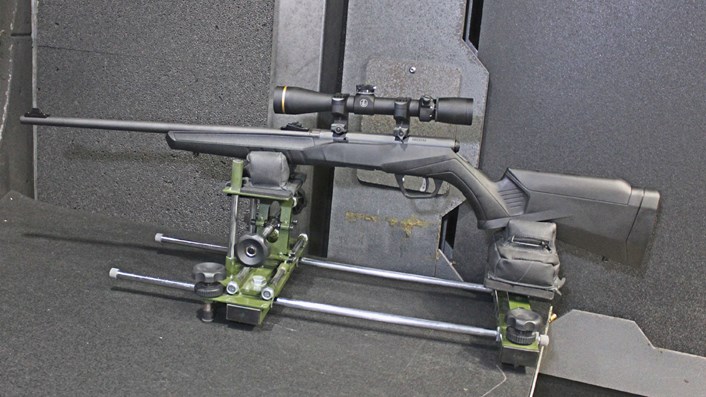
The B21 bolt-action generated levels of recoil on par with similarly sized .22 LR rifles.
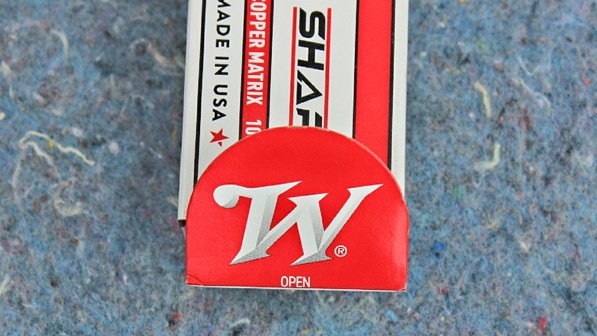
The Super X Target & Varmint 34-gr. jacketed hollow point is listed at 1,500 f.p.s. while the relatively light weight 25-gr. copper matrix Game & Target load zips right along at a listed velocity of 1,750-f.p.s. Both loads operated flawlessly without any ammunition, magazine or rifle related issues throughout the course of the evaluation. And as expected, levels of felt recoil were on par with .22 LR rifles, which is to say, mild and all-day-comfortable to shoot.
-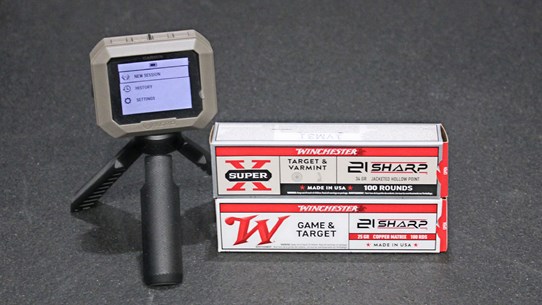
Bullet velocities were measured using a Garmin Xero C1 Pro chronograph.
Formal benchrested performance testing was conducted by firing three 3-shot groups of each load into paper targets posted at a distance of 50 yards. A Garmin Xero C1 Pro chronograph was used to check bullet velocities for 10-shot strings. Thanks to the B21's rifle-length barrel, both loads generated higher than listed velocities. But they were impressively accurate as well. The jacketed hollow point gained 145 f.p.s. with a best individual group of 0.44" and a three-group average of 0.61". The copper solid picked up 47 f.p.s. with accuracy comparable to the hollow point. It printed a best group of 0.49" and a group average of 0.57".
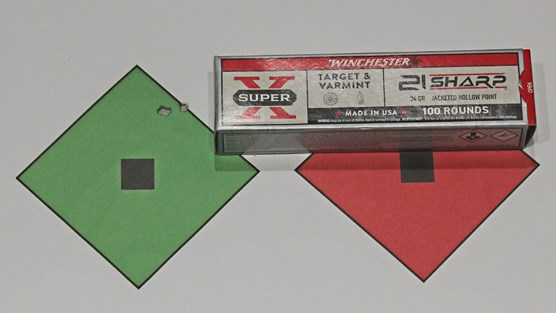
The best individual 3-shot group of 0.44" was printed using the Super X hollow point load.
Parting Shots
What does the future hold for the Winchester .21 Sharp cartridge? Now in production for nearly a year, it’s hard to say for certain. It was designed to fill a particular regulatory niche, and it does that quite well. And, based on the performance results, it clearly has more to offer rimfire fans than just being a lead free option. It's accurate, affordable and hunters are reporting that it's an effective caliber for potting small game. It even garnered a coveted American Rifleman Golden Bullseye Award.
Although it is challenging to introduce a new cartridge at the best of times, recently released loads have been affected by enthusiasts tightening their shoot sports budgetary belts. Hopefully it will successfully weather the current shooting industry slowdown and stay in production long enough to garner a larger following. For more information about this ammunition and rifle, visit winchester.com and savagearms.com.