
The story of the American Revolution is one of bravery, ideology and sacrifice. The Revolution created the best nation the world has ever known, one that will continue to lead for generations. History books are full of paintings immortalizing the men who fought and died for America. Fortunately, the story of the great “American Experiment” does not stop with the “Founding Fathers” and the “Brave Men of the Continental Army.”
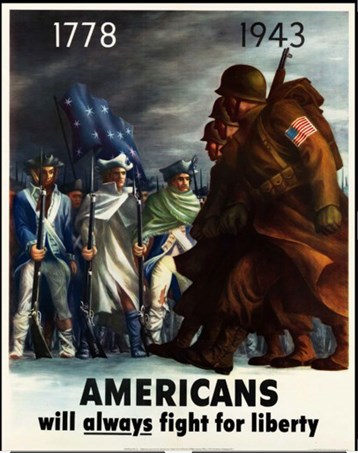
The complete story of the American Revolution includes many women from all walks of life, cultures and legal statuses. The story of the American Revolution cannot be completely told without including Native American women, enslaved women and Colonial women.
Oneida Women
The important and strategic Fort Stanwix was located on Oneida Nation lands. The Oneida Peoples were invaluable to colonial revolutionaries between 1777-1778. During this time, these Native Americans provided intelligence, warriors, spies and scouts to the American cause. Two women of the Oneida Nation in particular played important roles in the American Revolution: Tyonajanegan and Polly Cooper.
Tyonajanegan, a mother of four, was married to the Oneida warrior Han Yerry Tewahangarahken. She fought alongside the colonists against the British during the August 1777 siege at Fort Stanwix. During the battle she fired at the British until her husband was shot through the wrist. She then reloaded various firearms for her husband and other wounded colonists as the battle raged. As the battle waned, she rode into the nearby valley to warn the unsuspecting settlers of a potential attack and to prepare them for the wounded colonists.
Polly Cooper was part of a 50-member party sent to Valley Forge in 1778 by Chief Shenendoah of the Oneida Nation as part of a relief mission. Their mission was to walk 400 miles through the severe cold to feed General Washington’s troops, who were suffering from food shortages. The Oneida delivered hundreds of bushels of white corn to the starving soldiers. It was Polly Cooper who taught the soldiers how to prepare the corn, while also providing medical care to the wounded. After the revolution, the colonial army wanted to pay Cooper for her heroic deeds, but she declined payment, stating that it was her duty.
Enslaved Women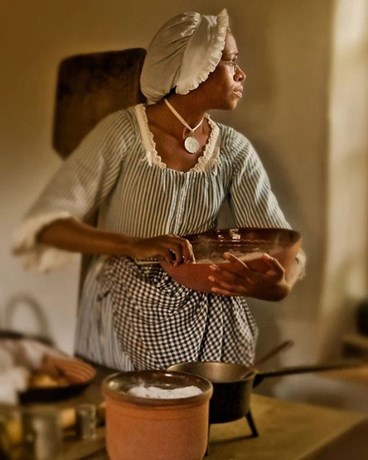
Enslaved cultures also played a key role in the American Revolution. Ironically, they were helping their young nation fight for the freedom that many of them would not enjoy the benefits of in their own lifetimes. Two enslaved women who helped the American Revolution were Hannah Till and Mammy Kate. (Hannah Till portrayed by Park Ranger Ajena C. Rogers; NPS.gov image)
Hannah Till and her husband Isaac Till were enslaved people during the American Revolutionary War. The couple was leased to General George Washington by the Reverend John Mason of the Associate Reformed Church in New York. Hannah was responsible for cooking and feeding General Washington and ensuring that he was ready to lead his army. As the old saying goes, “An army runs on its stomach!” Therefore, it was Hannah Till’s job to make sure that the leader of that army stayed well fed. Hannah and Isaac had an agreement with General Washington that they could purchase their freedom over time. On October 30, 1778, the Tills earned their freedom and continued serving General Washington—for pay.
Mammy Kate and her husband Daddy Jack were enslaved by Colonel Stephen Heard in Georgia. During the Battle of Kettle Creek in 1779, Colonel Heard was captured by the British. Mammy Kate learned that the British had plans to execute Heard, thus she devised a plan to rescue Colonel Heard from certain death. She convinced the guards of the prison that she was there to work for the prison in which Heard was kept. Mammy Kate smuggled Heard out of the prison in a laundry basket covered in dirty clothes.
Mammy Kate was the first black woman in Georgia honored as a Revolutionary War hero by both Daughters of the American Revolution and Sons of the American Revolution.
Colonial Women
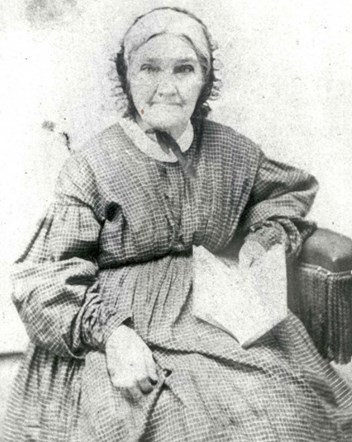
Many Colonial women fought in the American Revolution. Some women assisted the cause by supporting the soldiers while others actively picked up arms to fight side-by-side with the enlisted men. Two women in particular deserve to be remembered as revolutionaries: Deborah Sampson and Sarah Osborn Benjamin (shown here).
In a time where men were the only ones allowed to enlist in the army, Deborah Sampson took matters into her own hands. Sampson spent her childhood as an indentured servant from age 10 to 18. In 1782, at 21 years old, Sampson disguised herself as a man and enlisted in the Continental Army—with the Fourth Massachusetts Regiment—under the name Robert Shurtleff. Sampson was part of a unit that took part in dangerous missions in the Hudson Valley.
Deborah Sampson served from May 1782 to October 1783. At one point she incurred a gunshot wound and, to keep her identity a secret, she removed the bullet herself and treated her own wound. Sampson’s identity remained a secret until she became ill with a high fever in 1783. Once the doctor discovered her identity, she was honorably discharged from service. Sampson had the distinction of being known as “Woman Soldier in the War of the Revolution.”
Sarah Osborn Benjamin followed her husband into the Battle of Yorktown in 1781. Seeing the soldiers of the Continental Army exhausted, dehydrated and starving, Benjamin organized a coalition of women to prepare food for the troops. Benjamin then led the women through the trenches to feed the starving troops. On one trip, Benjamin met Gen. George Washington, who asked her if she was afraid of the cannonballs. Benjamin replied, “No the bullets would not cheat the gallows, and it would not do for the men to fight and starve too.”
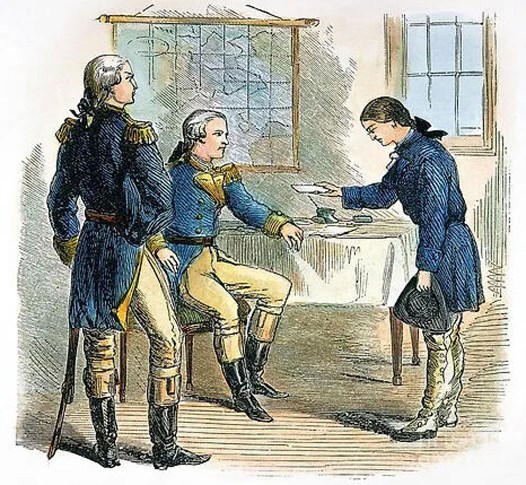
Deborah Sampson receiving full military pension from the state of Massachusetts; photo by Mass.gov Commonwealth of Mass. website
In 1837, at the age of 81, Sarah Benjamin served the soldiers of the Continental Army one last time. Benjamin went to court and fought for the veterans of the Continental Army to receive compensation for their military service. She also argued that widows should receive compensation and that she and other women should be paid for their service. The courts agreed.
Women played an integral role in the American Revolution. Some women supported the cause by maintaining the homestead and keeping the family together and safe. Some women took on more of an active role on the front lines. It was all vital to achieving victory over the British.
—Heidi Lyn Rao