
If you’ve ever wondered what the numbers in rifle and handgun designations are, I’m here to explain it in simple terms—or at least partially explain it, because the naming conventions follow a couple of similar patterns, but there are a ton of wildcards thrown in that are exceptions to the rule. To boil it down to basics, we’re looking at three related-but-not-quite-identical terms: cartridge, caliber and chambering.
What’s a Cartridge?
This is the easy one: A cartridge is the full piece of loaded, ready-to-shoot ammunition that you put in your firearm. It consists of a case (usually brass, sometimes steel or something else) that holds the primer, powder and the bullet/projectile, with the bullet visibly sticking out of the top of it. People colloquially say they’re picking up “a box of bullets,” but if they’re referring to loaded ammunition, they actually mean cartridges.
What’s Chambering?
This one is pretty easy, too. Every gun is “chambered” to shoot a particular cartridge based on the size of the chamber and the bore. This will be stamped on the barrel, and whatever’s stamped on the barrel is generally the only thing that’s safe to shoot out of that particular gun (with some exceptions like .223 out of a 5.56 or .38 Spl. out of a .357 Magnum).
Chambering and caliber are sometimes used interchangeably. If I ask you what your rifle is and you tell me it’s a 30-06 caliber, I know what you mean, but technically, 30-06 is the cartridge the gun is chambered for. You actually have a 30-caliber gun.
What’s a Gun’s Caliber?
This is where it gets complicated. At its root, a gun’s caliber refers to the diameter of its bore and/or the diameter of the bullet that will fit down the bore. A bullet of that particular diameter can then be seated into a number of different cases and turned into complete cartridges that are made for firearms with different chamberings. As an example of this, the 22LR, 22-250 Rem and 223 Rem are all 22-caliber cartridges with virtually identical bullet diameters (.22-something inches), but they are very different rounds shot out of very different guns. The case makes the difference. Similarly, the 30-06, 30-30, 308 Win, 300 Win Mag and more are all 30-caliber cartridges that shoot virtually the same-diameter bullets.
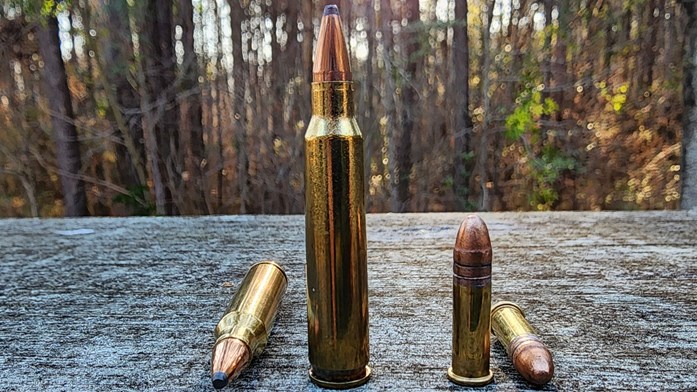
22-cals: The 223 Rem, left, and the 22LR, right, have a huge variation in cartridge size — but both are 22-caliber, shooting a bullet with a diameter of .224 and .223 inches, respectively. (author image)
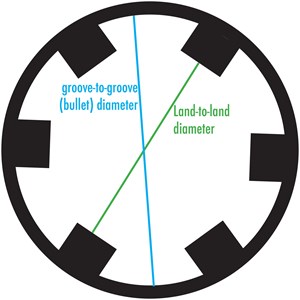
Now, a rifle’s bore has two different diameters: The distance between the lands (the high points in the rifling) and the slightly longer distance between the grooves (the low points between the lands). Caliber designations can be based on either, and they’re not exact. And some are imperial and some are metric. And then we’ve thrown in some marketing jargon and some random numbers and before long, none of it makes a ton of sense.
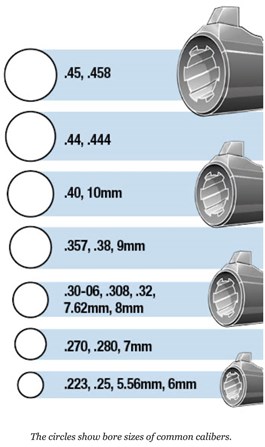
Here in the U.S., we use imperial measurements, so most of the cartridges developed here use inches: The .45 ACP shoots a bullet that’s .45 inches in diameter. Since most of the rest of the world uses the metric system, many cartridges are identified in millimeters: The 9mm Luger shoots a bullet that’s 9 millimeters in diameter, which is equivalent to .354 inches. To use another common example, the .223 Rem and the 5.56 NATO are both 22-caliber rounds. The .223 Rem’s bullet diameter is .224 inches, while the 5.56 NATO’s bullet diameter is exactly the same .224 inches, which is equivalent to 5.7 millimeters. (image courtesy Hunter-Ed.com)
Now, remember how I mentioned the land diameter vs the groove diameter? The diameter of the bullet is equal to the groove-to-groove diameter; it has to be in order for the rifling to engage the bullet and spin it. A cartridge can be named for either diameter, so the number in a cartridge’s designation isn’t usually an exact measurement. For example, a few paragraphs ago I called a 30-06 a 30-caliber firearm. Technically, .30-inch is the measurement from land to land. But the measurement from groove to groove in a 30-06 (and a 300 Blackout, and a 30-30, etc.) is actually .308 inches—that’s where the 308 Win got its name. The 30-06 and the 308 Win both fire the same diameter bullets (bullet diameter matches groove diameter), but the numbers in their names represent different measurements. And that random “06” that got thrown into the name? It’s because the 30-06 was created in 1906.
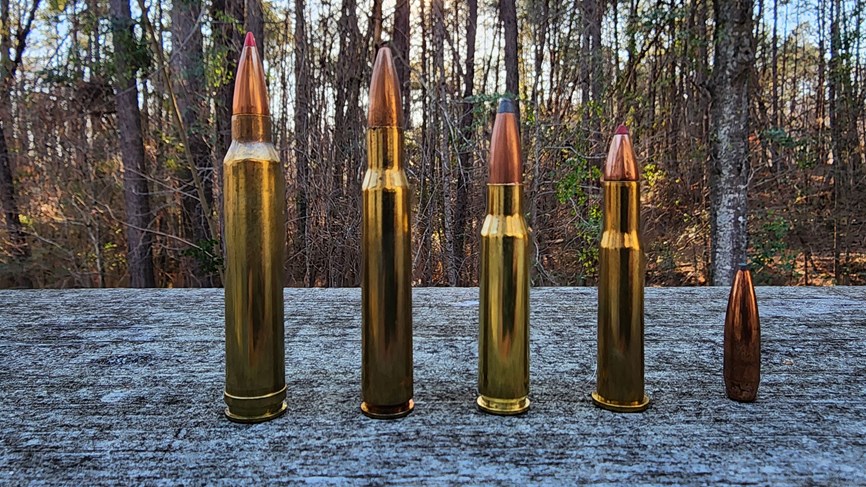
30-cals (left to right): The 300 Win Mag, 30-06 Sprg, 308 Win and 30-30 Win are very different cartridges, but they are all considered 30 caliber, as they all use a bullet with a diameter of .308 inches, shown on the far right.
For metric cartridges, the numbers tend to be a little more standardized: The first number is the bullet diameter, approximately, and the second number is the length of the case. So, a 5.56x45 NATO round shoots a bullet with a diameter of 5.7 millimeters and the cartridge case is 45 millimeters long.
Are you confused yet? If not, let me throw in another wrinkle: Sometimes companies just call their new cartridges something different for marketing purposes. Because there can be so many different cartridges using the same-caliber bullet, sometimes it’s hard to think of a new name that still reflects the caliber measurement accurately—so we exaggerate or throw in an extra word. This explains why the 44 Magnum shoots a bullet with a diameter of just .429 inches, which is pretty far from 44. But 44 sounds bigger and better, and 44 Mag rolls off the tongue more easily than .429 Mag. In a similar vein, the 350 Legend uses a bullet with a diameter of .357 inches—but we already have a 357 Magnum round, so calling it 350 helps differentiate it and creates a nice, even number for marketing purposes. Then throw in the word “Legend” because it makes it sound reliable and classic, and you’ve got a new cartridge name that uses a not-quite-accurate number but sounds great.
Phew. All that to say, cartridge designations do follow some specific rules, but there are at least two different measuring systems (imperial and metric) and two different diameters to consider, plus some rounding off and some marketing hype thrown in.
Wrapping It Up
Although we often use “caliber” when we really mean “chambering,” the word caliber actually refers to the diameter of the bore—either the diameter between the lands or the diameter between the grooves (bullet diameter). If you tell someone you shoot a 30-caliber rifle, you could be referring to a 30-06 Springfield, a 308 Win, a 30-30 Win or plenty of other chamberings that all shoot basically the same-diameter bullet, just in a very different diameter and length casing. And if you tell someone that your gun is a 30-06 caliber, you won’t be wrong per se, because we use the word “caliber” that way these days, but it’s more accurate to say that your gun is chambered in 30-06 (because it shoots a 30-06 cartridge).
So if you ever want to start an argument in deer camp, try telling people that a 22 caliber is perfectly suitable for shooting deer. Most folks will assume you mean a .22LR, which would be absurd, so they get fired up in a hurry. But the .223 Rem is also a 22 caliber, and I have personally seen deer drop in their tracks with one shot from a well-placed .223 round. Remember: .223 Rem and .22LR is the cartridge, but 22 is the caliber.