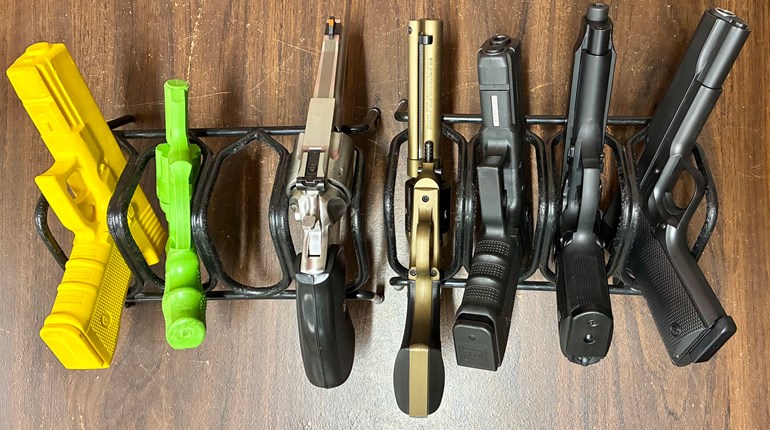
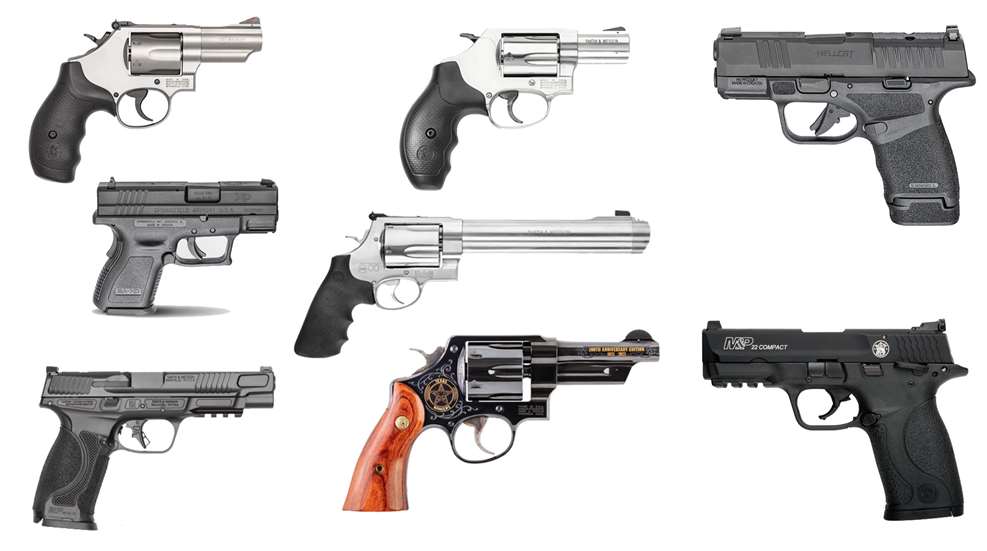
Semi-automatic pistols and revolvers have their own terminology when it comes to the different sizes available to consumers. Understanding these terminologies and sizes will help you choose the right gun for you.
Semi-Automatic Pistols
Full Size
When we think of law enforcement or military handguns, full-size pistols usually come to mind. These firearms have a barrel length ranging from 4.5” to 5.5 “. The height of these guns can be more than 5”. Although full-size pistols can be concealed, they are frequently open-carried due to their size.
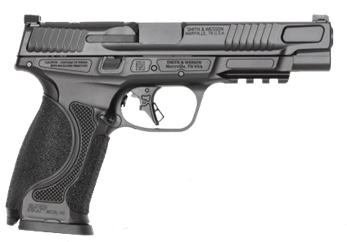
Full-size pistols have several advantages over smaller handguns, the greatest being that they hold more rounds or have a higher capacity than other pistols. Full-size pistols can hold more than 20 rounds, depending on the caliber. These larger guns can also be easier to shoot because of the extra weight. The more weight that a firearm has, the more recoil it can absorb. With less recoil and less muzzle flip, the shooter is generally able to stay on target easier.
Full-size pistols have several disadvantages. First, the gun is heavier. This also makes the firearm harder to carry and conceal. The extra weight can be restraining, especially if you carry it for long periods of time. Another disadvantage is that full-size pistols often have double-stack magazines. This means that individuals who have small hands may not be able to hold, properly grip, and control the firearm when shooting. Full-size pistols can weigh 30 oz. to 45 oz. (approximately 2 to 3 lbs.).
Compact
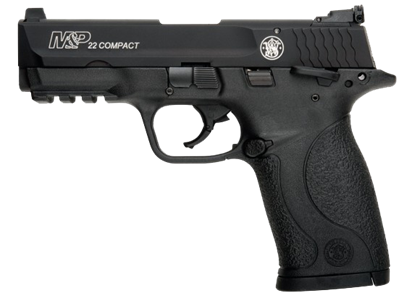
Compact pistols are typically used for concealed carry. These firearms have barrel lengths between 3.5” to 4.5” long. These firearms are often up to 4.5” in height. Compact pistols are a great balance between ease of handling and ammunition capacity.
The biggest advantage of compact pistols is that they are easier to conceal than full-size firearms while still maintaining a good number of rounds. This is why many off-duty law enforcement officers carry compact pistols. Some compact pistols can hold more 15 rounds, depending on the caliber. Many compact pistols handle just as easily as full-size pistols.
A disadvantage of many compact pistols is that they still use double-stack magazines. This means like full-size pistols, individuals with small hands may have trouble maintaining a proper hold control when shooting. Compact pistols can weigh 20 ounces to 30 ounces (1 lb. to 2 lbs.).
Sub-Compact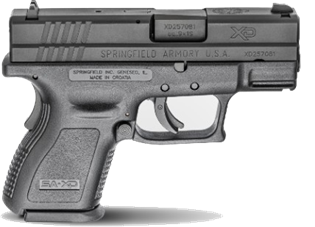
Sub-compact pistols are usually preferred by new gun owners or those who are just starting to conceal carry for personal protection. Sub-compact pistols usually have barrel lengths between 3” to 3.5” long and 4” to 4.5” in height. For many, these guns are the ultimate choice with their combination of concealability and ease of shooting.
The biggest advantage of compact pistols is that for those with small hands, these guns usually have a single-stack magazine.
The disadvantages of the sub-compact pistol are that they hold fewer rounds of ammunition than larger guns, often fewer than 12 rounds. Another disadvantage is their weight. Sub-compacts can weigh between 16 oz. to 25 oz. (1 to 1.5 lbs). This means that recoil can be greater, since a lighter-weight gun will not absorb as much as a heavier firearm will.
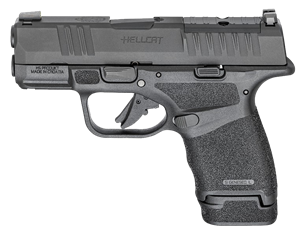
Micro-Compact
Micro-compact pistols are great for shooters with very small hands. Micro-compact handguns usually have a barrel length of less than 3” and a height less than 4”. Additionally, micro-compact pistols are usually chambered in smaller calibers such as .25 ACP, .32 ACP or .380 Auto.
The biggest advantage of micro-compact pistols is that they are the easiest to conceal. Another advantage is for those who want to carry a secondary or back-up gun, a micro-compact is the way to go. These firearms are also very easy to maneuver, especially in tight quarters such as while seated behind the steering wheel of your vehicle.
The disadvantages of micro-compact pistols are that they hold the fewest number of rounds and are extremely light weight. This means that micro-compact pistols will project the most recoil. Micro-compact pistols weigh less than 20 ounces or even under 1 lb. Micro-compact pistols can be very difficult to handle for someone with above average or large hands to maintain proper hold control while shooting.
Revolvers
Large Frame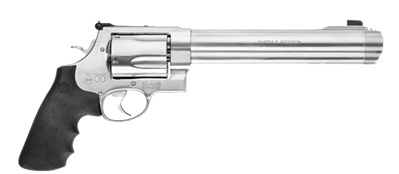
Large frame revolvers are frequently used for hunting or long-range shooting. These handguns are extremely accurate at long distances. These firearms are usually chambered in calibers ranging from .44 Rem Magnum to .500 S&W Magnum. Large frame revolvers are almost exclusively designed for outside the waistband (OWB) holsters, large shoulder holsters, or chest holsters. Many of these guns are used in bear country, where encounters with large grizzly or brown bears are a real possibility.
The biggest advantage of large frame revolvers is the fact that they act as an intermediate firearm between regular size revolvers and rifles. This means that they have the ability to stop dangerous game animals in their tracks. There have been many hunters, hikers, and backpackers that owe their life to having a large frame revolver on their hip. Additionally, these heavy revolvers absorb quite a bit of recoil. Many individuals are often surprised at how easy they are to shoot. Large frame revolver barrels range in length between 4" to 12".
The biggest disadvantage to large frame revolvers is their size and weight. As mentioned above, these are not typically used for concealing. John Wayne and Marshal Matt Dillon (Gunsmoke) would have had a hard time concealing these “hand cannons!” A Smith & Wesson X-Frame revolver can weigh between 56 oz. to more than 80 oz. (3.5 to 5 lbs.). A Ruger Super Redhawk can weigh more than 55 to 65 ounces (3 to 4 lbs).
Duty
Duty revolvers are what law enforcement and the military once carried. Examples of duty revolvers include S&W N-Frame and S&W L-Frame handguns. Like the large frame revolvers, duty revolvers are designed for outside the waistband (OWB) holsters, shoulder holsters, and chest holsters. Large frame revolver barrels range in length between 2.5" to 12".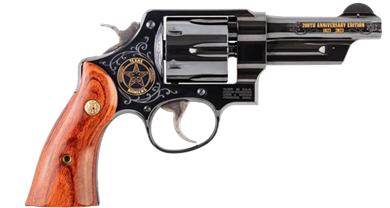
The biggest advantage of duty revolvers is the wide range of calibers available to the shooter. Common calibers include .38 Special, .357 Rem Magnum, and .44 Rem Magnum. These revolvers are also very accurate, and the weight of these guns tends to absorb a lot of recoil.
The disadvantage of duty revolvers is their size and weight. Even though the weight of the gun can absorb a lot of recoil, it can tire out the wearer quickly. S&W L-Frame revolvers can weigh over 40 ounces (2.5 to 3 lbs.) S&W N-Frame revolvers can weigh over 70 oz. (4 to 5 lbs.).
Mid-Size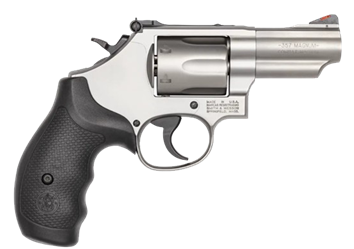
Mid-size revolvers are great for outside the waistband (OWB) carry or concealed carry. An example of a mid-size revolver is a S&W K-Frame. Mid-size frame revolver barrels range in length between 2” to 6”.
The advantage of mid-size revolvers is that they are still large enough for accuracy yet small enough for concealment. Like large-frame revolvers, these guns are chambered in a variety of calibers such as .38 Spl. and .357 Rem. Mag.
The disadvantage of mid-size revolvers is the increased recoil due to the lighter weight. A S&W K-Frame revolver weighs between 30 ounces to 40 ounces (2 to 3 lbs.). Alloy frame guns can weigh as little as 16 oz. (1 lb.).
Pocket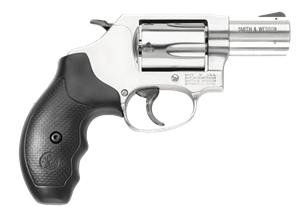
Pocket revolvers are small revolvers that can be carried in your pocket. Back in the 1950s to 1980s, these were referred to as “kit” guns. This is because people would keep these guns in their tackle box, tool kit or lunch kit. Pocket revolver barrels range in length between 1” to 3”.
The advantage of pocket revolvers is that they can be kept or hidden almost anywhere. They also make great guns for those who do not feel comfortable carrying a semi-automatic pistol.
The disadvantage of pocket guns is their greater recoil, depending on the caliber. A S&W J-Frame revolver can weigh as little as 13 ouces to 16 ounces (3/4 to 1 lb.).
Choosing a handgun is a very personal decision. Finding the right size gun is extremely important, especially if that firearm is for personal protection. When choosing any handgun, try different grips, sizes and weights of a variety of handguns including semi-automatic pistols and revolvers. Even though a smaller gun makes it easier to conceal and to carry, what you gain in ease of handling, you could be giving up in accuracy.
—Heidi Lyn Rao