
In 2006, Taurus launched what would become one of the company’s best-selling double-action revolvers. These days the dual-caliber Taurus Judge series boasts an impressively diverse selection of models while continuing to be one of the most controversial commercial handguns of the 21st century. After two decades in production, despite its detractors, the Judge is still king of the .45 Colt/.410-bore handgun hill. Why does it still inspire such strong opinions for and against it? Keep reading to find out.
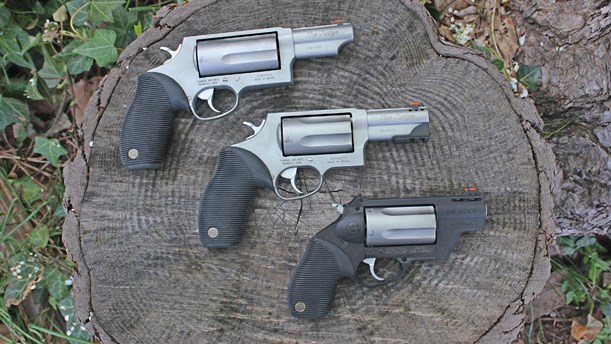
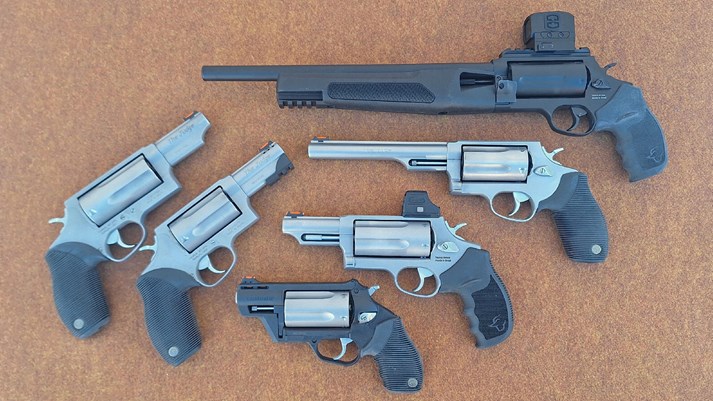
The Judge models have diversified over the years to 20 different models today.
Prior to “Judge”-ment Being Rendered
Before the development of the Judge, the gun that is often attributed with bringing the “shot revolver” concept into the American marketplace is the Munitions National Laboratories MIL Thunder 5. Produced between 1992 and 1998, it has a unique profile and feature set straight out of a Hollywood action movie. A couple of years after they were discontinued, I found one in a local pawn shop where I had the opportunity to examine it firsthand. Although the Thunder 5 was impressive at first glance, it had notable limitations that kept it from becoming a big hit at the time.
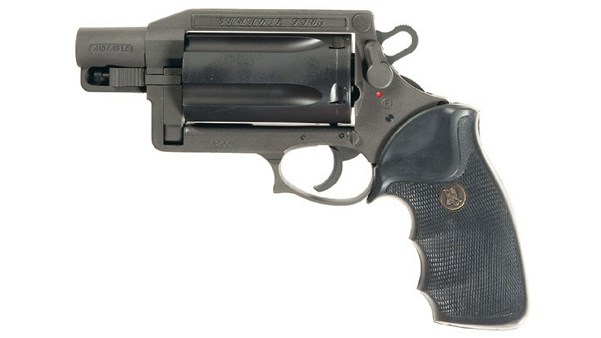
The hefty MIL Thunder 5 “shot revolver” preceded the Taurus Judge (Image courtesy the Internet Movie Firearms Database).
The gun was quite heavy for its size. Despite a snubby 2" or 3" barrel, it weighed in at 3 lbs., unloaded. It was strong enough that the company also offered a model chambered in the .45-70 Gov't. rifle cartridge. But the overall appearance and finish looked kind of shoddy and thrown together. The controls were odd as well. The cylinder release was mounted to the ejector rod, not the frame. It had a fixed gutter sight instead of typical revolver sights, an ambidextrous pivoting safety lever inspired by an AR-15 safety selector and I recall the trigger pull being on the heavy side. Despite its uniqueness, and pricing that was on par with typical double-action revolvers in the 1990s, the MIL Thunder 5 did not catch on.
The Judge Takes the Bench (Literally)
With the MIL Thunder 5 out of production, the executives at Taurus decided to try their hand at a .45 Colt/.410 bore, double-action revolver. They used the 5-shot Model 44 Tracker as a starting point. This 5-shot sports a medium-large frame comparable in size to that of the Smith & Wesson L Framed Model 686, or the Ruger GP100. It was certainly strong enough to do the job without the bulkiness or added weight of the MIL Thunder 5.
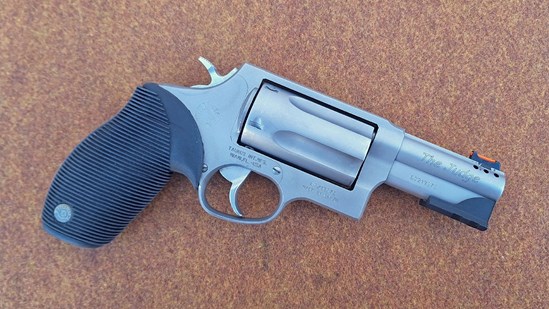
This Judge has an uncommon ported barrel with a polymer accessory rail mounted below the muzzle
The stainless steel Tracker frame was extended to accommodate a cylinder sized for .410 Bore shells. The cylinder of the shorter “Standard” Judge will chamber 2.5" shells only. Later, the longer Magnum models would be introduced which can fire 2.5" and 3" shells. The heavier 4" long ported Tracker was replaced with a 3" long rounded, full under lug profile borrowed from the medium-frame models with modified rifling. The sight configuration consists of a bright fiber optic front sight paired with a fixed square notch rear sight. The controls remained unchanged and the gun was capped off with a recoil absorbing “Ribber” rubber grip.
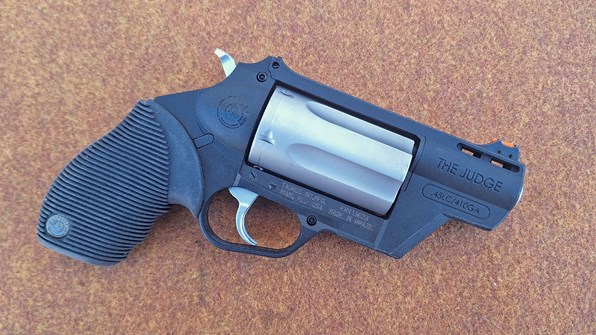
The polymer-framed Public Defender is the smallest and lightest version of the Judge currently in production.
With these features in place, the original Taurus Model 4410 (44 Tracker + .410 Shell) was launched. The model number was quickly changed to 4510 to clarify that it was chambered for .45 Colt, not .44 Mag. and .410 shells. It was advertised as a close-range defensive option for use at home or while driving. As it turned out, the revolvers became popular with judges serving in the high-crime areas of Miami, Florida, who would carry them in court. When Taurus Executive Vice President Bob Morrison learned this, they were re-branded as “The Judge” series, and the name has stuck ever since.
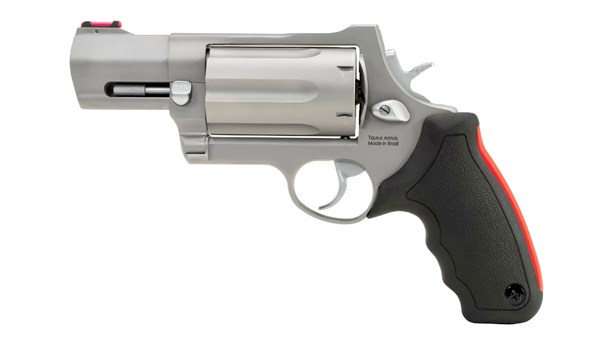
The massive 6-shot Raging Judge can fire the hot .454 Casull handgun hunting cartridge in addition to .45 Colt and .410 loads.
The original 4410/4510 models would continue in production until 2010 before Taurus would transition to the various configurations in production today. As of this writing, the company currently offers 20 models, including the compact Public Defender line up, the massive 6-shot Raging Judge and the long-barreled Home Defender. It has also been added to the T.O.R.O. line up, meaning, there are models that arrive from the factory ready to be fitted with a micro red-dot optic.
A Judge of All Trades
So what is it about the Taurus Judge that has kept it a top seller for so many years? It can be summed up in two words: ammunition flexibility. Handguns chambered to fire both .45 Colt revolver rounds and .410 shotshells can launch an impressive range of projectiles. On the .45 Colt side, you have the full range of modern bullet styles including jacketed hollow points and hard cast solids for deep penetration. You can also use CCI Ammunition's Pest Control loads in .45 Colt, filled with fine lead rat shot. They are ideal for dispatching mice, rats and similar vermin at close range.
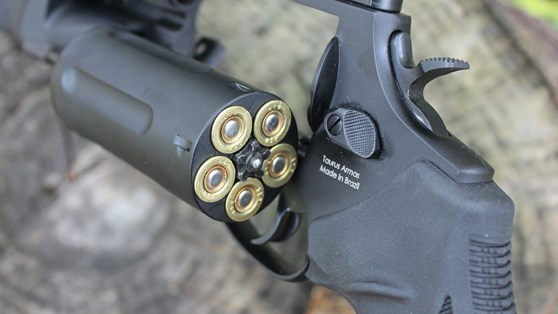
Although the Judge’s 5-shot cylinder is longer, it is comparable in width to typical mid-size .357 Mag. revolvers.
On the .410-bore side of the aisle, shells are available stoked with lead birdshot, buckshot or rifled slugs. You will also find specialized mixed-payload defensive rounds, many of which were developed with the Judge in mind. The birdshot is a useful pest control option. And the buckshot and mixed loads produce multiple impacts with each pull of the trigger. A Judge Magnum loaded with 3" shells can launch 25 pieces of 000 buckshot with five pulls of the trigger. That’s a lot of lead!
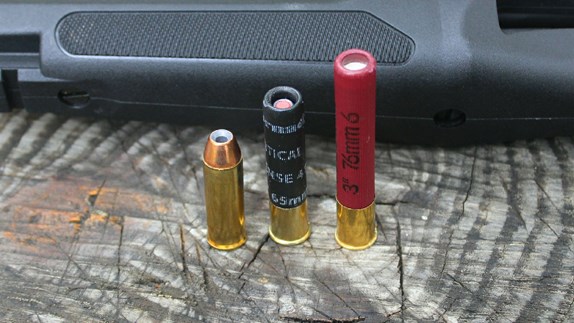
The Judge can fire a variety of .45 Colt and .410 Bore loads.
However, this flexibility is not without its trade-offs. A notable one is the levels of felt recoil the Judge can generate. With the heavier and hotter loads in both calibers, it can be a real wrist bender! But how much recoil is too much recoil with any platform is subjective, and a topic we covered here. The other concerns have been related to accuracy potential.
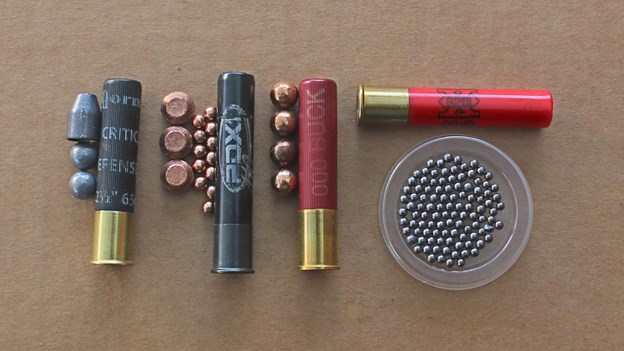
Defensive .410-bore shells with mixed payloads are available for the Judge along with buckshot and birdshot options.
A Master of None?
A handgun configured to fire both .45 Colt and .410-bore shells, including the Judge, requires a series of internal compromises. In order to fire both rounds, the chambers of the cylinder and the barrel’s bore are not an optimal fit for either one. This cartridge dimension balancing act allows for greater ammunition flexibility but in turn sacrifices varying degrees of ammunition performance potential. I went into this topic in greater detail in this post, but here are the highlights.
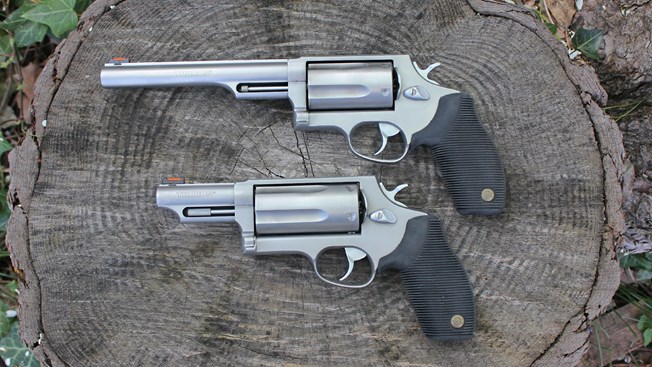
Oddly enough, the rifled 6” barrel (top) can cause shotshell patterns to spread more quickly than a snubby 3” barrel (bottom).
A well-made .45 Colt revolver can typically exhibit useful levels of accuracy at distances up to and well past 25 yards. Skilled shooters can land practical shots at 100 yards. But the Judge has long cylinder chambers which allow a .45 Colt bullet to rattle around a bit before engaging the barrel's forcing cone. Once in the barrel, the bullet is engaged by shallow rifling with a long twist rate for a fairly short 2" to 3" distance. Overall, the bullet does not achieve optimal stability resulting in larger patterns down range. In the course of my testing over the years, practical accuracy levels of 5-shot groups between 3” to 3.5” in size tend to occur at around 15 yards with the short-barrel models.
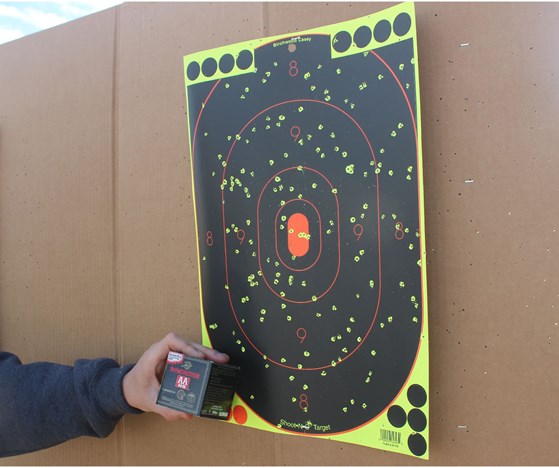
This Winchester #9 lead birshot load spread to cover the entire target from a distance of just 7 yards.
As for the .410-bore shells, they were originally designed for use in smooth-bore shotguns with barrels between 18.5" to 28" in length, not rifled revolver barrels that are 2" to 6" long. Although the barrel's rifling is shallow and slow, it still puts a spin on the .410 payload which in turn causes the pellet patterns to open up very quickly. For NRA evaluations, the sporting .410-bore shotguns are patterned at 25 yards. Handguns like the Judge form similarly sized patterns at distance of between 2 to 7 yards.
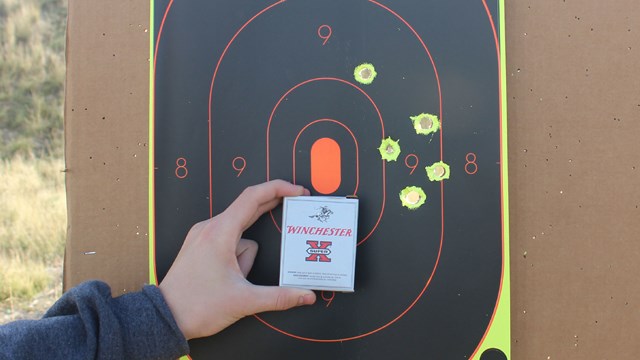
A close range pattern from a Winchester Super X .410 shell filled with five pellets of 000 lead buckshot.
Remember, Taurus originally advertised the Judge as a close-range defensive option. Detractors of the platform are not satisfied with these performance tradeoffs. They often advise folks to use dedicated, one-caliber revolvers or shot guns to maximize their ammunition performance. But fans of the Judge are willing to work within these distance limitations for the portability and flexibility these guns provided.
Future Rulings
Panned by some and embraced by others, the Taurus Judge now has two decades of production history under its belt. This means it is not just a fluke or a fad. But its future may be shaped by the same U.S. regulations that dictated its features in the past, namely, the Nation Firearms Act (NFA).
The Judge exists in its current dual-caliber configuration because, under NFA guidelines, a .45 Colt revolver that just happens to fire .410 shells can be sold over the counter at sporting good stores just like other revolvers. If the Judge were a dedicated .410-bore revolver with a smooth-bore barrel, it would be classified as Any Other Weapon (AOW) under the NFA with the requisite registration and fees.
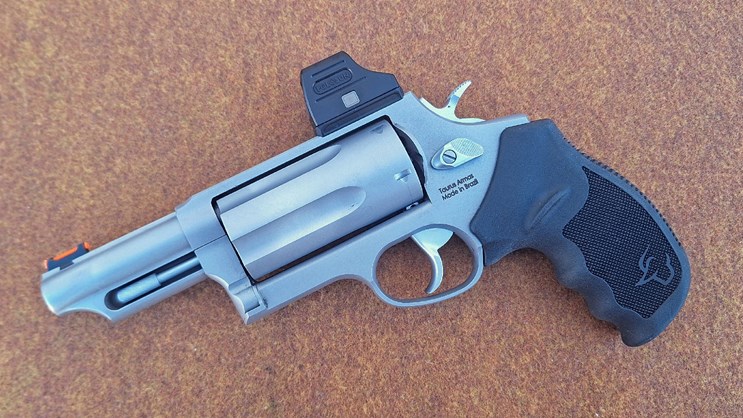
Taurus is keeping the Judge up to date by offering T.O.R.O. optics-ready configurations.
But with the passage of the "One Big Beautiful Bill" (P.L. 119-21) in July of 2025, the $200 NFA tax stamp fee was discontinued for sound suppressors, short-barrel rifles (SBR), short-barrel shotguns (SBS) and AOWs. Several lawsuits have since been filed to do away with the federal registration requirement for these items as well.
If AOWs are successfully removed from the NFA regulations, would Taurus convert the Judge into a dedicated, smooth-bore .410 revolver? The company went through the trouble of making it a dual-caliber revolver to meet existing regulations 20 years ago. So who can say what will come next? Whichever way the regulatory winds may blow, the Judge will continue to hold court. For more information about available Judge models, visit taurususa.com.