
The thing about a defensive gun use is that you don’t get to choose the circumstances—the time, the place, or even what you’ll be doing and what position you’ll be in when you need your gun the most. And since most of us sit all day long—at our desks while we’re working, in our vehicles while we’re driving or riding, at a table while we’re eating, on the couch while we’re watching TV—there’s actually a fairly good chance that if you ever need to use your gun in self defense, you might be sitting down at the time. Few of us ever train for this, but we probably should.
The mechanics of shooting while you’re sitting down aren’t necessarily different from shooting standing. What makes this something to train for, however, are the complications regarding your draw and the obstructions that might make drawing and shooting a real challenge.
Accessing Your Gun While Seated
First, think about your chosen carry location and whether you can access your gun while seated. I carry on my right hip at 3 o’clock. In my office chair, this wouldn’t be a huge problem. On a couch, it might be, if I’m sunk down in the cushions or if the arm of the couch is on my right side. In a car, the seat belt buckle is going to be in my way. All these problems are much worse if you carry at 4 o’clock or, worse, small of back, as you’ll actually have the gun sandwiched between you and the back of your seat and will have to lean forward just to access it. If you carry appendix, most of these problems (except maybe the seat belt) fade away. How about if you carry in a bra holster? An ankle holster?
Next, think about what will be in your way. In addition to the seat belt, in a car, you’ve also got to work around the steering wheel and the center consol if you’re right-handed or the car door if you’re left-handed. If you’re at a table in a restaurant, the table itself will be in your way—even worse if you’re in a booth and can’t just scoot your seat back to make room. Even your clothing can be an impediment while you’re seated, if your shirt or coat is long enough that you’re sitting on it or pinning it between your body and the seat, making it hard to raise it for a draw.
These things are difficult to practice for, but some empty-gun dry-fire drills at home can help you figure out the best ways to access your gun while you’re seated in various positions.
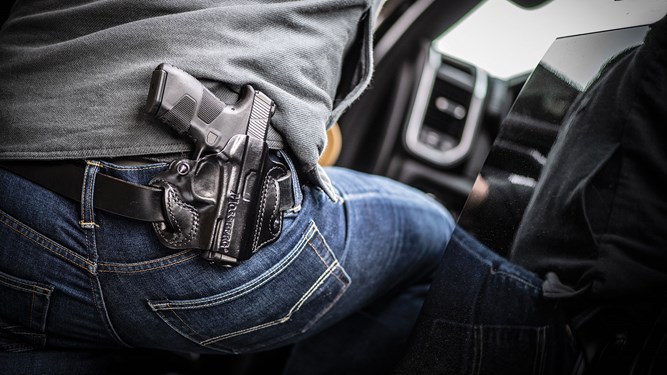
Image courtesy Mossberg
Drawing Safely from a Seated Position
As for the draw itself, once you get past the access problem, there are two primary things to worry about: not muzzling your own legs while you draw, and not smacking the gun on something while you bring it up to a shooting position. Again, this varies widely depending on where and how you’re sitting, but your legs are in front of you instead of underneath you as they are when you’re standing, so it’s very easy to sweep the muzzle across them as you bring a gun from your holster to a threat, particularly if that threat is toward your off-side. Muzzling your own thighs is a horrible idea at any time, but particularly when you’re filled with adrenaline and preparing yourself to pull the trigger imminently.
Obstructions are the other problem. You don’t want to sweep the gun up and bang it into the steering wheel or the table.
The best way to prevent both problems is to draw in the basic manner described in this article, summed up in these five steps:
- Grip: Establish a firm, proper grip on the gun.
- Clear: Pull straight up just high enough that the gun clears the holster. While seated, you might need to cock your elbow out at a weird angle or lean forward or over to accomplish this.
- Rotate: Rotate your wrist and the gun so the muzzle points forward. Your arm and elbow and the gun all remain tight against your side.
- Smack: Bring the gun, muzzle pointed forward at the threat, to the center of your chest where it will meet your support hand and establish a two-handed firing grip if possible.
- Push the hands out to a firing presentation.
You might have to modify these steps slightly to make them work while you’re seated, but the point is, the muzzle is pointed first at the ground (in step two) and then forward at the threat (in step 3) while the gun remains tight against your body. This keeps you from hitting most obstructions and almost prevents you from sweeping the gun, muzzle-down, across your legs on its way to pointing at the threat.
That’s not to say that this will be easy. All kinds of crap, including obstructions, your position, and the presence of bystanders, is going to make this much more complicated than it is when you’re standing up at the range. You might have to present the gun one-handed depending on where the threat is and how far you need to rotate to shoot at it. That’s all the more reason to practice this with an unloaded (triple check!) gun at home. You’ll identify all the troublesome quirks in your car or at a table or desk, and you’ll find some important modifications. You might have to scoot your butt to one side to reach the holster. You might have to uncross your legs or slap them tight together if you’ve been sitting with them wide open. You might even consider a new carry position if the one you currently use just isn’t workable while you’re seated.
Presenting the gun toward the target might be relatively easy after a safe draw, or it might be complicated, depending on where you’re sitting (like in your car) or where the threat is (like behind you). Actually pulling the trigger and executing a proper shot is similar to what you do at the range, other than the one-handed situation, but you might be contorted, so a follow-up shot might take an extra second. Unfortunately, very few of us have access to a range that will let us practice sitting down, much less from a car or at an angle, so dry-fire is about the best we can do to prepare for this.
One last note: If you can stand up before you shoot, great, but you likely won’t have time. But unless you’re in your car, you almost certainly WILL have time to stand up before you reholster after the threat has stopped, and I highly recommend that you do so. Reholstering while you’re standing is simpler, safer and more familiar.
It sounds complicated, and it can be, but it’s worth considering how much time you spending sitting down and whether you’d be able to access your gun, draw it safely and present it to the target from a seated position if you ever had to.