
We’ve talked before about cover vs. concealment, and the difference between the two is pretty simple: Cover stops bullets; concealment only hides you from sight. Should you ever find yourself in an armed confrontation, taking cover is an excellent idea to protect yourself from gunfire. However, if you need to shoot around cover or from behind cover, you must do so very carefully. It’s much too easy to pop out from behind cover and offer yourself as an easy target while you’re getting your own shot off. Here’s how to shoot from behind cover.
The overarching rule is that you shouldn’t expose yourself any more than is necessary to take your shot. Say you are shooting from behind a brick wall and someone is shooting back at you. You wouldn’t just walk out from behind the wall, stand next to it and line up your shot—you’d expose your entire body this way, and you’d stand a good chance of getting hit before you could get a shot off.
Play the Angles
One of the ways we avoid exposing ourselves is to play the angles. As we learned in this article, when you must enter a room where you might encounter a problem, you don’t just stand in the doorway and look around. Instead, you “pie the corner,” which means you start at an angle and ease your way around the opening one step at a time, as if you were taking small slices out of a pie. You can’t see the entire room this way, but you can see a lot more of it than you can just standing still, and you can keep yourself shielded behind cover for much of the time.
It’s the same when you’re shooting around cover. You can’t fully see everything that’s happening out in front of you, but if you work the angles and pie the corner of your cover (especially if you have more than one corner to work), you can see a lot without exposing yourself.
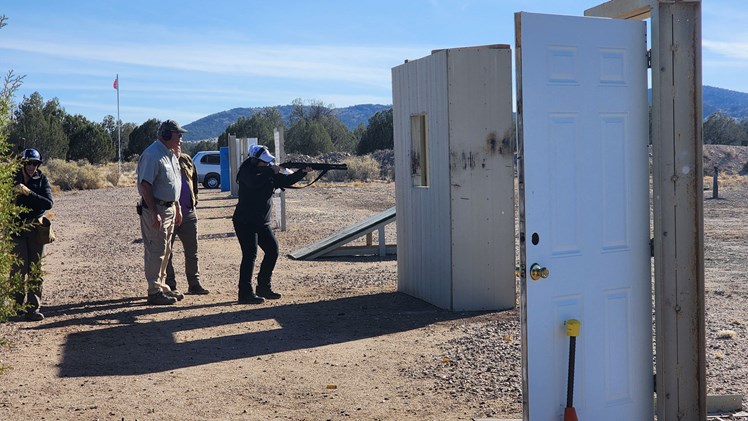
Notice how far back from the cover the shooter is standing. (Author photo)
Stay Back
It’s a natural tendency to smush up against the thing that’s keeping us safe, but tucked up against the cover is actually a more dangerous spot to be. The safest and most effective way to see around blind corners is to stay well back from the cover—at least three or four feet, more if you can do it safely. This gives you a much better vantage point and a broader field of view for your pie-ing while still keeping your body shielded behind the cover. It also gives you some room to react if a bad guy breaches your cover/comes around your corner unexpectedly. And, of course, if you are right up against the cover when you lean out to take your shot, your gun and/or arms might actually be close enough for a bad guy to grab through the door or around the corner.
Staying a few feet back is also helpful in case you’re experiencing ricochets or debris from incoming fire (like a brick wall that’s chipping as it takes hits) or from your own shots that maybe didn’t clear the cover as you had planned. And, of course, if you’re four feet behind your cover when you take your shot, you’re also four feet farther from whoever’s shooting at you, and thus a smaller target.
Lean
Because you want to expose as little of yourself as possible to take your shot, you won’t be stepping out from behind cover. Instead, you’ll pie your corner as far as you can without exposing yourself, and then when you can’t see any further, it’s time to lean out and shoot. Put your weight on whichever leg is on the side you’re about to shoot around and use it to support yourself as you lean your torso/head out just far enough to see the target and take your shot. Depending on your normal stance, this might be the opposite of the leg you’d normally have in the forward/weight-bearing position, so it’s good to practice this opposite stance in training so it doesn’t feel unbalanced. If you’ve pied the corner correctly and you’re far back enough from your cover, you should be able to shoot without exposing much more than part of your head/eye and shoulder.
Get your gun up in a shooting position, sights aligned with your eyes as much as possible, before you start your lean. You don’t want to lean out and then waste a second bringing the gun up to shoot, exposing yourself for longer than necessary.
Alternatively, if your cover is more horizontal, like if you’re kneeling behind a low wall, you will probably have to pop up instead of lean out. This forces you to expose more of your head than a sideways lean. In general, a vertical line of cover provides more protection than a horizontal line of cover.
Keep Them Guessing
If you can, try not to lean out and shoot from the same place twice, or at least not twice in a row. Predictability is dangerous; if you keep popping out from the same spot, the bad guy will quickly learn to just line up on that spot and pull the trigger the next time you appear.
The size and shape of your cover will dictate the extent to which you can vary your shooting position. If you’re behind a huge tree, you can shoot from the left or the right (on the downside, you probably can’t get back away from it as far as you’d like to pie effectively). If your cover is a long, high, brick wall, you only have one side to shoot from. You might be able to vary the height from which you shoot a little bit, but don’t compromise your mobility just to vary your shooting position. For example, don’t lay down on the ground just to get a shoot off where they aren’t expecting you—you won’t be able to get up fast enough if someone breaches your cover. Kneeling or crouching will probably work, as it’s fast to get out of for most of us.
Practice It
You can use your unloaded gun or, better yet, a dummy gun or even just finger guns, to practice shooting around cover in your own home. There’s not much in a standard house that actually counts as cover, but we’re just simulating here, so practice pie-ing the corners in your own home, popping up to line up a “shot” (again, unloaded gun in a safe direction) from behind your couch or around the side of the fridge, etc. You will find your tendency is to snug up against the cover, and now’s a good time to start training that instinct out.
Remember, shooting around cover is all about minimizing your profile and exposing as little of yourself as possible while still getting off a safe and effective shot. It’s not a natural skill, nor is it one you’re ever very likely to need, but it’s a technique you can practice and prepare for just in case.