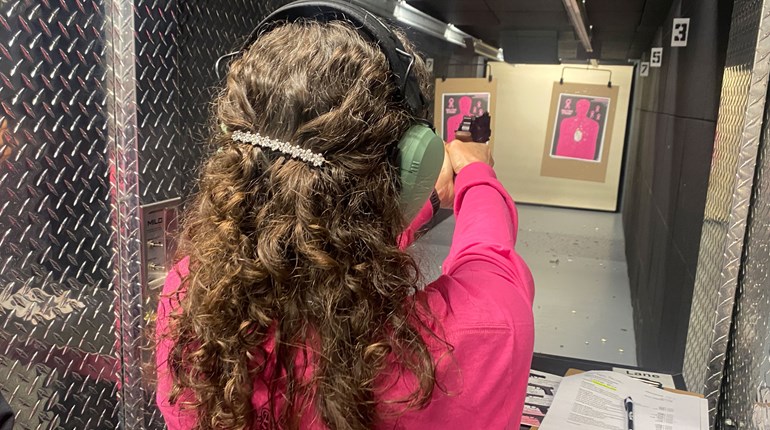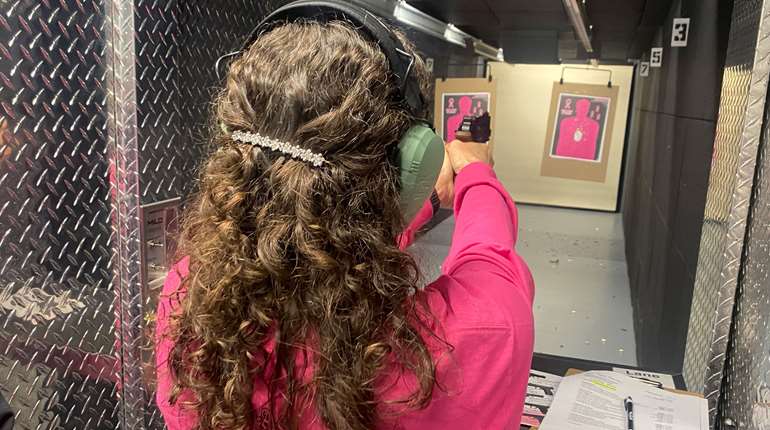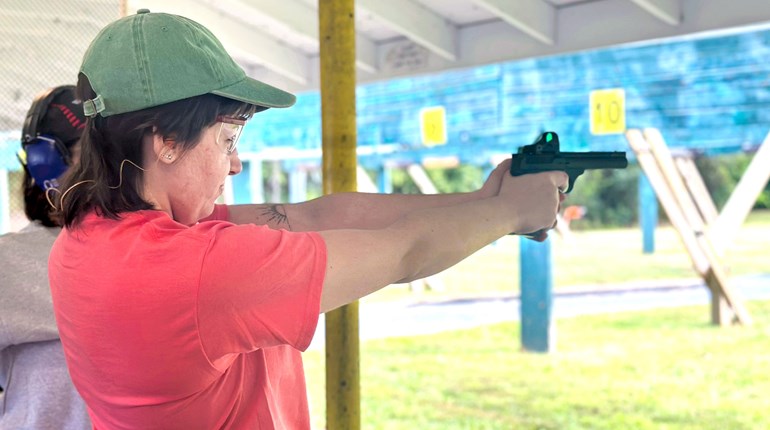

When you’re training at the range, you probably have a particular draw method that works well for you—I use the five-step method Gunsite Academy teaches that I’ve outlined here. Regardless of method, they all end the same way: With your arms extended in a firing position so the gun is held away from your body, pointed at the target.
This is very safe and effective, but in a real-life defensive situation, there’s a good chance you won’t have the luxury of a full, easy draw to your perfect shooting position. After all, many attacks happen from such close range that you have very little time to react once you realize what’s going on. You might have to literally shoot a bad guy off you, and if he’s get-off-me close, you won’t have the time or the space to extend your arms into your practiced, carefully aimed firing position. This is why it’s important to learn to shoot from a retention position.
By far the most common retention position happens in step 3 of the draw method I mentioned above. You’ve gripped the gun, ripped it clear of the holster vertically, and rotated it by pivoting your elbow down. The gun is still held tight to your side, and it is pointed in front of you in the general direction of the threat. Your support hand is safely out of the way, pressed to your chest unless you are actively fighting off an attacker. This is exactly why I like this draw method—you can safely shoot at any point during step 3, 4 or 5 if you really have to.
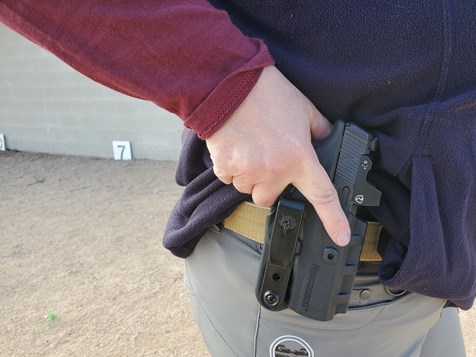
Of course, there are a few things to know about how to shoot from retention like this. The first and most obvious is that there’s no way to aim because you can’t line the sights up with your eyes. This is point-shooting—the gun is pointed at the threat, even though you don’t know exactly where. If you are forced to shoot in this manner, it’s because the threat is so close that you are pretty much guaranteed not to miss his torso if the gun is pointed forward.
You cannot rush this step and fire between steps 2 and 3—you’ll hit the ground or, worse, yourself if you’re rotating properly. Rushing it is easy to do in the midst of an adrenaline dump.
Secondly, and also obviously, this is one-handed shooting. If that’s not something you’ve practiced before, you might be surprised at how different it feels from two-handed shooting. The recoil hits differently. Keeping your hand and part of your forearm pressed tight to your side will help you manage this, serving as a second point of contact to stabilize everything.
Third, if you are carrying a semiautomatic handgun, as most of us are, be aware that if the slide hangs up on anything during the shot (like your shirt or your torso) the gun might not cycle properly and you won’t be able to shoot a second time without clearing the malfunction—a two-handed job that you certainly don’t want to deal with in the middle of a fight. The way to avoid this is to cant the gun out a bit from your side so that the slide has room to cycle properly without contacting your clothing or the holster. Again, keep the gun to your side, not in front of you, where the slide might hit your stomach on its way back.
At get-off-me point-shooting distance, you’ll likely hit the attacker in the abdomen, which might or might not stop the threat or at least cause him to back up and give you some room to come to a full-draw, aimed firing position. But this is no guarantee, so be prepared to shoot more than once until you have the space you need to evaluate the situation.
There are a couple of other, much less common retention shooting positions. The first is in step four of the draw cycle, where you have a two-handed grip on the gun but it is still held tight to your chest directly in front of you rather than extended. Again, the gun is pointed in the general direction of the threat, but you are not able to see the sights to properly aim it. You would use this if you were facing an advancing threat and this is as far as you happened to get in your draw cycle before making the “shoot now” decision, or perhaps if you were clearing a house (which you should never, ever do unless you absolutely have no choice) and can’t extend the gun in front of you when entering a room.
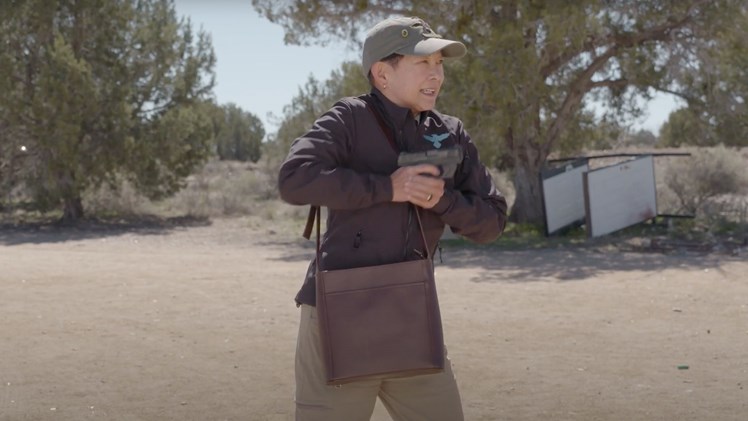
The other sort-of retention position is shooting through your purse. I am not a fan of purse carry, but if you’re going to do it, you should practice drawing from the purse into a firing position. But if space is tight, you have no time to draw fully and you have the gun and purse oriented in the right direction, you could conceivably fire the gun through the purse as soon as you have a good one-handed grip on it. To be clear, this is an absolute last-ditch measure because of the myriad ways it can go wrong. If you shoot a hammerless revolver, everything will probably work fine. If you use a hammered revolver, the hammer is likely to snag at some point—if you’re lucky, it’ll be after you get one shot off. If you carry a semiauto, you almost certainly will only get one shot before the gun jams up. Don’t try shooting through a purse unless you have no other option, because the results are unpredictable.
The odds are very high that you’ll never have to use your firearm in self-defense. But if you do, there’s a very good chance that you won’t have the luxury of utilizing your standard range stance and firing position. Because defensive situations tend to happen in very close quarters, knowing how to shoot from a retention position can be very helpful for getting a threat off you. If your range allows, practice drawing and shooting from a retention position at least a few times so you know what to expect and you get used to the press-and-cant posture. If there’s no safe or allowable way to practice this at your range, some dry-fire practice at home with an unloaded gun will at least allow you to get more comfortable with the motion.