
Many different types of wood are used in the manufacture of firearm stocks, the most common being American walnut, Turkish walnut, Claro walnut, Birch and Figured. But here's why the wood chosen for a particular model firearm is anything but random.
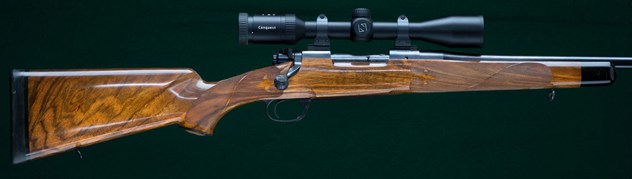
Image courtesy The Hallowell & Co Illustrated Firearms Dictionary.
American Walnut
American walnut is the most common wood found on high-end retail firearms like the Winchester Model 70 and the Remington Model 700. This wood is durable and stable, allowing it to absorb a lot of recoil. Thus, walnut is frequently used in firearms chambered in magnum cartridges.
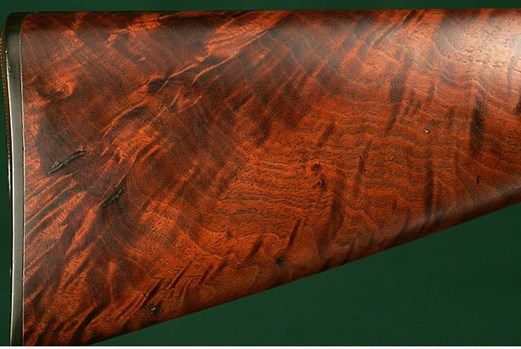
American Black walnut image courtesy The Hallowell & Co Illustrated Firearms Dictionary.
American walnut is considered the standard for the “classic” look, especially in bolt-action hunting rifles. This wood is graded from Grade 1 (plain grain) to Grade 5 (Exhibition), with grade 5 being the most expensive.
The most common American walnut variety is Black walnut, which usually has an attractive grain and can also be found containing figured wood. Walnut has a rich grain that is easy to carve, yet very strong. Firearms that are made with walnut stocks are considered “heirloom-quality” guns. American walnut blanks that are from trees that are between 30–50-year-old, are considered ideal.
Turkish Walnut
Many high-end firearms, especially from Europe, are made with Turkish walnut. A single blank, with the right quality and grain, can fetch tens of thousands of dollars to the right gun manufacturer. High-end rifle makers such as James Purdey & Sons, Holland & Holland, J.P. Sauer and Sons, and John Rigby & Co. produce guns in excess of several hundred thousand dollars, and a large part of that cost is the Turkish walnut blank.
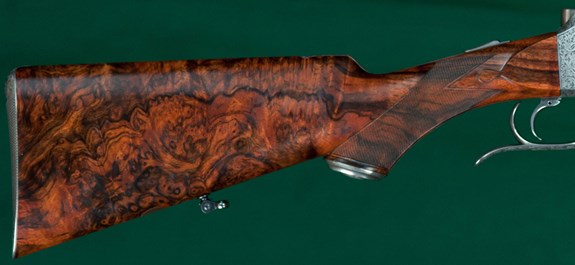
Turkish walnut images courtesy The Hallowell & Co Illustrated Firearms Dictionary.
Turkish walnut is prized for its exceptional beauty. If you ever gaze upon a rifle and are blown away by the beauty of the wood, more than likely it is Turkish walnut. This wood is extremely dense and strong, so it is ideal for the largest calibers that have extremely high recoil such as heavy guns used in Africa chambered for the Nitro Express cartridges.
Turkish walnut stocks are so dense it makes them resistant to extreme heat and humidity, ideal for tropical climates found in Africa and India. Turkish walnut is also stronger than most walnut lumber. This makes this wood ideal for very fine checkering on the grip areas of the stock, which also strong enough to resist the wear brought on by heavy use.
Turkish walnut trees come from Turkey, Iran and the Caucasus region of the Middle East, with the best Turkish walnut blanks from trees that range from 200 to 300 years old.
Claro Walnut
Claro walnut is hybrid walnut tree found on the west coast of the United States. It is produced by grafting an English Walnut to a California black walnut rootstock. This wood is a very desirable wood for rifle stocks, containing vibrant colors ranging from dark chocolate, purple, red and even gold. Claro walnut is an extremely figured wood with various patterns like fiddleback, crotch and curly.
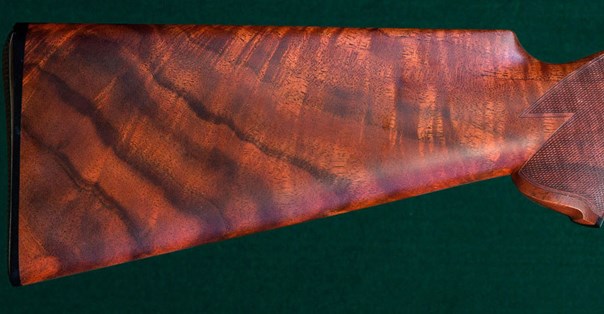
Claro walnut image courtesy The Hallowell & Co Illustrated Firearms Dictionary.
Roy Weatherby made this stock famous. Weatherby exclusively used Claro walnut for his rifles, especially for his Mark V series. These stocks were so beautiful that they were referred to in the gun industry as “Weatherby Stocks.” The stocks made for his Mark V Series rifle featured AA-Grade Claro walnut stocks with a high Monte Carlo cheekpiece. To see one of these masterpieces, one can only appreciate this fine rifle.
Birch
Birch wood is a very good choice for firearms, as it is strong and very durable, making it ideal for rifles chambered in magnum cartridges. This common wood is even stronger than the American walnut species. The strength of Birch also makes it ideal for laminated stocks, which usually result in a colorful and vibrant product. Even though Birch is stronger than walnut, walnut is still the choice for high-end firearms because of its grain pattern.
Birch is a good choice for firearms because it is strong, durable and economical, and is one of the reasons Ruger became such a popular gun maker. Bill Ruger started making guns chambered in calibers that were traditionally “guns of the wealthy,” but wondered why the average American couldn’t buy guns that were traditionally used in Africa even though the average American may never get to hunt in Africa. He decided to do just that, which proved successful. By producing guns chambered in high-end calibers using Birch, the average American could afford firearms that he or she could only previously dream about.
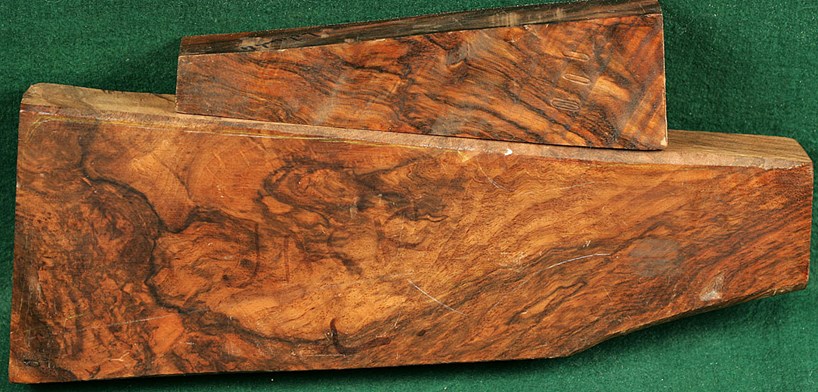
Walnut two-piece image courtesy The Hallowell & Co Illustrated Firearms Dictionary.
Figured Wood
Figured wood is highly desirable and can be very pricey. This type of wood is one that has unique patterns in its grain for that timber, which shows through the surface. Figured wood is caused by external forces that give a decorative or even three-dimensional appearance. This unique pattern can be caused by disease, injuries to the tree when growing, stress, fire, etc. There are several types of figured wood: Bird’s Eye, Burl, Quilted, Spalted, Crotch and Tiger Stripe.
Bird’s Eye. This pattern is often found in sugar maple tree blanks. The pattern in this wood contains small circles that look like bird eyes. The pattern is very subtle and easy to look at.
Burl. Burl is a highly sought after wood pattern. Many high-end firearms, especially double rifles, will sport this chaotic pattern. The pattern of the burl is irregular and, like the Bird’s Eye pattern, will have small “eyes.” Burl patterns can also have very pronounced rings. This type of wood pattern is caused by trauma or disease.
Quilted. Quilted wood has a three-dimensional aesthetic. The grain appears very wavy, with the waves giving off a bubbled or blistered look. Quilted pattern wood is very pleasing to the eye and normally stained a light maple color.
Spalted. Spalted wood has a unique look in that there are irregular waves, streaks or “worm-like” dark lines caused by fungus. The spalted look gives off a “wild” vibe. This wood pattern is very busy, so it is important to choose the right blank for a firearm, so the wood does not detract from the smooth lines of the gun.
Crotch. Crotch figured wood has a very concentric pattern. It can be described as smooth, uniformed arcs or a feathered pattern. Crotch patterns are usually found where a limb branches off from the main trunk. There are usually light and dark areas that accentuate each other. Crotch wood is perfect for wide parts of the gun, like the cheekpiece, so that the pattern can be appreciated.
Tiger Stripe. Tiger striped figured wood is also referred to as Fiddleback wood, which has very distinct wavy or straight lines running across the grain. Many older firearms from Austria and other Northern Europe can be found with this type of figured wood. Some of these patterns can be very faint while others are very prominent. Tiger striped figured wood looks especially stunning on rifles with full length stocks such as the Mannlicher Schoenauer.
Next time that you are drawn to a firearm due to its beauty, pay attention to the wood. It is the wood that caught your eye. Wood gives a rifle character. Some believe that the wood of a firearm is the soul of that gun. Many times, the wood of a gun represents the personality of its owner—classic, flamboyant, subtle, quiet, loud or just classy.