
As gun ownership among women rises, and more women are taking responsibility for their personal protection—and more states are adopting constitutional carry—the number of women carrying a firearm to and from work also rises. However, employers often prohibit firearms on the premises, and working in state or federal buildings makes carry at work illegal. If you carry in or to your place of work, here are a few points to consider to make this practice as sound as possible.
Check the Law
First, you must be aware of any state and local laws, workplace rules and whether those supersede the law or can be ignored. Consider talking to a local attorney and asking for actual legal advice, specific to your situation. Many people feel that they would “rather be judged by 12 than carried by six,” but in reality, the legal ramifications of carrying where you are not allowed can cost you your job. Carrying where it’s not allowed is more likely going to affect your ability to provide for your family, or be charged with a crime (which could potentially impact your ability to even own a firearm).
Furthermore, while “... guns are used defensively by firearms owners in approximately 1.67 million incidents per year, only 3.2% of defensive incidents of gun owners using their firearm occurred at work”..
Ignorance of the law governing firearm carry won’t always land you in a place of leniency, as many are prosecuted for carrying in prohibited places. The numbers are difficult to pull, since non-criminal firearms possession doesn’t seem to be broken out from all “illegal” firearm possessions prosecuted (i.e., there’s no break-down on actual criminal possession vs. someone forgetting to stow their concealed carry before they entered a building).
Dream Job
Say that you have a “dream job” or at least, a dream employer who encourages concealed carry. How do you store your firearm at work? Does your employer offer a safe for daytime storage, say, if you leave your desk for a meeting and do not want to lug a bag with your concealed carry along? What about something as simple as going to the rest room? Is your firearm secure? A safe for your desk might be a good option.
What if you work in a place where it’s not illegal to carry at work, but maybe just frowned upon? Perhaps it’s the best career choice not to draw attention to it. Do you have a locking desk drawer to which only you have the keys? A locker? Or maybe even a locking bag that you can secure to a desk?
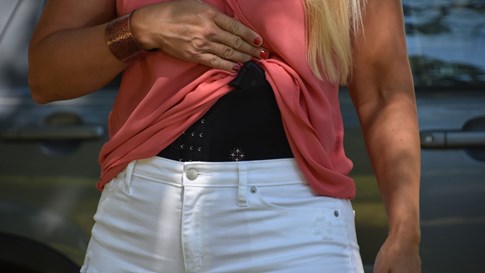
And if you are in a dream job and carry, for example, someone who works at a firearm retailer and carries—do you want people knowing that your firearm is on your person? Are you dressing for concealment at all times?
These are all questions to ask yourself before you decide to carry concealed in the workplace.
Mental Awareness and Carry in the Workplace
Concealed carry requires mental acuity—that means thinking about what you’re doing, being intentional with your method of carry and clothing, and generally, being a bit more aware of your surroundings. Perhaps you are that aware all the time out of habit. But a lifetime of carry as an adult does carry risk.
Steps for Concealed Carry Consistency:
- Verify before you leave your home. This can be as simple as physically checking that your firearm is in your concealed carry bag. If you carry on your body, you will verify by putting the firearm on. Ensure any spare mags, pepper spray, pocketknives, etc. are where you want them as well.
- Carry in the same location for to-work travel. Keep the firearm where you need it to comply with your state and local laws on the way to work. But if you are required to leave it in your vehicle, be diligent and give yourself time to verify that your firearm is stored where you need it, before you leave your vehicle.
- Verify before you leave your car. Again, put your hands physically on the firearm and/or magazines. Make sure that you do not have anything on your person before you leave your vehicle.
- Keep a separate bag or purse for to-and-from work, and a separate bag to go into work. This can help prevent accidentally having a firearm with you in prohibited places. Think of it like a gym bag: Your firearm, mags, pocket knife and other restricted items stay in one place. Your work bag with your items for work are in a separate bag. If you carry two bags, never put the firearm in the work bag and inspect it before you leave your car.
If this sounds like overkill, consider this cautionary tale. My husband worked over a decade in the Pentagon and heard about an incident with a civilian woman who forgot her concealed carry was in her purse. Instead of their security using discretion and allowing her to put it in her vehicle or return home with it, they escalated it. It might have cost her security clearance. The reality of life as a human is that we are fallible: We can forget. Establishing patterns and being consistent is critical when it comes to concealed carry, especially if your job might be put at risk from a simple mistake.
In the end, concealed carry happens so many times each day in this country with very few instances of problems arising from it! We tend to only hear the stories of something going wrong.
The 2021 National Firearm Survey estimates that “approximately 20.7 million gun owners (26.3%) carry a handgun in public under a “concealed carry” regime; and 34.9% of gun owners report that there have been instances in which they had wanted to carry a handgun for self-defense, but local rules did not allow them to carry.”
That means that on average, 5.4 million Americans carry a handgun. And of the “approximately 1.67 million incidents per year, only 3.2% of those people used a gun defensively at work. Your risk of needing it is many times lower than needing it at home (“25.2% of defensive incidents occurred within the gun owner’s home… and 53.9% occurred outside their home, but on their property,”
So be diligent. Be intentional. And build good habits so you have all the tools available for your personal safety at your disposal.