
Semi-automatic pistols are today’s reigning king of self-defense guns. When I teach the NRA Basic and Instructor Pistol Courses, most of my students—of all ages—cringe at the thought of shooting the revolvers I incorporate into the range portion of the class. But many of my students endeavor to become NRA Certified Pistol Instructors, so I must sign off and verify that these students have met all the objectives of the course, including the range qualifications and different types and categories of handguns.
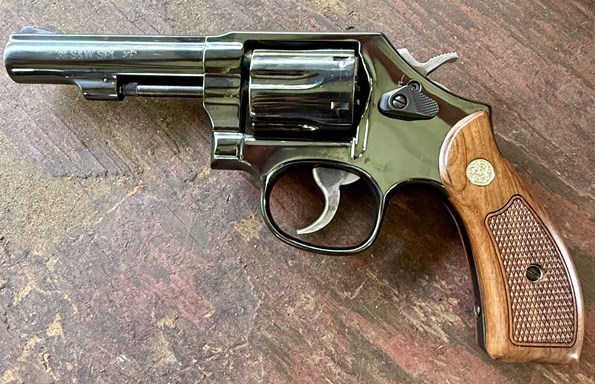
The .38 Special is by far the most widespread revolver self-defense caliber, used by military, police and civilians for almost 100 years.
Many of my younger students have never even fired a revolver. In fact, quite a few tell me that they are a little intimidated by revolvers due to what they have been told by the “experts.” A student recently told me she was terrified at the thought of shooting a revolver. She told me that she expected fire and flames to shoot out of every opening (each of the individual chambers within the cylinder). When I asked her where she heard such a thing, she said it came from her last instructor. Once she learned the terminology and operations of the revolver, she quickly overcame her fears, shot the revolver, and did an excellent job on the range.
To pass the course, my students must demonstrate they can properly load, fire and unload a revolver. I am confident that when my students leave my course they can positively acknowledge they understand how to handle, operate and shoot this type of handgun.
In general, younger generations have never been exposed to the action of a revolver. Most shooters who “cut their teeth” on revolvers are either retiring or passing away, unable to pass revolver knowledge down to future generations. This is unfortunate because many of the techniques used in shooting revolvers can be applied to semi-automatic pistols, which often surprises my students when they see how much tighter their groupings become.
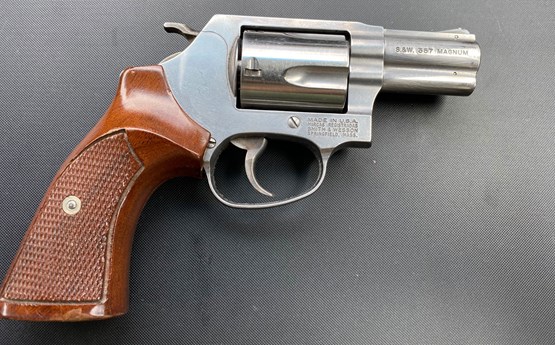
A revolver chambered in .357 Mag.
Two things that many people think when they hear the word “revolver”: magnum and recoil. Some people even refer to certain large-caliber revolvers as “hand cannons.” These calibers include .357 S&W Mag. (introduced in 1934), .41 Rem. Mag. (introduced in1964); .44 Rem. Magnum (introduced in 1956); .454 Casull Magnum (introduced in 1958); .460 S&W Magnum (introduced in 2005); and the .500 S&W Mag. (introduced in 2003).
Cartridge ballistics can tell the shooter many things about the performance of a particular round. Data such as bullet weight, muzzle velocity, and muzzle energy tells the shooter what he or she should expect from projectile when it leaves the muzzle and when it strikes its intended target. Free recoil energy is what the shooter should expect to feel when the cartridge is fired or in other words, “felt recoil.” It is the free recoil energy that most shooters are concerned about.
Although revolvers can be chambered for magnum cartridges, alternative cartridges can be used in the four most common calibers used in this type of handgun. These lower recoil cartridges are called “Specials.” The only magnum handgun cartridges that do not have “Special” calibers are the .41 Rem Magnum and the .500 S&W Magnum.
Special calibers allow the shooter to practice more often and in longer sessions. This gives the shooter the ability to really concentrate on the 5 Fundamentals of Pistol Shooting,
The skills that the shooter improves upon with a revolver will directly translate into improved marksmanship when he or she shoots a semi-automatic pistol.
The four magnum calibers that have less powerful “special” rounds are .357 S&W Magnum, .44 Rem. Magnum, .454 Casull Magnum, and the .460 S&W Magnum. What is unique with these special rounds is that they all served as the parent cartridge for the powerful offspring.
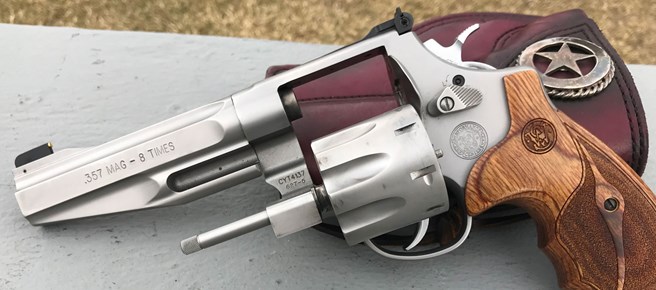
.357 S&W Magnum
The .38 Special is by far the most widespread revolver self-defense caliber. This caliber was used by the military, police, and civilians for almost 100 years. Law enforcement and civilian slowly made the.357 S&W Magnum the go-to cartridge. Now it is one of the most popular revolver chamberings on the market.
Because of its versatility, the .357 S&W Magnum revolver is a popular choice for many, even those who do not intend to shoot this powerful cartridge. Handguns that are chambered for this caliber can usually safely shoot the .38 Special, .38 +P, and the .38 +P+.
The .357 S&W Magnum produces pressures up to a maximum of 35,000 psi. This equates to approximately 8 to 15 ft-lbs. (foot-pounds) of felt recoil. The .38 Special produces a maximum of 17,000 psi. This equates to approximately 2.5 to 3.5 ft-lbs. of felt recoil. The .38 +P and the .38 +P+ can generate pressures and ft-lbs. of energy between these two.
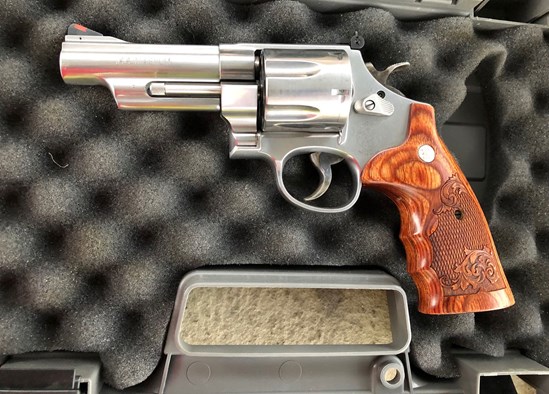
.44 Rem. Magnum
In December 1971, Clint Eastwood’s “Dirty Harry” film made its debut, and the .44 Rem. Magnum instantly became a film cult gun. After its debut, every man with a 70s-style mustache had to have one. Unfortunately, very few individual, both male and female, could effectively shoot this powerful handgun. This is still true today.
The .44 Rem Magnum is still one of the most popular back-country handguns carried for protection, especially in bear country. In the early 2000s I was finishing writing my first book, Entering the World of the Predator, and I contacted an Alaskan game warden for some information. He said that in rural Alaska you cannot even go out of your house to retrieve your mail unless you are armed due to the state’s population of brown bears. He said that men usually carry a .454 Casull. while women are usually armed with a .44 Rem Magnum.
The .44 Rem Magnum produces a maximum pressure up to 36,000 psi. This equates to about 13.7 to 18.5 ft-lbs. of felt recoil. The .44 Special produces a maximum pressure up to 15,500 psi. This equates to approximately 4 to 5 ft-lbs. of felt recoil. It is easy to see why these 1970s, Burt Reynold look-a-likes chose to carry .44 Special rounds in their revolvers chambered for .44 Rem. Magnum.
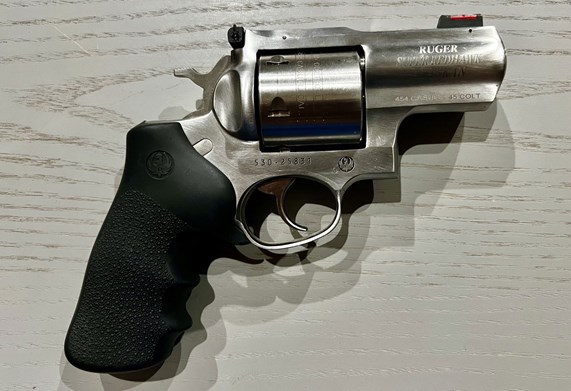
.454 Casull (Magnum)
The “special” that can usually be shot out of a handgun chambered in .454 Casull is the .45 Colt. Many gun owners do not think of the .45 Colt as a “special” round even though the .454 Casull is sometimes referred to as the .45 Colt Magnum. This is because the parent cartridge of the .454 Casull is the .45 Colt. That would make the .45 Colt cartridge a .45 Colt Special.
Depending on the gun, the .454 Casull can be a very punishing cartridge to fire. I think the most punishing revolver I have ever shot is the Ruger Alaskan with a 2.5” barrel chambered in .454 Casull. It is a great gun; it just likes to let you know who is in charge!
The .454 Casull generates approximately 50,000-65,000 psi, the same as the .460 S&W Magnum. The .454 Casull produces between 27 to 36 ft-lbs. of felt recoil, which is considered excessive recoil by many shooters. The .45 Colt is a great alternative. It has a very manageable felt recoil between 8 to 10 ft-lbs. and lower pressures of 12,000 to 14,000 psi.
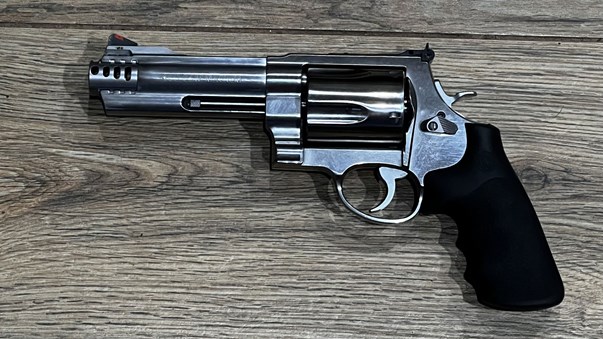
.460 S&W Magnum
Compatible cartridges that can usually be fired out of a gun chambered in .460 S&W Magnum are the .454 Casull and the .45 Colt.
The .460 S&W Magnum is one of the two “Big Daddies” of the Smith and Wesson line of handguns. The other cartridge is the .500 S&W Magnum. Both guns are made on the massive X-Frame offered by Smith and Wesson. The .460 S&W has some very impressive ballistics. This caliber can be used to take almost any dangerous game animal that walks the earth.
The .460 S&W Magnum delivers an impressive pressure between 50,000 to 65,000 psi. This translates into approximately 27 to 36 ft-lbs. of free recoil energy. Luckily there are other options that are available to the shooter. The alternative to the .460 S&W Magnum is shooting the .454 Casull and the .45 Colt out of a revolver chambered for .460 S&W Magnum.
To reiterate, the .454 Casull generates approximately 50,000 to 65,000 psi with a lower felt recoil energy of 15 to 20 ft-lbs. of felt recoil energy. The .45 Colt has even standard lower pressures between 12,000 to 14,000 and a pleasant 8 to 10 ft-lbs. of felt recoil. Depending on the gun these two alternatives give the shooter the ability to carry different calibers and choose the one that best meets his or her needs.
It is very important to always check the owner’s manual to see which rounds are compatible with your firearm. Never assume that substitutions are permissible. Every gun is different and you should take nothing for granted.
—Heidi Lyn Rao