
Years ago, a relative of mine handed me his latest handgun purchase for inspection. It was a recent introduction from Springfield Armory into the polymer-framed, striker-fired pistol market. Dubbed the XD (eXtreme Duty), it was based on the HS2000 military sidearm and made for Springfield by HS Produkt in Karlovac, Croatia.
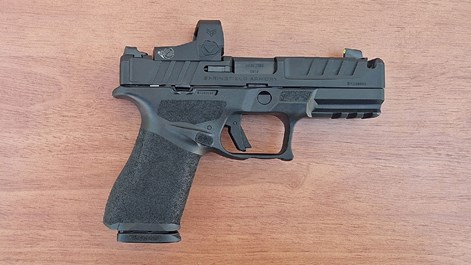
This compact version of the Echelon ships with a 4” barrel and an optics-ready slide.
My impressions of this particular XD pistol, which happened to be chambered in .45 ACP, were mixed. It certainly looked and felt well-made and it had a useful feature set. But in my hands, it felt top heavy. The grip shape was not a good fit for me and I was not sold on the grip safety. But to be fair, I was in the Glock Gen 3 phase of my polymer semi-automatic explorations. In short, I liked the Glocks better than the XDs so I did little to pursue them.
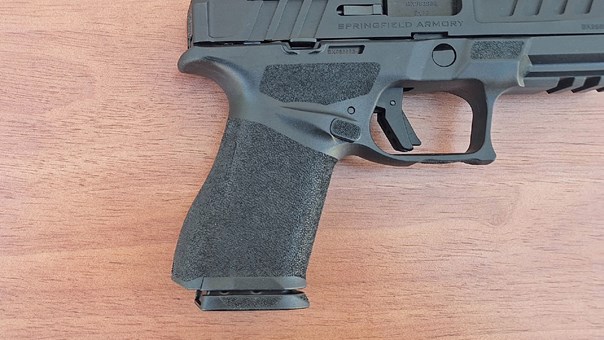
The grip contouring and texturing make this gun impressively comfortable to hold.
More than two decades have passed since my first hands-on experience with Springfield's Croatian pistols. The XD series was a success resulting in a long-standing partnership between HS Produkt and Springfield. And the last I checked, my relative still enjoys shooting his when .45 ACP ammunition is available for a good price.
In 2023, the two companies teamed up once again to introduce the new, up-to-date Springfield Echelon pistol series. These guns have quickly garnered a reputation as highly reliable, top quality duty-type pistols. As a result, the lineup has continued to expand to include dozens of variations built around three standard sizes and two primary slide designs. This year I decided it was finally time to give the Echelon a try and see for myself how they handle. I went with the recently released Echelon 4.0C Comp model (UPC: 706397982553), which proved to be an excellent fit.
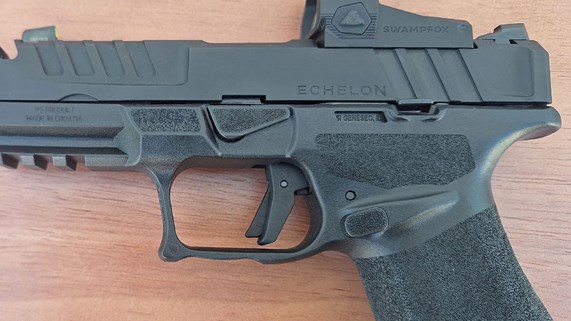
The slide stop and the magazine release are ambidextrous.
Like other members of the 9 mm Echelon series, the 4.0C Comp is a striker-fired, semi-automatic pistol which employs a short-recoil operated, locked breech action. The 4.0 in this pistol's designation means it has a 4" barrel. The C lets folks know it is outfitted with a Compact grip module while Comp indicates that this particular gun leaves the factory with a compensated barrel.
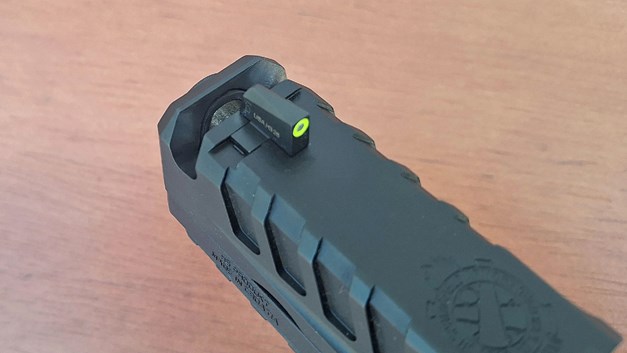
The “chunk” port is cut through the barrel and the slide just in front of the forward night sight.
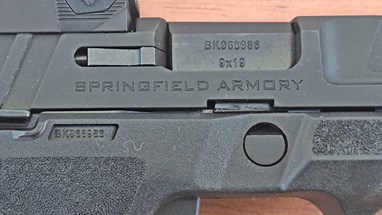
The buzz word Springfield has applied generously to the Echelon series is “modularity,” and rightly so. The pistols are assembled around a removable stainless steel chassis system, or Central Operating Group (COG), that supports the trigger assembly. The pistol's serial number is applied to this chassis. This allows it to be removed and installed into a different polymer frame, also called a grip module. If you decide you want a grip that is a different color, texture or length, the modules can be traded out for about $65, which is significantly less than purchasing a new pistol.
Often there is not all that much to report regarding a pistol's slide assembly. But in this case, it is among the most feature-rich components of this semi-automatic. To begin with, it is milled from a billet of proprietary alloy steel which is treated with a durable, corrosion-resistant Melonite finish. It features an oversized extractor claw set into a beveled ejection port.
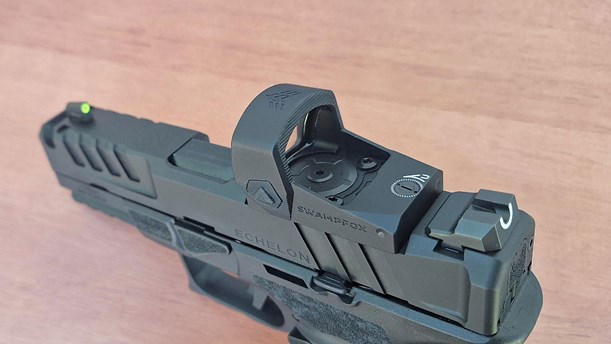
The slide’s VIS system made mounting this Swampfox optic a snap.
This slide's gripping surfaces are well-designed. In addition to the canted slide serrations at the front and the rear, the slide is also contoured on both sides just in front of the barrel's chamber and just below the rear sight. These dips into the slide produce two sets of ledges that act like hand stops. They offer a useful level of added purchase while providing distinctive touch points so that you can feel right where the support hand is resting along the slide's surface.
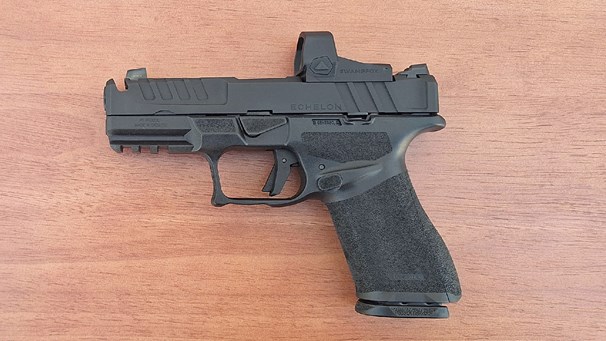
A stand-out feature of the Echelon is the careful design of the slide’s gripping surfaces.
The slide is dovetailed for and outfitted with a set of Springfield's Tactical Rack U-Dot sights. Made from hardened steel, these sights are a standard feature for Echelon and Hellcat models. The front sight has a bright yellow ring around its Tritium night sight lamp. The rear sight is of the U-notch variety with a white outline. I'm a fan of this sight configuration because they can be quicker and easier to work with than the square-notch 3-dot sights.
One of this pistol's features that I was working with for the first time is the Springfield Variable Interface System (VIS) for mounting optics to the slide. In place of a stack of optics plates, this system consists of a series of ports, milled into the slide, with a set of self-locking pins. Depending on the model of the optic to be installed, the pins are moved around or traded out to support 30 different red-dot optics. The VIS is simple to adjust and it allows the optic to be set directly into slide. It's an elegant solution for hosting a variety of optics.
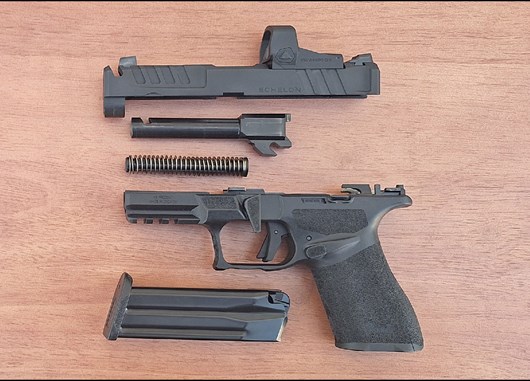
The 4” barrel is supported by a polymer guide rod and on flat wire recoil spring.
The slide is paired with a 4" hammer-forged steel barrel treated with a matching matte black Melonite finish. It is supported by a fluted polymer guide rod that captures a singular flat wire recoil spring. The bore is cut with traditional land and groove rifling with a 1:10 twist rate.
At the muzzle end of the slide and the barrel is a forward canted, 0.2" wide cutout. It forms an integral compensator, the type of which is more casually referred to as a “chunk port.” This port is designed to reduce recoil and muzzle rise by redirecting a portion of the hot gases produced by the cartridge upwards. It has become a more popular option recently because it works, it’s fairly simple for manufacturers to install and it does not change the holster profile of the pistol like an external compensator attached to the end of the threaded barrel. More information about using compensators with defensive pistols is available here.
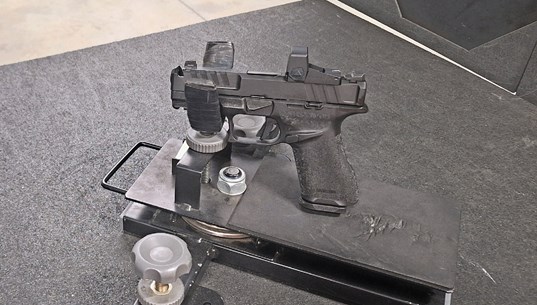
This Echelon proved to be utterly reliable during the course of testing.
The polymer frame features a molded in 3-slot accessory rail and a generously sized trigger guard with a textured flat to serve as a finger rest. The guard is undercut and beveled where it meets the grip for added comfort. The flat-faced trigger sports an integral blade safety. It exhibited a light, 0.25" take-up with a firm stop before breaking with 5-lbs. 2-oz. of trigger pull.
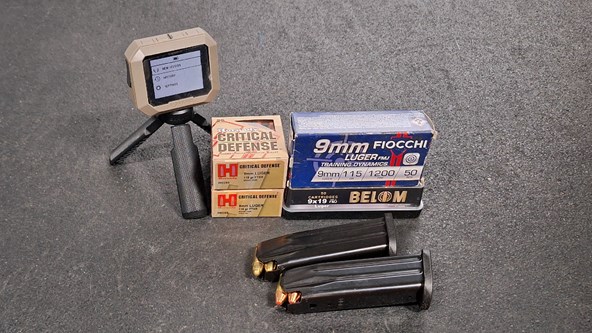
Test ammunition included practice and premium-grade loads.
The other external controls include a left-side takedown lever, a diminutive ambidextrous slide stop and a textured magazine release button that is also ambidextrous. Raised ridges behind the magazine release buttons guard against unintentional bumps. The grip is nicely rounded with a moderate, but effective, molded-in texturing all the way around.
Tipping the scales at 24 oz., unloaded, the pistol arrives with three interchangeable backstraps that fit so neatly the seam almost disappears. This grip is on the short list of pistols in this class that fit my somewhat smaller hands like it was made just for me. A pair of blued steel double-stack magazines with polymer bases are also provided. This model is listed as shipping with one flush fit 15-round magazine and one slightly longer 18-round magazine. But the gun I worked with arrived with two 15-rounders in the case.
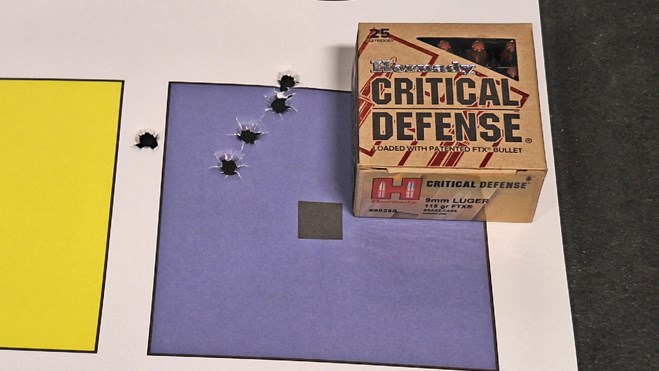
The best individual 5-shot group of 2.39” was fired using the Hornady load.
For the range test, the Echelon was outfitted with a Swampfox Liberty II ($289) micro red-dot optic. It was fired using a mix of practice and defense-grade ammunition using the two 15-round factory magazines provided with the gun. This pistol proved to be utterly reliable with all ammunition tested and the chunk port did contribute to a more comfortable shooting experience.
Formal performance testing was conducted by firing five 5-shot groups using three different loads into paper targets posted at a distance of 15 yards. The two practice-grade rounds included Belom and Fiocchi USA Training Dynamics loads along with Hornady's premium-grade Critical Defense FTX load. A Garmin Xero C1 Pro chronograph was on hand to measure bullet muzzle velocities for 10-shot strings. Here are the results:
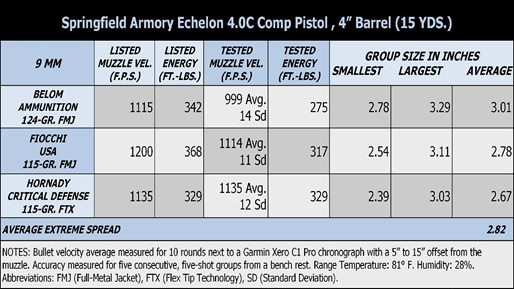
Nearly 40 years ago the Glock G19 pistol chambered in 9 mm set the standard for what is now considered an optimal pistol for civilian and law enforcement applications. This includes the footprint, action type, frame material and caliber. Since then, other manufacturers have invested a good deal of time and energy into developing models that both fit into and stand out from this defensive handgun class.
The Springfield Echelon is impressive in the way that it proves that there is still plenty of room for growth within the relatively narrow boundaries of the polymer-framed, striker-fired compact semi-automatic. The slide's forward gripping surface is just as fully developed as the rear rather than just being an afterthought. The sights and the VIS optics mounting system are both rugged and easy to use. The contouring and texturing of the grip frame make this one of the most comfortable double-stack polymer pistols I've worked with so far. Simply stated, if this had been the first polymer-framed Springfield I was handed all those years ago, I would have made a bee line to a local dealer to buy one!
The Echelon 4.0C Comp 9 mm pistol has a suggested retail price of $784. And if any of this particular model's features are not quite your cup of tea, there are dozens of other configurations to choose from. For more information, visit springfield-armory.com.