
Defensive 12-gauge shotguns are, simply stated, among the most effective close-range personal protection tools yet devised. The pump-actions, in particular, are favored for their reliability and flexibility. Because the action is manually cycled, they can operate reliably with a wide variety of loads and cartridge lengths.
However, when compared to handguns or some rifles, like the AR-15, some shotguns can be relatively heavy and unwieldy for use inside the confines of a dwelling. And there are those self-defenders who would prefer their pump guns to be more portable for use outside of the home as well. For these reasons gun makers have endeavored to compress the 12-gauge pump-action footprint using various design methods. Here is a look at three of the more unique compact shotguns on the market along with their advantages and tradeoffs.
Non-NFA Firearms: The Mossberg 590S Shockwave
Although scatterguns have received nip and tuck treatments since their inception, among the more notable guns are the famously sawed-off shotguns of Prohibition era America. Facing off against a desperate criminal armed with a buckshot loaded 12-gauge, with the shoulder stock cut into a pistol grip and the barrel cropped to the tip of the magazine tube, was an intimidating proposition. So much so that some gun makers started offering “civilian” models for personal protection against the thugs, including models like the Ithaca Auto & Burglar Gun and the H&R Handy Gun.
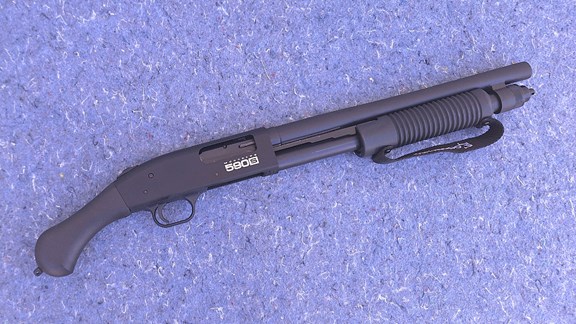
The Mossberg 590 Shockwave was the first commercially successful non-NFA firearms.
But in 1934, short-barreled shotguns were restricted under the National Firearms Act (NFA). The ownership of a short-barreled shotgun, or a smooth-bore pistol, included a federal registration process with the ATF. This process was topped off with a steep transfer tax of $200, which was the equivalent of about $5,000 today. However, there is a class of short-barrel firearms that does not fall within NFA regulations.
A gun maker can manufacture a 12-gauge pump-action at the factory with a barrel shorter than 18" if it meets a few requirements. First, the action must never have been configured as a shotgun, meaning, no shoulder stock has ever been attached to it. It must be manufactured with a pistol grip only. And secondly, the gun's overall length must be 26" or longer. That's it. This type of shotgun is not a shotgun, legally speaking. It is instead a “non-NFA Firearm” that can be legally sold in sporting goods stores without the NFA tax stamp.
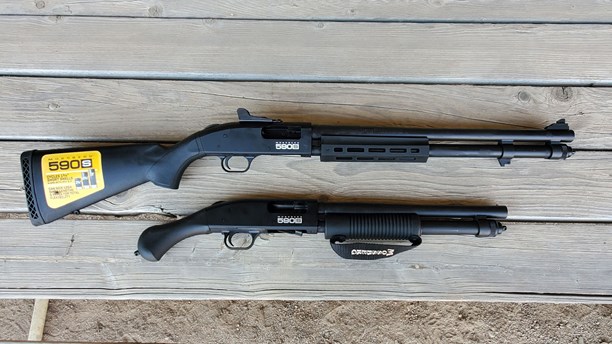
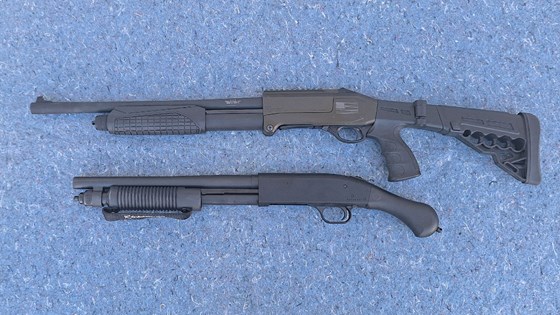
The 590S Shockwave firearm (bottom) compared to the 590S shotgun (top).
Although Non-NFA firearms were legal from the get go, gun manufacturers steered clear of them for decades. That is until 2017 when Mossberg broke the industry ice with the release of the commercially successful 590 Shockwave series of pump actions. Once other gun companies saw that the federal government did not shut Mossberg down, and they realized just how well the Shockwaves were selling, they launched their own non-NFA firearms that now include a variety of calibers and action types.
The Mossberg 590 Shockwave series is a good example of just how much can be trimmed away from a full-size 12-gauge action while still having enough gun to hold on to! The slim Shockwave pistol grip contributes to the gun's mandatory 26" overall length and gives it a sleek, no-snag profile. It features a 14.375" barrel with a 3" chamber.
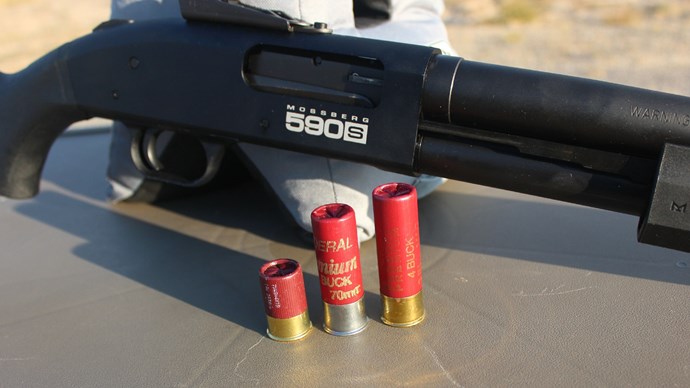
The S in the name indicates this model can safely chamber and fire 3”, 2.75” and 1.75” 12-gauge shot shells.
Among the members of this series is the unusual model 590S. The S stands for Short, meaning the action has been redesigned to reliably feed, fire and eject 1.75" long 12-ga. shells along with the more common 2.75" and 3" shells. Recently I put this gun through its paces using a set of Federal Ammunition’s Shorty shells. You can see the range results here. The 590S Shockwave is currently listed with a suggested retail price of $700.
Folding Receiver Pump Action: Rock Island Armory PK-12 Pak-Out
A pump-action shotgun with a hinged receiver that allows it to fold in half is not a new idea. In fact the first one, the Burgess Folding Shotgun, was invented in 1894. The hinge, which was located at the front of the receiver, allow the barrel and 6-shot tubular magazine to fold down to the shoulder stock. When folded, it could be tucked into a handy hip holster and worn under a jacket or great coat.
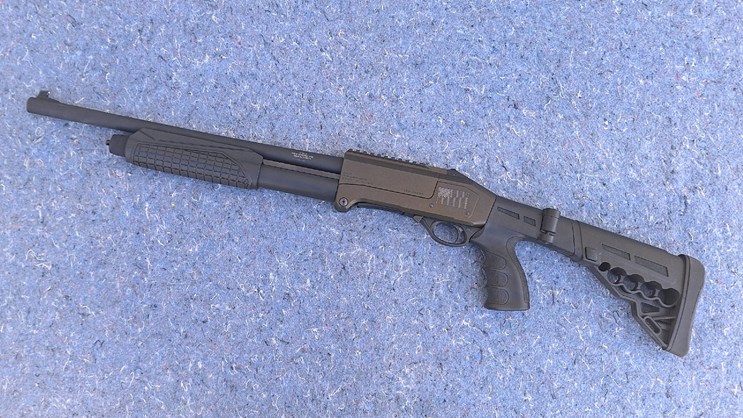
The PK-12 shotgun is a thoroughly modern take on the folding pump-action design.
This model was even more uncommon due to the position of the action’s slide. Instead of being located up front in the fore-end, like most modern pump guns, a sliding sleeve was set into the wrist of the shoulder stock. Built specifically for combat and law enforcement applications, Theodore Roosevelt bought thousands of the Burgess shotguns for use by the New York City police department. Production ended in 1899 when Winchester Repeating Arms purchased and closed the company in order to reduce their competition.
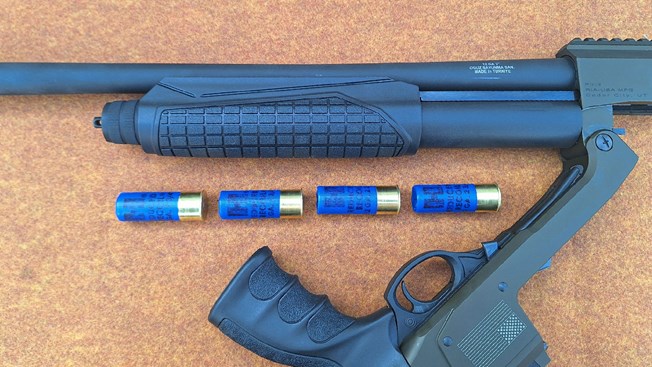
The PK-12’s magazine can hold up to 4-rounds of 2.75” 12-gauge shells with the receiver folded.
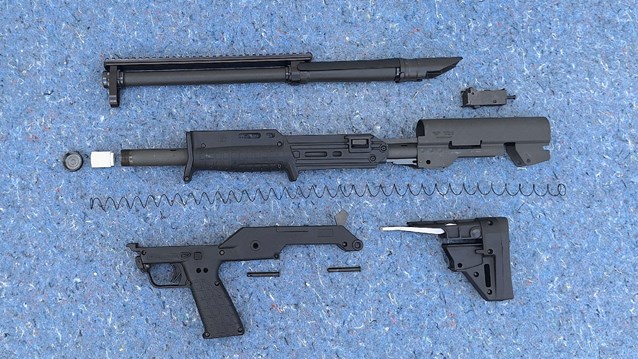
A thoroughly modern update to the folding pump-action was recently released by Rock Island Armory. Dubbed the PK-12 Pak-Out, it is available in a shoulder-stocked shotgun configuration, which is the model discussed here, or as a non-NFA firearm. I was more interested in working with the shotgun version. The aluminum receiver, with the hinge located at the front, splits into upper and lower sections when the rear sight is thumbed back to release them.
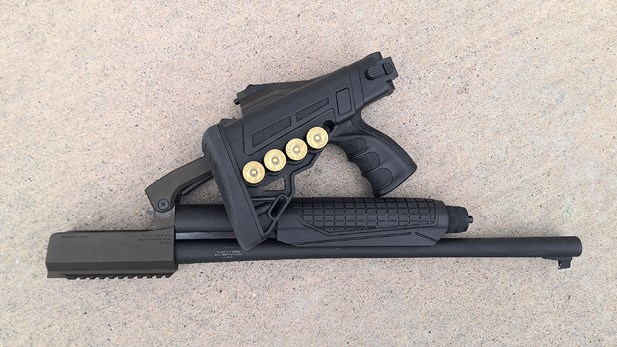
With the receiver and stock folded, the PK-012 can be tucked into a backpack or a duffle bag.
The action's slide is located up front in the textured polymer fore-end in familiar, pump-action fashion. The black polymer stock assembly, which is also hinged to fold to the left side, incorporates a vertical pistol grip, a 4-round cartridge holder and a rubber recoil pad. This model is listed for $650 and you can see it in action here.
Bullpup Configuration: Kel-Tec KS7
A “bullpup” is a long gun in which the trigger and grip have been moved in front of the receiver and ejection port. The receiver then serves double duty as what would otherwise be the shoulder stock. The key advantage of this arrangement is a gun that has a shorter overall length without cutting down the barrel length or eliminating the shoulder stock. Although the origins of the term “bullpup” is unclear, the name is most likely inspired by the guns' similarities to a bulldog puppy, which is to say, squat and inelegant looking but ready for a fight!
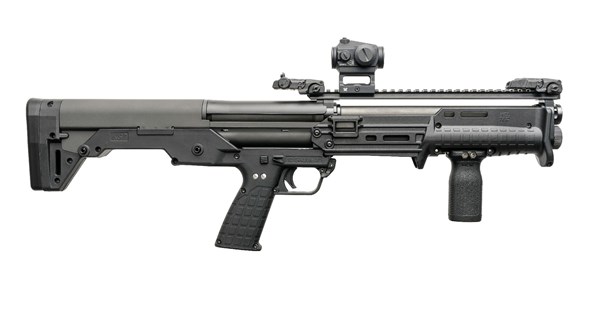
The slimmed down KS7 is essentially the KSG with just one magazine tube.
This design approach has origins going all the way back into the 1860s. However, the first military model of note was the Thorneycroft Carbine bolt action rifle of 1901. It has since been followed by other compact rifles such as the Steyr AUG, British SA80, and the IWI Tavor. The shotguns in this class include the Smith & Wesson M&P 12, UTAS UTS-15 and, the subject of this conversation, the Kel-Tec KS7.
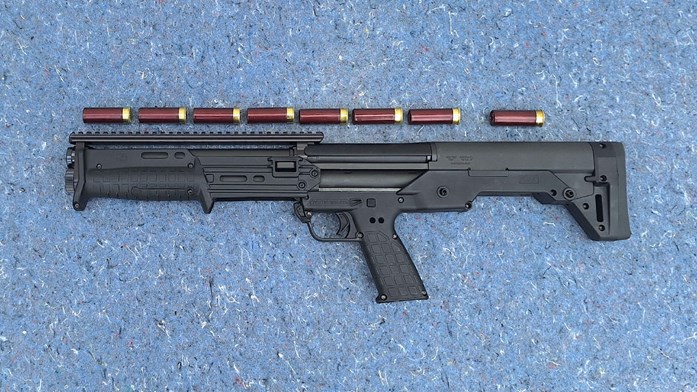
Despite its 26.1” length, the KS7 has a 18.5” barrel and a 7+1 round capacity when loaded with 2.75” shells.
Prior to the launch of the KS7, Kel-Tec developed the KSG series of bullpups which feature two tubular magazines instead of just one in order to double the gun's ammunition capacity. Although the 12-gauge KSG is an impressive pump-action for tactical operations, it’s also relatively bulky for some applications. The KS7 is essentially what the KSG would be if it had just one magazine. I had an opportunity to work with the Gen 1 version of the K7S back in 2019, which you can read about here. It would go on to win the American Rifleman Golden Bullseye award for Shotgun of the Year in 2020.
The KS7 has an utterly unique design which is easy to learn but notably different from typical pump-actions.
Recently Kel-Tec launched the Gen 2 KS7 which offers some notable modifications. The receiver has been strengthened and the internal components have been upgraded so that the action cycles more smoothly. The polymer carry handle with its fiber-optic sights has been traded out for a 12.25" long aluminum optics rail. This allows much more flexibility for installing the sighting system you prefer. In the photos, the Gen 2 is shown with both a red-dot optic and a set of AR-15 style folding backup sights. Another nice touch is an accessory rail added to the fore-end which can be used to mount a forward vertical grip for added control. The black version of this shotgun is currently listed for $699.99.
Which One is Right for You?
When comparing these three designs it is reasonable to wonder which one might be the best option for personal protection. Especially because each one is so unique in regards to its features. As with most highly specialized modern firearms, the answer depends on your needs and preferences.
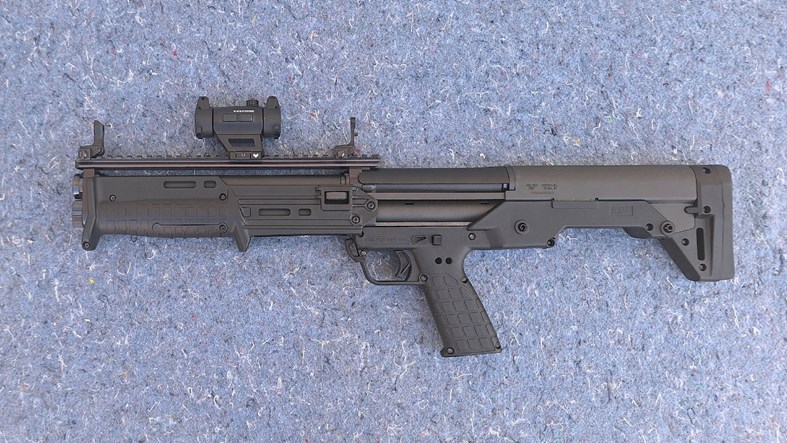
The KS7 Gen 2 aluminum optics rail supports red dots and AR-15 style back-up sights.
Weighing in at 5 lbs. 5 oz., unloaded, the non-NFA 590S Shockwave is lightest, slimmest and sleekest of the three. It also sports a familiar set of pump-action controls and it is loaded and unloaded in a typical fashion. Its ammunition flexibility can't be matched by the other two guns shown here. However, it is notably more challenging to master and manage due to the levels of felt recoil it generates and the lack of a shoulder stock. It can be done but this 12-gauge is not for the faint of heart.
The Rock Island Armory PK-12 Pak-Out neatly blends useful tactical features with the nifty factor of having a folding receiver and stock. The 4+1 ammunition capacity with 2.75" shells is sufficient but not remarkable. However, with an unloaded weight of 6 lbs. 11.7 oz., a pistol grip and a rubber padded shoulder stock, it is much easier to manage than a Shockwave. For the most part, the loading and firing operations are fairly typical. But getting the gun unfolded, while not difficult per se, means extra steps to get this gun into action that are not required for other shotguns.
The Kel-Tec KS7 splits the difference between the other two models in a few regards, including its unloaded weight of 6 lbs. 2.5 oz. The 26.1" overall length makes it notably more compact than the PK-12. But the pistol grip and shoulder stock make it easier to use than a Shockwave. It has the highest 2.75" shell capacity of 7+1. But Kel-Tec shotguns are unlike most every other model in the market place. While they are by no means difficult to use, they take some time to get used to.
For more information about defensive shotguns, take a look at the following posts:
In Defense of the Sub-Gauge Shotgun for Home Defense
A Cure for Bore-dom: .410 Bore Shotguns and Handguns
The Shotgun’s Big Advantage
The Secret Sauce to Enjoying Shotgun Shooting
5 Reasons To Check Out the KelTec KSG410 Shotgun