
When NRA Certified Firearm Instructors teach students to use the correct terminology, many times it is in general terms. For example, we teach the terms “forearm” and “stock.” While these terms are correct, they are general terms. There are different types of forearms and stocks.
The reason for this is that we are teaching to a “basic” or beginner audience. As we get more proficient with our firearms, it is important to know the differences between the parts to which we refer. Whether we are instructing students or are in the company of other experienced shooters, we should understand what our students and fellow shooters are asking about or referring to so we are all on the same page.
This is what the NRA calls a “knowledgeable shooter.” Being a knowledgeable shooter exudes confidence and shows that you are also a responsible gun owner. This is accomplished by learning the correct terminology of different firearms, especially the ones that you own.
Beavertail Forearm
Beavertail forearms are very large and stout. They resemble a beaver’s tail because they are wide and thick, and flat on the bottom. The sides of the forearm partially wrap around the barrels that extend to over half the diameter of each one. This type of forearm also protects the shooter’s fingers and hand from getting burned from the hot barrels while shooting.
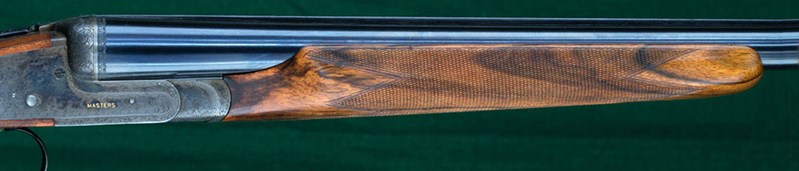
Photo courtesy Hallowell & Co.
The size of these forearms makes it easier to hold and control the firearm. Beavertail forearms are usually found on side-by-side shotguns and rifles that have heavy recoil. The shape of the forearm has a larger surface area than other types of forearms for a firm grip to minimize recoil and fatigue of the shooter. Not only do beavertail forearms have a broader gripping area for better control, but it also adds extra weight to offset the felt recoil when the firearm is discharged.
Splinter Forearm
Splinter forearms are very small forearms. They are very thin and shallow and, from the side, resemble a splinter of wood. The purpose of these forearms is to keep the barrels on the receiver of the shotgun, not necessarily for gripping.
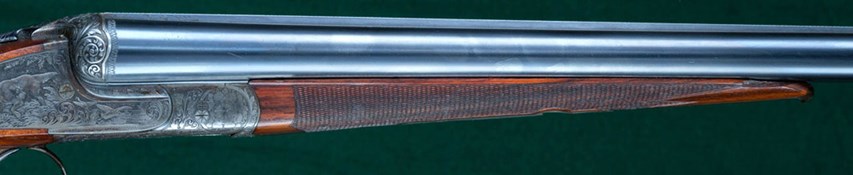
Photo courtesy Hallowell & Co.
Splinter forearms are often referred to as English style. The proper way to hold the splinter forearm is to not grip it. The small design of the forearm allows the shooter to grasp the barrels just ahead of the splinter, after all, the closer a shooter’s hand is to the bore and line of sight, the better he or she can maintain hand-to-eye coordination.
Schnabel Forearm
Schnabel forearms are considered the most elegant forearms. This type of forearm can be found on over-under shotguns, single-shot firearms, and rifles. It is very sleek and maintains a tight profile for easy gripping by the shooter. It is named for its shape: a thin, flared, downward curve. It is said to resemble the beak of a bird.
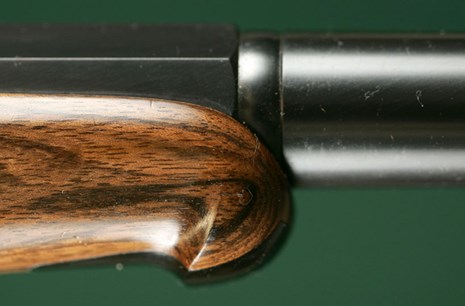
Photo courtesy Hallowell & Co.
Schnabel forearms can have a slight flared appearance or an obvious pronounced one. This type of forearm that is generally preferred by individuals who participate in clay shooting or upland game bird hunting, as the design enables the shooter to make quick shots while maintaining enough grip to allow for a fast follow-up shot if necessary. The Schnabel forearm is larger than the splinter forearm and smaller than the beavertail forearm.
Comb
The comb, considered the top of the rifle or shotgun’s stock, is where the shooter rests his or her cheek when shooting. The comb can be the top of the stock that is straight or the comb could have a pronounced and raised portion.
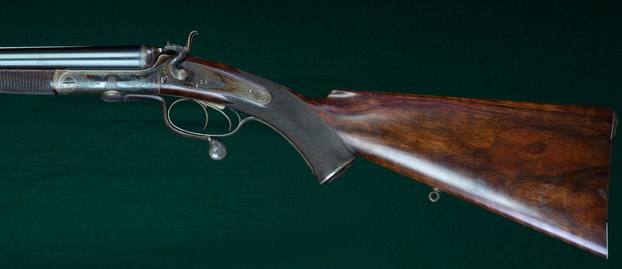
Photo courtesy Hallowell & Co.
The comb is vial to ensuring the shooter’s eye is in line with a rifle’s sights or a shotgun’s barrel(s). A comb is found on every long gun. Some modern firearms, especially synthetic stock firearms, have adjustable combs, allowing the shooter to customize his or her comb.
Shadowline Cheekpiece
Shadowline cheekpieces are raised cheek weld points that rise out of the right or left side of the stock. This is unlike a comb that rises out of top of the stock. Shadowline cheekpieces are designed to get the shooter’s eye to the firearm’s sights naturally and smoothly, almost an automatic and instinctive move, once the firearm is properly mounted.
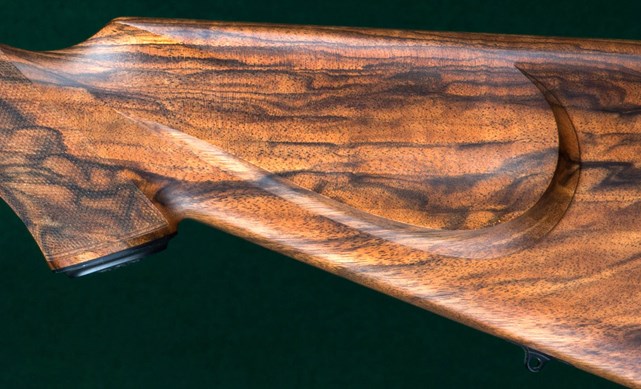
Photo courtesy Hallowell & Co.
The shadowline cheekpiece has very distinct and sharp angles and lines as opposed to rounded cheekpieces. The cheekpiece goes from a sharp outer edge and elegantly curves in a smooth concave arch to the stock. The shadowline cheekpiece is usually found on high-end and custom firearms.
Monte Carlo Stock (Comb & Cheekpiece)
Monte Carlo stocks indicate a particular style that incorporates a specialized comb and cheekpiece. Even though this style of stock usually incorporates both the Monte Carlo Comb and the Monte Carlo Cheekpiece, they are still referred to separately. This type of cheekpiece and comb combination starts on the side of the stock like a shadowline cheekpiece and continues to the top of the stock, ending in a raised comb.
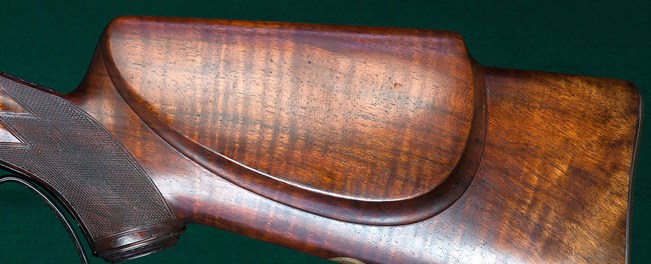
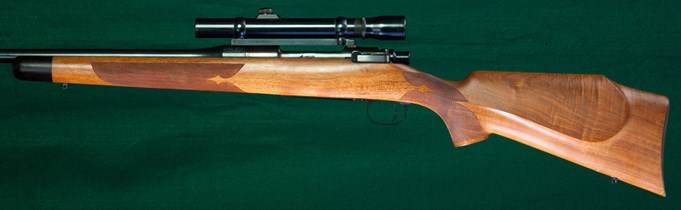
Photos courtesy Hallowell & Co.
The Monte Carlo Stock are found on high-end and custom firearms. It is designed for scoped rifles to get the shooter’s eye higher for scope alignment. It is also used on trap and skeet shotguns to get the shooter’s eye higher for a high point of impact.
Weatherby California Stock
Roy Weatherby introduced his “California Style” gun stock in the late 1940s, taking existing designs and melded them into a distinct design. The stock was made from high-grade California Claro walnut with a high-gloss finish. These stocks also incorporated a pronounced Monte Carlo stock (comb and cheekpiece) with a slim and very high comb.
Weatherby California stocks were considered the flashiest and most recognizable stocks. The stocks were designed for ergonomics to help reduce the recoil of the extremely powerful cartridges that he designed.
We live in a world of mass production. This also applies to firearms; many of which lack the soul of the older works of art. Numerous firearms today have machined actions made with inexpensive resin used for the stock. Fortunately for the gun buyer, he or she can still find both new and older guns that tell a story in the grain of their stocks. The older guns had character and distinct shapes. Anyone who has acquired this knowledge usually has an eye to identify a Mannlicher-Schoenauer or a vintage Weatherby from across the room, just buy the shape of the stock.
The new synthetic guns also carry some of the distinct shapes that grace new and older walnut stocks. As such, the terminology that we commonly used in the past is still used today.
—Heidi Lyn Rao