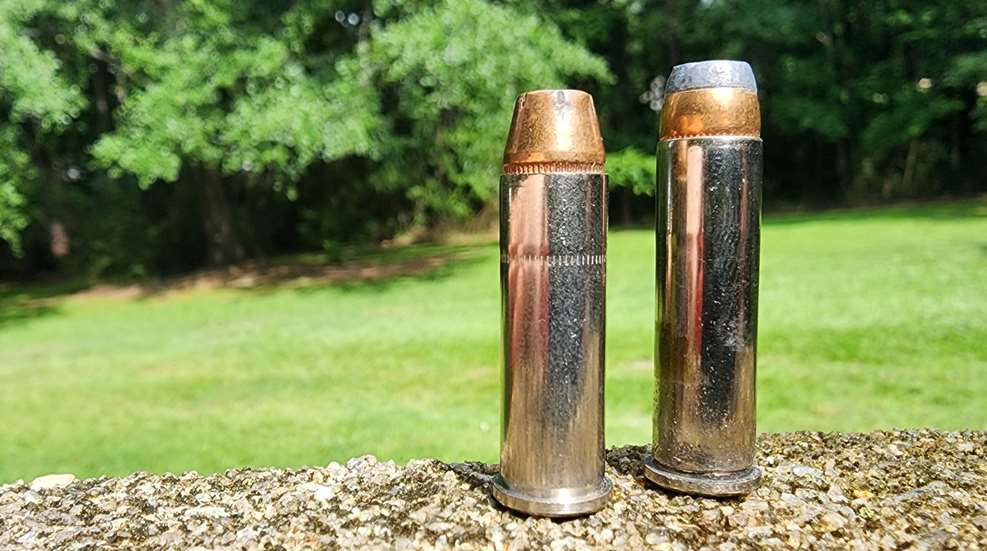
The .357 Magnum and the .38 Special are two of the most popular revolver rounds on the planet, and they’re very similar. In fact, they fire the same size projectile. How did this come to be?
The .38 Spl. actually came first, developed in 1898. It shoots a .357-cal. bullet. Over the years, we got better at making higher quality steel and better gunpowder, and in 1934, gun writers Elmer Keith and Phillip Sharpe added more smokeless powder to the .38 Spl. case and created the .357 Magnum. That little bit of extra powder gave the round considerably higher (double in many cases) muzzle velocity, better penetration and more recoil. It also created more pressure that .38 Special guns didn’t handle well, so the case was redesigned to be a bit longer to accommodate, and new guns were built to fire the longer, higher-pressure round.
So, .38 Special rounds and .357 Magnum rounds are the same diameter and fire the same size projectile, but the .357 Mag. is longer and a good bit more powerful. Because of this, you can safely fire the smaller .38 Spl. round out of a .357 Mag. handgun, but the reverse is not true: DO NOT fire a .357 Mag. round out of a .38 Spl. gun.
That being the case, which gun should you buy? It depends. By their nature, .38 Spl. guns can be made smaller and lighter, which is an important consideration if you’re going to be carrying this gun concealed. Just keep in mind that the lighter the gun, the more felt recoil you will experience. Guns chambered for .357 Mag. will generally be a bit larger and heavier, which will help you manage recoil, but might make the gun a bit more cumbersome to conceal.
The major advantage of the .357, aside from the extra velocity and penetration, is that you can shoot .38 Spl. loads out of it for practice and get the benefit of considerably less recoil, then load the gun up with .357 Mag. loads for self-defense. Be sure to shoot the .357s occasionally to make sure your chosen defense load works well in your gun.
Bottom line: Because the two cartridges are the same diameter and shoot the same size projectile, you can safely fire .38 Spl. ammo in a gun that’s marked .357 Mag. You cannot safely fire .357 Mag. ammo in a gun that’s marked .38 Spl. Generally, it’ll be too long to fit, but if it does and you make the mistake of firing it, you could have a serious gun malfunction or worse on your hands, because the .38 Spl. gun is not built to handle the pressure generated by the .357 Mag. round.