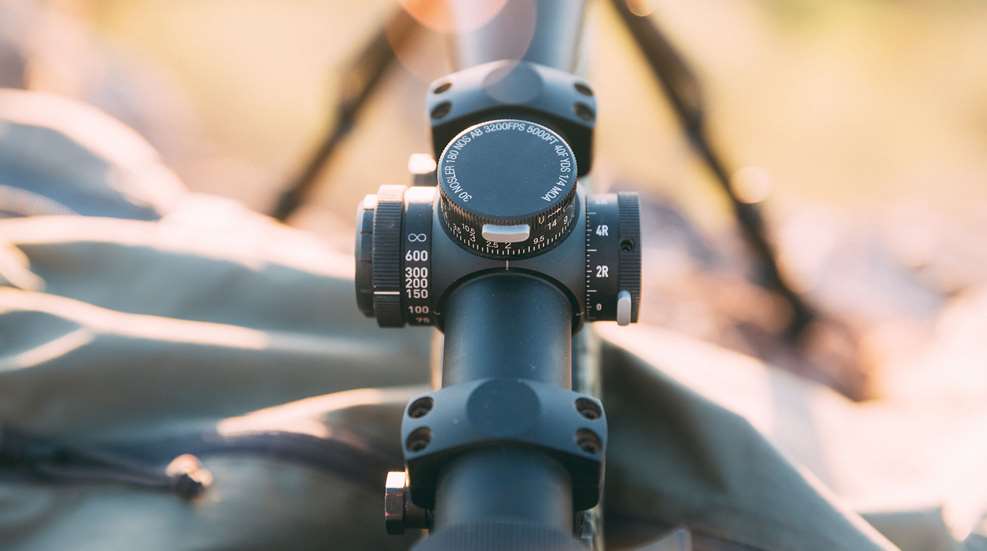
When we shoot at long distances, we use an angular unit of measure to measure size. Imagine a slice of pie, where the shooter is at the center of the pie and the target is at the edge of the circle—the pie crust. The amount of crust you get on your slice gets bigger and bigger as the pie gets bigger and bigger. That’s essentially what we’re talking about: how you measure something that’s getting larger the farther out it goes.
Just like inches and centimeters are used to measure straight-line distances, milliradians (mils) and minute of angle (MOA) are used to measure an angle within a circle (or the length of an arc at the end of a circle—the size of that pie crust). And you thought you’d never use that high-school trigonometry class again, didn’t you? Fortunately, ballistics apps do most of the math for us these days, as long as you understand the data you’re putting in and they’re spitting out.
Mils are used by most of the world and the U.S. military, while MOA is popular among civilian U.S. shooters. Every shooter will have their favorite, but it’s smart to understand both. And to do that, you’re going to have to get into a little math.
Getting Started
When you first start learning how mils and MOA work, your brain will want to convert everything back to inches, because that’s the measurement you’re comfortable with. Being able to do that calculation is very handy because it lets you measure either the size of something if you know the distance, or the distance to something if you know its size. For example, if the average man is about 70 inches tall, and you’re looking at a man through your scope (as in the case of military snipers), and you use your scope’s hashmarks to figure out the man measures seven MOA, you know he is approximately 1,000 yards away from you. More on that math in a minute.
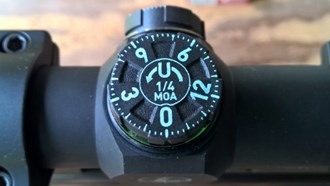
The more you use your chosen measurement, the more you will begin to think in mils or MOA and leave inches mostly out of the picture except when necessary. I personally found it easier to stop trying to take everything back to inches and just embrace thinking in MOA once I got a handle on it.
MOA Math
One minute of angle is 1.047 inches at 100 yards. That means it’s 2.094 inches at 300 yards, 3.141 inches at 300 yards, 10.47 inches at 1,000 yards, etc. In all but the most serious precision shooting, we generally just round down to 1 inch at 100, 2 inches at 200, 10 inches at 1,000, etc. The farther you shoot, the bigger your groups will be in inches—but they can stay the same in MOA if you’re a good shooter. When you buy a rifle that has a sub-MOA guarantee, it means the rifle is capable, under the right conditions and using the right ammo, of putting all its shots in a circle of less than 1 inch at 100 yards and less than 10 inches at 1,000 yards.
Mil Math
One mil is .1 meter or 10 centimeters at 100 meters, which is 3.937 inches at 100 meters. But because we generally think in terms of yards and not meters, what you probably want to know is that 1 mil is 3.6 inches at 100 yards, and you just multiply from there: 7.2 inches at 200 yards, 10.8 inches at 300 yards, 36 inches at 1,000 yards, etc. Because mils are so much bigger than minutes of angle, shooters often speak in terms of tenths of mils, usually expressed as “points,” so a common wind call might be “.4 left,” meaning the shooter should hold four-tenths of a mil to the left. At 100 yards, that’s 1.44 inches.
Going Back and Forth
If you ever need to go back and forth between mils and MOA (although I can’t recommend torturing yourself like that), the formulas are simple. One mil is 3.43, so MOA is converted to mils by dividing it by 3.43. Mils is converted to MOA by multiplying by 3.43.
Which Is Right for You?
Whichever system you learn first might end up being your favorite just based on familiarity—this is the case with me. I first learned serious long-range shooting using MOA, and it’s still my go-to system. However, because of that whole rounding thing where we take 1.047 inches down to 1 inch at 100 yards, MOA can get less and less precise the farther you shoot. If you’re shooting at 2,000 yards, that 5% rounding error represents an entire inch. That might or might not matter to you.
For me, I like the easy math of 1 inch at 100, 2 at 200, etc. Mil math is more difficult to calculate inches at distance (who can multiply by 3.6 in their head?), but it’s easier in a different way—because it’s metric and therefore based on 10s (1 mil is 10 centimeters at 100 meters), all you have to do is move the decimal point. One-tenth of a mil is .36 inches at 100 yards; 10 mils is 36 inches at 1,000 yards. MOA makes more sense to me, and I don’t shoot much past 1,000 yards, so I stick with MOA most of the time. Hunters in the U.S. will generally choose MOA because their distances are shorter and they might want to easily and quickly do angle-to-inches math.
Both systems are great. Mils are more widely used across the world, and they can be more precise at very long distances. If you really don’t have a preference yet, use what your friends use—if you shoot with buddies who spot for you or who you just like to hit the range with, it’ll be a little easier to communicate if you’re all speaking the same language. Otherwise, both systems work well once you understand them. My advice is to familiarize yourself with both before you settle into a favorite.