
Whether you’re new to shotguns completely or you’re a shooter who wants to invest in a waterfowl-specific model, shopping for your first duck-hunting shotgun can be intimidating. Prices are all over the place, and you might wonder if some of the touted features fall into “Do I really need this?” territory. What do you need to know? Here are the decisions you’ll have to make, in order of importance.

1. Price
Go ahead and get a budget in your head, but keep it flexible for now. You can get a shotgun that’ll do the job for as little as $300, or you can spend $3,000 or more for the latest whiz-bang model with all the bells and whistles your little heart desires. The rest of this article will explain how each choice affects the price, so you can decide what’s worth paying more for and what’s not.
2. Semi-automatic vs. Pump
Do you want a semi-automatic or a pump-action? Semis have considerably less perceived recoil and are simpler to shoot—just keep pulling the trigger for follow-up shots—but are a little more complicated mechanically, which requires some extra cleaning. They’ll also usually be a little more expensive than a pump-action. Pump guns come with an extra step built in (you must pump the action before you can shoot again), but they’re less prone to hanging up or jamming as long as you do your job properly. Plus, they tend to be cheaper and they’re generally quite durable.
Wild card: Over-unders and side-by-sides are also an option, but they come with some quirks and limitations that make them, in my opinion, not the best choice for new duck hunters.
3. Inertia vs. Gas
If you go with a semi-auto action, you’ll need to decide if you want an inertia-driven action or a gas-operated one. Inertia guns have a bit more perceived recoil than gas guns, but gas guns are a little more finicky about being kept clean. In the dust and muck of the fields and marshes, that matters. Inertia guns tend to be slightly less expensive than gas guns in many cases. You won’t go wrong with either, but you should know the difference and choose based on what’s more important to you. Read more about it here.
4. 12 vs. 20
A 12-gauge shotgun shell holds more pellets than a 20-gauge. More pellets flying through the air means harder hits and a greater chance that at least one “magic golden pellet” will impact the target. The 12-gauge kicks substantially harder, however, because it’s pushing that bigger payload. Most hunters will eventually settle on the 12-gauge, but there’s nothing wrong with a 20 if you want to reduce recoil and carry a gun that’s smaller and lighter overall. Do be aware that 20-gauge ammo tends to be more expensive than 12-gauge ammo.
Wild card: Do you need a 10-gauge for geese? Should you go down to a 28-gauge to save even more recoil? In my opinion, for your first gun, absolutely no to both questions. The 10-gauge is overkill for everything (although I have killed turkeys with it) and the 28-gauge is sort of a specialist’s gun. Go with a 12 or a 20 for your first waterfowl shotgun.
5. 3-inch vs. 3½-inch
Assuming you go with a 12-gauge, you have three choices for chamber length: 2¾-inch, 3-inch and 3½-inch. You can shoot shorter shells in a longer chamber (2¾-inch shells in a 3½-inch gun, for example) but you cannot shoot longer shells in a shorter chamber. The longer the shell, the bigger the payload and the more the recoil, all else being equal.
There’s no need to limit yourself by buying a gun that only chambers 2¾-inchers, but the 3-inch does the job just fine. You can go with a 3½-inch chamber if you really want the ability to shoot longer/heavier shells, but be aware that some 3½-inch semi-auto guns don’t cycle 2¾-inch shells well, which could be a problem if you plan to hunt doves or shoot sporting clays with this gun. A 3-inch chamber is a great all-around compromise, and it’ll generally save you a little money over a 3½-inch gun.
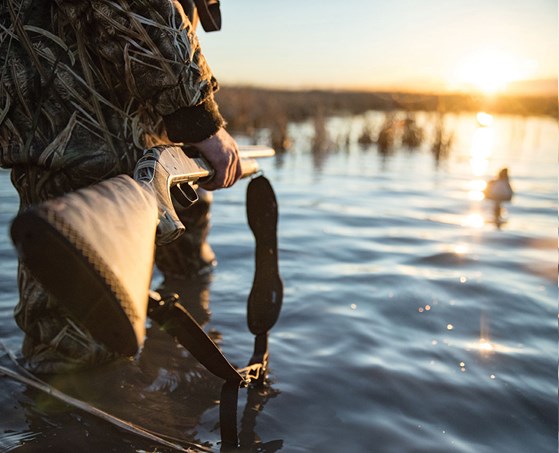
6. 26- vs. 28- vs. 30-inch barrels
Longer barrels swing more smoothly, which is really helpful on fast-flying ducks. Of course, they’re also pretty unwieldy in the confines of a pit blind or layout blind. Shorter barrels can feel whippy or make the gun feel unbalanced, although they’re easy to maneuver in tight spaces. Barrel length doesn’t really affect price, so the ideal compromise is the middle-of-the-road 28-inch barrels.
7. Camo vs. Black vs. Wood
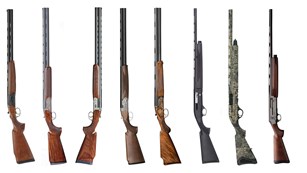
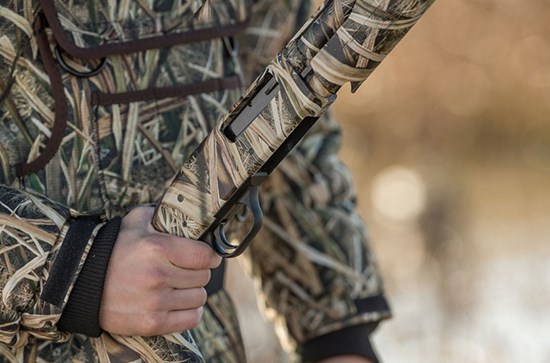
The finish on the gun is a matter of aesthetics but also a matter of function. Wood and blued steel is traditional and beautiful, but duck hunters are hard on their guns, and wood and steel require frequent cleaning and are going to take a real beating in the duck blind. Unless you just really, really like the classic look and you don’t mind babying the gun a bit during or after the hunt, stick with a synthetic stock. Does it need to be camo? Absolutely not. Camo looks cool, and you could maybe argue that it helps you hide from waterfowl a fraction of a second longer, but it’s mostly a marketing pitch.
What does make a big difference when it comes to the finish is a protective coating, like Cerakote or Benelli’s BE.S.T. Good coatings provide protection from the elements and the rough conditions of the outdoors, and they help stave off rust and corrosion. If you hunt in salt water, this is even more important. Buying a gun that has a protective coating on the receiver and barrels will cost you some extra money, but it’s a good idea if it’s in the budget. Whether the coating is solid or camo is up to you (camo will usually cost a little more).
8. Sights & Chokes
A simple white bead on the end of your shotgun will suffice, but many duck guns come with fiber-optic sights that are easier to see in lower light. Some people find this helps their shooting, while others find it distracting—you’re not supposed to be looking at the sight while shooting moving targets, after all. This is a personal choice and is not a deal-breaker if you like a gun that doesn’t have your preferred sights. It’s pretty easy to switch them out with aftermarket parts.
The same goes for choke tubes. Waterfowl-specific shotguns will come with interchangeable choke tubes, typically with three or five included. These are all good enough for hunting, and you don’t need to invest in aftermarket choke tubes to have success as a beginner (or ever, really). The only thing to really pay attention to here is if you already own other shotguns and you’d like to be able to share choke tubes between them—there are a handful of different choke-tube threading systems by which they attach to barrels, so if you want your new gun to be able to share chokes with guns you already own, buy one that uses the same threading system. I wouldn’t pay extra for gun that comes with extra choke tubes or name-brand tubes. The standard IC, modified and full will take you far as a beginning shooter. You can always upgrade later.
9. Manufacturer-Specific Features and Warranty
Some manufacturers make a big deal about lengthened forcing cones in their barrels, which helps improve patterns. This isn’t a huge deal for your first gun, so don’t get too hung up on it. Some manufacturers might have proprietary coatings or camo patterns. Others put the gun’s safety in a different position—behind the trigger or on the tang of the shotgun. This only matters if you’re already a shooter and you’re used to (and prefer) a specific position.
Do pay attention to the manufacturer’s reputation and the warranty they put on their guns. A gun from one of the major brands might cost a little more. No-name guns might be less expensive, and many of them are great—but if you have problems down the road, it could be more difficult to use that warranty or to find an authorized dealer of that brand who can work on the gun. Overall, shotguns are pretty durable and most gunsmiths can work on any brand, so I wouldn’t spend more than a few extra dollars for a better warranty or a lot of name recognition if all else is equal.
10. Price Again
As you’ve gone down this list, you might have realized that you need more features or different options than you thought, and maybe your original budget was unrealistically low or even too high for what you actually need. Do you need to reevaluate your price point or trade off some features you thought you wanted? Maybe save up for another season or give up that camo finish in favor of a cheaper but very serviceable plain-Jane gun?
Don’t forget that buying used is always on the table. This can be an especially good option if you’re not too particular about many of the choices we brought up in this article. If you could go either way on chamber length, color/finish and the sights and chokes, cruise the used-gun rack at your local sporting goods store regularly and keep an eye out for 28-inch-barreled 12-gauge semi-autos. Read our guide to buying used guns so you know how to not get ripped off—you might find your perfect duck gun waiting for you at a great price.