
f you’re not familiar, a “button buck” is a young buck—just a few months old—who hasn’t yet grown visible antlers. By the time hunting season rolls around, he’s lost his spots, so he no longer looks like a fawn. In fact, he looks a lot like a doe, and if you mistake him for one, you’ll be the butt of camp jokes and you’ll have taken out a potential future trophy.
This happened to me years ago, and it remains one of the most embarrassing moments in my hunting career. I’d been invited to hunt on a friend’s father’s property—a beautiful place that was very well managed, with extensive food plots, carefully maintained shooting houses and a rule to only shoot does and 8-point bucks or larger. I was sitting by myself overlooking a greenfield, and it was getting late in the season and we had no venison in the freezer, so I was planning to shoot a doe. I was a relatively inexperienced hunter at this point, but I was a good shot and had my binos along to count antlers if I needed to.
In the middle of the afternoon, a single deer walked out of the treeline and went straight to the center of the field, feeding about 150 yards from me. It was clear it had no antlers, so I waited a few minutes deciding if I really wanted to shoot a doe or if I wanted to hold out for a big buck. The promise of venison convinced me pretty quickly, and I shot the deer. It ran just a few steps and piled up with that white belly facing toward me. I sat in the stand for hours, until dark, when the landowner drove out to pick me up.
He was excited for me, but as we drove up to the deer and the headlights illuminated that white belly—and the rest of the anatomy—it was obvious that I’d actually shot a buck. And it was much smaller than I expected; small enough that I picked it up and heaved it into the back of the truck by myself. Sure enough, a quick inspection of the top of its head revealed two little nubs still covered by hair—the very beginnings of antler growth.
The landowner was disappointed and unhappy, but he tried very hard to not let me know it; shooting young bucks was definitely not good for his herd management plan. I was disappointed in myself, and to add insult to injury, I took the deer to a processor (I wasn’t set up to process my own venison at the time) and paid an $80 processing fee to get just 12 pounds of meat back!
Looking back, I did several things wrong and ignored a handful of clues that the deer in the field was actually a young buck.
Button bucks travel alone: Does tend to travel in groups, while button bucks are frequently alone. If you see an antlerless deer by itself, chances are good that it’s actually a young buck.
Button bucks are careless: Does are cautious and wary. They move slowly, pausing to look around and listen and smell their surroundings before taking a few more steps and pausing again. Young bucks, on the other hand, much like young humans, are carefree and reckless because they haven’t learned to be cautious yet. The fact that my deer walked straight out to the middle of the field without so much as sniffing the air should have been a huge clue that he was very young.
Button bucks are, obviously, smaller: Because button bucks are often alone, you might have no way to compare two deer side by side. If a mature doe had been in the field when my button buck walked out, it would have been extremely obvious how small he was. The fact that he was alone was a clue in itself, but it almost made comparison impossible. If you are watching a solitary antlerless deer, strongly consider waiting until more deer show up before you make the shoot-or-no-shoot decision.
But be careful, because the size-comparison thing has one caveat. If you see just two deer by themselves, and one is slightly larger, inspect both carefully—it could be a pair of fawns, and the larger one is typically the button buck.
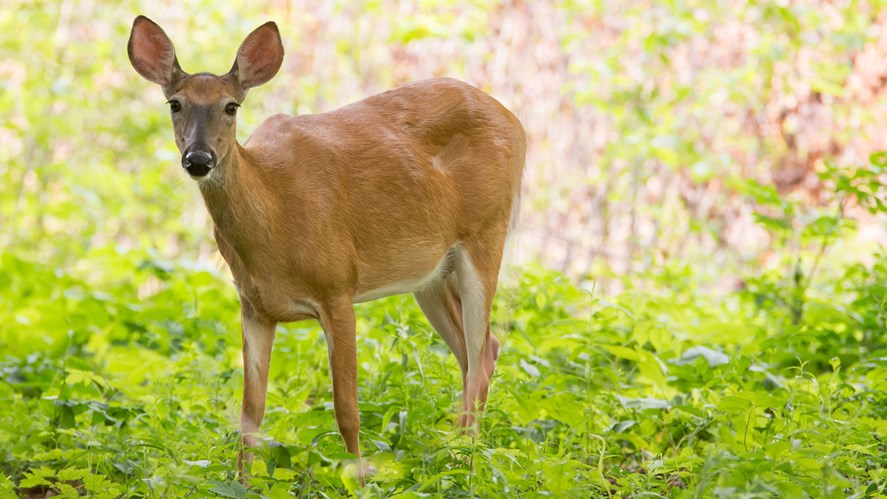
A doe’s head tends be rounded between the ears, like the one shown here, while a button buck’s head will be more flat.
Button bucks have flat heads: A doe’s head tends be rounded between the ears, while a button buck’s head will be more flat. In some cases, tiny antlers an inch high might be visible, and if not, he might have dark spots on the top of his head where the antlers are starting to form under the hair. Use your optics to study the deer’s head carefully to look for those tell-tale signs of antler growth.
Button bucks look compact: They’re shorter and smaller than mature does, obviously, but they’re also sort of squat and square, while a doe’s body will be more rectangular. A doe’s face will look sort of elongated, but a button buck’s is shorter and more compact, so much so that its ears might look too big for its head. Again, you often will not have the luxury of comparing a button buck and a doe side by side, so the best way to get good at identifying them by body shape is to spend a lot of time studying what does look like. The more familiar you are with the characteristics and mannerisms of a mature doe, the easier it is to spot when an antlerless deer doesn’t seem to fit the pattern.
When in doubt: Check your local laws, but in most if not every state, shooting a button buck is not illegal. What we call “doe season” is actually, technically called “antlerless deer season” in a lot of states for this reason. There’s nothing really wrong with shooting a button buck if it’s legal and it’s not frowned upon by whoever manages the property you’re on, but most hunters prefer not to shoot young bucks because the meat yield is low and because it eliminates a future potential trophy. If you see a deer by itself, particularly one who acts more curious than cautious, give it a very careful evaluation with your binoculars, because you might very well be looking at a button buck. When in doubt, don’t shoot.