
There’s no doubt that a firearm is the most effective threat-stopping self-defense tool, but when you’re traveling—especially by air, and especially overseas—it’s not always an option, or at least not a practical one. You can fly (domestically) with your concealed carry handgun in your checked baggage, but if the state you’re going to doesn’t recognize your permit or the hotel/resort you’re staying at doesn’t allow firearms, you’ll have to leave your gun behind and choose another tool for self-defense. What are your options?
Pepper Spray
This is probably your best bet, and you’d be well-served to carry it in your everyday life in addition to your gun. It has the benefit of stopping a lot of encounters without being considered lethal force and carrying all the legal ramifications that come with that. NRA Women has covered this topic pretty extensively, so I won’t elaborate too much other than to note three things:
- Make sure pepper spray is legal wherever you’re going.
- Practice using it at least once (buy two; one to carry and one to practice with).
- TSA and the airlines have specific rules regarding flying with pepper spray, including size restrictions, so check those out before you fly.
Noise Makers and Attention-Getters
Whistles, personal alarms and other tools designed to get attention can be helpful only in certain situations—when other people are around. That said, they are legal just about everywhere in the world, they’re inexpensive and easy to carry, and there are no restrictions on flying with them, so there’s almost no downside to having one.
Blades
You can fly with a knife in your checked baggage, and again, we’ve covered the subject of blades for self-defense in another article, so check that out here. You’ll want at least a little training in using knives to defend yourself, as knife fighting is a messy, intensely intimate endeavor.
As with everything else on this list, research any restrictions before you go. Many cities and states limit the length of a blade or restrict certain types of knives, and there are plenty of places that don’t allow them at all—schools and universities, government buildings, etc.
Flashlight
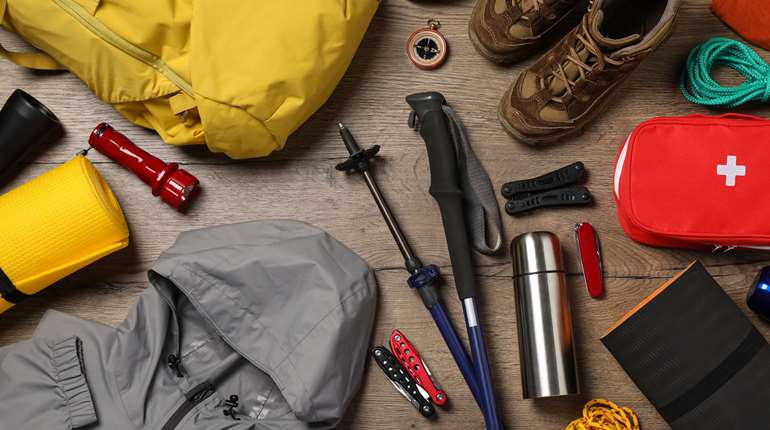
I don’t know of anywhere in the U.S. where a flashlight would be illegal. Aside from its obvious purpose of illumination (helpful in a defense encounter by itself), a big honkin’ flashlight can serve as an improvised striking tool. You might not carry it around, but it could be an option for keeping in your hotel room. Pack it in your checked baggage because TSA limits the length of all “tools” to 7 inches.
Pick a plain-Jane model, not a tactical one that has glass-breaking bevels or other “hey, this is great for hitting people!” features, particularly if you’re traveling overseas. Some countries with super-tight weapons restrictions might consider a heavy flashlight a weapon if you’re carrying it in public with no obvious purpose, so be aware of this. Again, a little research before you travel will go a long way.
Impact Tools
This is a broad category that includes everything from baseball bats to blackjacks, and there’s a huge variation in what’s legal where. It’s probably impractical to travel with a baseball bat or a golf club, but small impact tools can be useful if you have a little training in their use and if you are willing to wield them with considerable force.
Blackjacks and saps are similarly designed tools that are basically a slightly flexible wand/grip with a weight on the end. They’re designed for striking, and they are illegal in many states, so again, do your research. It’s also important to know that they’re considered deadly force in lots of jurisdictions, so you must use them as judiciously as you’d use a firearm or a knife. The same can be said of collapsible batons, which are legal in some places, illegal in other places, and permitted as long as you don’t conceal them in some states.
Kubatons and tactical pens can be used as force multipliers, but only if you really know what you’re doing or if you get lucky with a strike to the right area. The simplest kubatons are just little blunt sticks, often on a keychain, so they’re not likely to be restricted in most places, and tactical pens even less so. Still, check before you go. Neither is technically allowed in your carry-on bag, but they’re permitted in checked baggage. I put kubatons and tactical pens in the last-ditch-effort category and don’t carry one myself, because frankly, I’m totally untrained in physical fighting and I don’t think a five-inch stick would somehow make me any better at it.
Brass knuckles and cat-eye or stabby-cat keychains are in a similar category in that you need to be capable of exerting a certain amount of force on your own before they’re really useful. They are legal to own in about 30 states, but some states consider them a concealed weapon and require a permit to carry them. Overseas, you can mostly forget about it.
Tasers and Stun Guns
These are notoriously unreliable and difficult to deploy, so I put them in the “guess they’re better than nothing” category. Any number of things can render a taser ineffective—everything from your aim to the attacker’s physical and mental condition to how loose his clothing is—and stun guns require direct physical contact with skin. They’re just difficult to deploy and use effectively.
You can pack a taser in your checked baggage, but like most things mentioned in this article, their legality varies by state and country, so do your research.
Incognito Tools
Like the flashlight, there are some ordinary items that can be used as striking tools without looking like weapons at all. A coin purse, when full of nickels, can be surprisingly heavy—but be careful with the leather coin purses designed with a little carrying strap that are marketed as totally-not-a-weapon-wink-wink. Some jurisdictions will consider them blackjacks.
A (long, sturdy) umbrella is just an umbrella and a cane is just a cane, but both could be used as striking weapons if needed. Again, if it’s not raining or you don’t have a limp, this probably isn’t something you can carry, but it would be more of a hotel-room tool. And keep in mind that long tools like this are easy to swing, but they’re also relatively easy for the bad guy to grab and snatch away from you. Because of this, pretty much all striking tools are, in my opinion, mostly good for buying you a few seconds to escape rather than truly disabling the threat.
And don’t forget that heavy metal water bottle or tumbler you’re constantly carrying. It adds considerable weight and force if you should have to swing it at someone. I have a smaller, 12-ounce metal water bottle on a wrist lanyard that I carry around on vacation because it fits in a small crossbody purse, and it would be easy to swing.
Just be careful here that whatever you’re carrying around has a practical purpose that makes sense. In certain places, particularly overseas, you could get in trouble for having a “weapon” if you walk around with, say, a hammer when you’re obviously not building anything.
What I Do
When I travel without my gun, if I have checked a bag, it usually has a folding knife in it. I carry the knife when I get to my destination if it’s legal to do so, but mostly the knife is there for small cutting tasks like opening boxes. I am not trained in self defense with edged weapons.
I also keep a simple wedge-shaped doorstop in my toiletry kit, so I always have it when I travel. In addition to the hotel door’s deadbolt, a doorstop could buy me a few seconds to react if a bad guy tried to kick down the door.
But the best self-defense tool when traveling is the best tool you have in your everyday life: simple, deliberate awareness of what’s going on around you and a little foresight and sense to keep yourself out of situations where trouble is likely to brew. Heading off trouble before it starts is your best bet anywhere you find yourself.