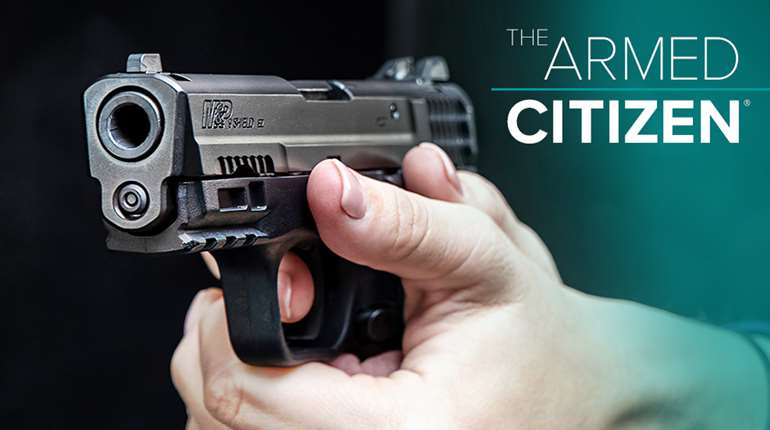

There are a few reasons why it’s beneficial to have as much hand strength as possible when shooting a pistol.
Control. You must control the pistol during recoil so that you can make faster and more accurate follow up shots. This is one of the primary goals of pistol shooting: hitting your target quickly when you need to.
You will control a pistol well by being able to manage the reciprocating mass of the firearm. And that’s true no matter which firearm platform you’re shooting. The part of the pistol for which you are controlling the reciprocating mass is the slide on a semi-automatic, and in a revolver, you’re controlling is the mass of the gun moving under recoil. Your technique will be slightly different for each, but this article will focus on semi-automatic.
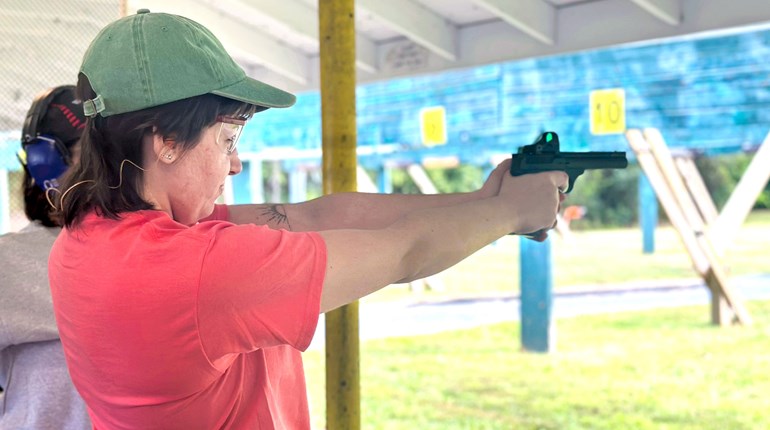
It’s important to have your hands as high as possible on the backstrap of the semi-automatic pistol, as close as you can get it to the point where the reciprocating mass is moving. This is why people will tell you to hold high up on the backstrap right under the beavertail. To do this and hold the gun so that you can control it, you need to be able to grip with your fingers, not necessarily your fingertips.
Exercise #1: Classic Grip strength, minus the fingertips
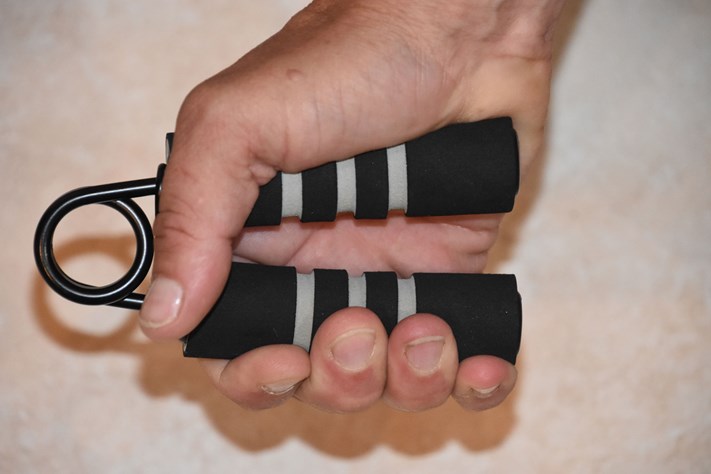
The first exercise is to build your grip strength in your whole hand. To accomplish this, you can get grip “exercisers,” or even do it with your steering wheel while you’re driving the car. Simply grip with the “meaty” part of your thumb, your palms and your fingers, trying not to engage your fingertips.
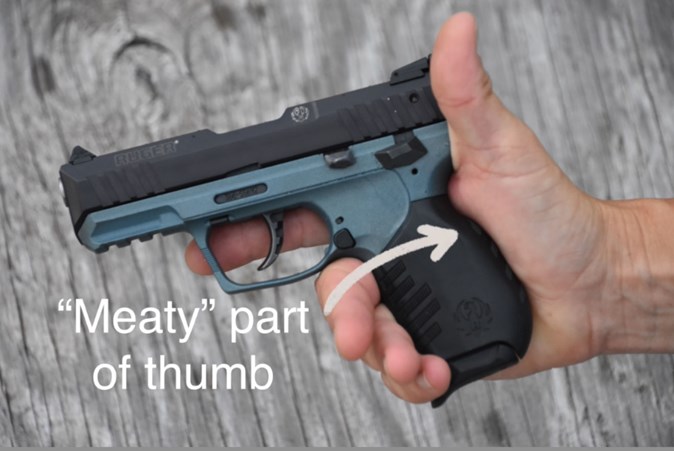
The reason you don’t include your fingertips is because when your hands are wrapped around the pistol, the fingertips tightening can induce sideways movement in the gun and move the gun/sights off the target.
This is why right-handed shooters who use their fingertips too much tend to have to have misses left or low-left, and left-handed shooters tend to have the opposite (right/low-right). As you squeeze the gun with your fingertips, it starts to pull sideways. To avoid that, grip with your fingers, pushing the grip back into your palm, below your thumb.
Exercise #2: clamshell or nutcracker motion
The second way to use your hands while gripping a pistol is to apply a sort of clamshell or nutcracker pressure. Think of it like it’s squeezing your palms together to apply pressure to either side of the pistol grip.
To do this, you can squeeze a foam ball between two hands. This involves more than just your palms, and you’ll feel it in your upper arms and chest as well. But it’s an area you should focus and have awareness of what pressures you are holding in your body in order to control the recoil of the pistol.
Exercise #3: Train your Fingers
A third way to prep your hands for control during recoil is by isolating your trigger finger from your other fingers.
You can train all your fingers’ strength with a rubber band or an extension exerciser. This just makes your proprioceptive muscles better controlled and more “aware.” Think of it like typing and how your hands need to do the work over time to be accustomed to the movements you will make typing. It’s not gorilla strength work; it’s fine motor skills. So while we want grip strength, we also want to condition fine motor skills.
You can practice training your fingers when you dry-fire. It is very beneficial to feel and see what happens with your fingers and what happens in your sights when you dry-fire. If you have not isolated your trigger finger from the rest of your fingers when you squeeze the trigger, and if you squeeze your fingertips, it can move your gun off target. It is helpful to isolate that movement to the trigger finger itself and move it rather than the other fingertips.
This is something I consider when I’m trying to shoot at very far distances, usually over 50 yards. I will focus on isolating the movement of that trigger finger so that I am not tensing up my other fingertips. It generally causes a more relaxed grip on the gun, and that’s OK. Knowing when raw muscular strength is required (6-round Bill Drill at 10 yards) as opposed to fine motor skills and finesse on the trigger (50-yard steel target) is a facet of pistol shooting of which every gun owner should be aware.
You don’t need to have “man hands” to control a pistol well, but you do have to put in some work to build not just general grip strength, but proprioceptive awareness and fine motor skills under stress. If you do these three exercises, you will find most manipulations (and shooting) of a pistol easier.