
All human beings have a formula that we run in order to evaluate our risk level in real time, all the time. Statisticians call it a “heuristic,” and self-defense experts call it an integral part of living life in Condition Yellow. Trouble is, the risk heuristic we run is based both on known factors and unconscious biases … and that means the formula is flawed. In a recent column about self-defense and situational awareness, we noted that “from a statistical perspective, men are far more likely to be physically violent towards women than the other way around.” That’s absolutely true according to these FBI statistics from 2018. What’s also absolutely true according to those statistics is that, sometimes, the “bad guy” is a girl.
If you look at this FBI chart, you’ll note a few things. First, that women accounted for 27 percent of overall arrests in 2018 … but once you sort for violence, the figures plummet to 23 percent of aggravated assaults, 12 percent for murder/homicide and 3 percent of rapes. What’s more, due to the way the justice system works, accomplices to crimes often receive the same charges as the actual perpetrator. And that’s where things get interesting for the woman who must defend herself against another woman. 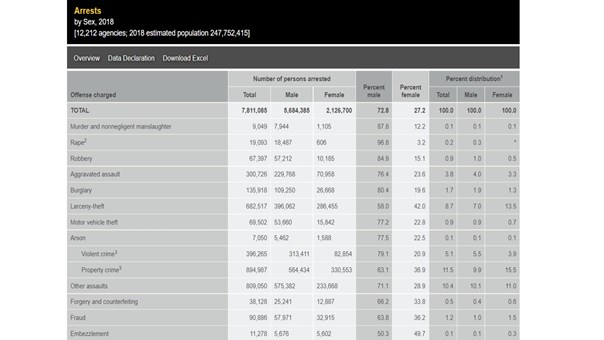
For illustration, I’ll turn to a recent crime story from Baltimore.
It started when Keith Smith and his wife, Jacquelyn, were stopped at a light. Smith claimed that a female panhandler who appeared to be holding a baby approached the couple and begged for money, which Jacquelyn supplied. At that moment a male accomplice appeared and stabbed Jacquelyn to death.
If the story stopped there, it would serve as a solemn reminder.
It seemed that what happened that night in Baltimore was a pretty good illustration of what frequently happens when women perpetrate crime—we tend to use what’s called “proxy violence.” This is for obvious reasons; most of us aren’t strong enough to decisively overpower a man (or many other women, for that matter). Therefore many female criminals employ a male accomplice to do the actual dirty work. That’s the usual pattern for “how” a woman may try to victimize you—by serving as lures or distractions, or simply by directing the action from the sidelines.
The “why” is almost as important as the “how.”
There are, essentially, two kinds of violence. There’s instrumental violence, which means that the violence is a means to an end. The classic example is the armed mugger who threatens you with a gun in order to get your valuables.
Then there’s the other kind … violence for its own sake, a.k.a. sadistic violence. The good news is that women who employ sadistic violence are extremely rare, and that violence of this type is almost always very personal. That means that if there’s a woman who means to seriously harm you physically for personal reasons, you probably already have an inkling.
But what was that about Baltimore?
As it turns out, Jacquelyn Smith was, in fact, harmed by a female perpetrator. It simply wasn’t who Keith Smith said it was. The “bad girl” wasn’t a panhandler at all, but Jacquelyn’s stepdaughter, Valeria Smith. Oh, Valeria didn’t wield the knife—her father Keith did that—but she did help him cover up his crime, so she’s an accomplice. Valeria made a plea deal in exchange for testifying against her father and received a five-year prison sentence. Keith Smith is doing life in prison.
Here's what to keep in mind.
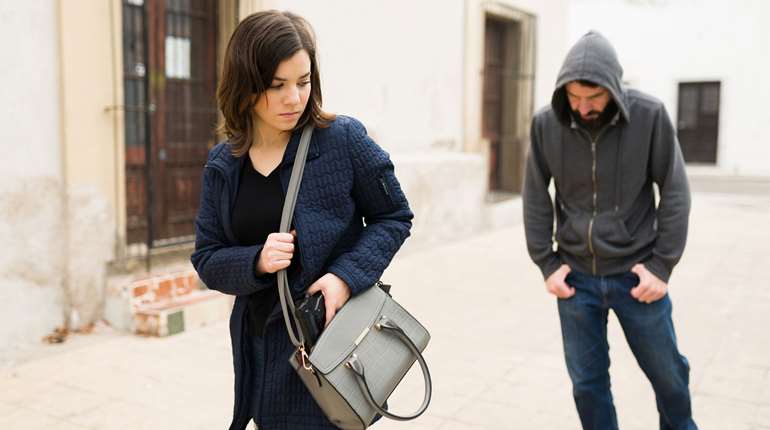
Both male and female criminals engage in what’s called an “interview process,” and your goal is to fail that interview. If a woman you don’t know approaches you and starts asking for things, she may be interviewing you and/or distracting you for a male accomplice. Keep a sharp eye out for women who make pleas for assistance that don’t make sense given the circumstances, but don’t just watch her. Watch her eyes—does she seem to be looking around you or over your shoulder at something out of your field of view?
Nobody is saying that you should never render assistance to a fellow woman in distress, but we are saying that you should employ a healthy level of skepticism. Being approached by a random stranger demanding things should cause your Condition Yellow to start shading into Condition Orange. We’re also saying that your first and best method of helping her—if that’s in fact what she needs—is to summon law enforcement. If she’s in danger, they are the best qualified to assist her. What’s more, her response to your offer to dial 911 for her will tell you everything you need to know about whether she’s scamming you or truly in a crisis.