
If you plan to hunt migratory waterfowl such as ducks or geese, and you’re 16 or older, you’re legally required to purchase a Federal Duck Stamp. You can do this at your local post office, at a sporting good store, or online. There are e-stamps available now if you don’t want or need a physical stamp, but the stamps are traditional and even collectible for many of us—I still have every duck stamp I’ve ever bought, going back about 15 years.
Why do we have the Duck Stamp in the first place? It started in the 1930s in the heart of the Dust Bowl, when serious drought conditions were devasting waterfowl populations as wetlands literally dried up. Concerned sportsmen proposed a fee on themselves, and in 1934, Congress passed the Migratory Bird Hunting Stamp Act as a way to generate funds for conservation and habitat. President Roosevelt signed it into law, and the program has been wildly successful. More than $1.3 billion has been raised since then, conserving more than 6 million acres of land within the National Wildlife Refuge System. A whopping 98% of every dollar generated from Duck Stamp sales goes directly toward acquiring and protecting wetland habitat and conservation easements. And that money is protected—legally, it cannot be diverted for other government use or unrelated projects.
Brush and ink drawings of Mallards by Jay N. "Ding" Darling/USFWS
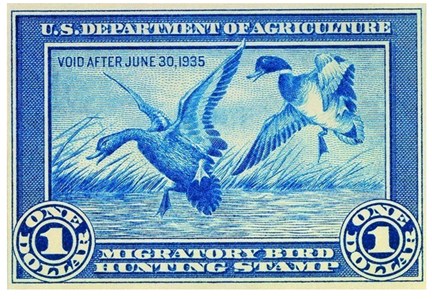
The Stamp has a storied history and has become an art form of its own. Back in 1934, Jay “Ding” Darling was president of the U.S. Fish & Wildlife Service. He also happened to be an artist, and he drew “Mallards Dropping In” as the design for the 1934 stamp, the cost of which was $1. More than 635,000 were sold that year. The USFWS commissioned various artists to design a new stamp each year for the first 15 years. Artists began submitting their work unsolicited, and it soon turned into an annual competition, and that tradition continues to today, with up to 300 artists entering submissions. There is no cash prize for the winner, but the artist retains commercial licensing rights to sell prints and license the image on commercial merchandise, which can be lucrative.
Around 1.5 million Duck Stamps are sold each year, and although hunters make up the lion’s share of sales, plenty of non-hunters buy one, too—about 25% of sales are to non-hunters. The program is such a success story that it’s also popular among bird watchers and other non-hunting conservationists, partly because it serves as a free pass into any national wildlife refuge that’s open to the public and partly because it’s such an excellent source of fundraising for habitat. Pretty much everyone loves the Duck Stamp and agrees that it’s a great program (name another government program we can say that about, huh?).
The Duck Stamp is a popular purchase among stamp collectors as well. A complete, mint-condition set of Federal Duck Stamps is valued between $7,500 and $9,600 today. Of course, the original 1934 stamp is the rarest and the most valuable. Hunters who use the physical stamp are required to sign their stamp in ink, which makes it virtually worthless as a collector’s item, so many hunters buy two—one for their collection and one to sign and hunt with. Today’s stamp costs $25. There’s even a Junior Duck Stamp program now to encourage young people to participate in conservation. It has its own art contest and its own printed stamp, which sells for $5. Proceeds from the sale of Junior Duck stamps goes to support recognition and environmental education activities for students who participate in the program.
Even if you don’t hunt, a Duck Stamp is an excellent purchase. For one thing, they’re just cool to collect. For another, they’re a wildly successful fundraiser for conservation that is universally supported by hunters and non-hunters alike. While the focus is on conserving habitat for migratory waterfowl, tons of other animals and birds benefit as well—from shorebirds and raptors to amphibians, reptiles and fish. Even songbirds, butterflies and native plants benefit from the habitat that’s been protected by Duck Stamp funds.
It’s important to note that many states also have their own duck stamps, with their own artwork and cost and legal requirements. You are required to purchase a Federal Duck Stamp if you are over 16 and planning to hunt waterfowl in the U.S., but your state might also require that you purchase a state stamp. Be sure to read up on it in your local regulations.
You can see a full gallery of Federal Duck Stamps, going back all the way to the original in 1934, here. The current 2025-2026 stamp features a pair of spectacled eiders, created by three-time winner Adam Grimm of South Dakota. The new 2026-2027 Duck Stamp will feature three buffleheads in flight, painted by James Hautman of Minnesota, and it goes on sale June 26, 2026. Consider buying the spectacled eider stamp before the new design comes out!