
If you normally drop your deer off at a processor to be butchered, but you’re interested in maybe butchering your next one yourself, I’m here to tell you not to be intimidated. You can make it as complicated as you want—and some people do—but at a fundamental level, it’s really pretty simple. I often say field dressing/gutting is as simple as “just get the insides on the outside” (with some caveats and helpful details), but butchering is the same—just keep cutting meat off the bone until there’s no more to get.
That said, even doing it the basic way is going to require a few essential pieces of gear, starting with the first job of gutting it and ending with a way to package the meat.
1. A Basic Hunting/Skinning Knife
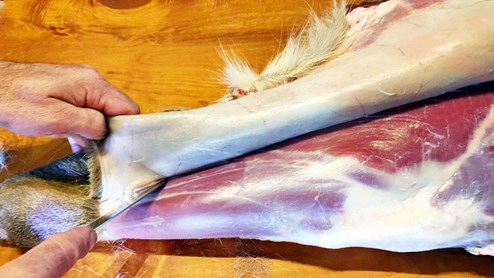
The first job when a deer is down is to field-dress it, and for that you’ll need a basic sharp knife that’s not too long. I use the same knife for field-dressing and for skinning, but some people prefer different knives for those two jobs, perhaps a knife with a gut hook for skinning and/or a small caping blade for skinning and caping if they are going to preserve the hide for taxidermy. But for a basic setup, the same knife will handle both chores.
Use a knife that feels good (i.e., comfortable and grippy, not slippery when wet) and make sure it is razor-sharp. Dull knives are dangerous.
2. A Gambrel or Other Way to Hang the Carcass
It’s not impossible but really difficult and messy to butcher a deer on the ground, so for easy access, you’ll want to hang the deer up. This is most easily accomplished with a gambrel, which is a little clothes-hanger-shaped metal device that lets you hang a deer up by the legs. You’ll also need a rope for this, and something to loop the rope over, whether that’s a tree branch or an eye bolt screwed into a beam in the garage ceiling. And you’ll need a way to cinch the rope down when the weight of the deer is on it. Many gambrels come with a pulley system to handle this, and you can get a gambrel-and-pulley system for less than $40. Take my advice: Don’t try to be cheap and skip the pulley!
3. A Boning Knife
Once you’ve skinned the deer, you technically can cut the meat off the bones with your skinning knife (if you do, wash it first), but the blade on many skinning knives is too short to get through the thicker muscles without having to peel meat back and make deeper and deeper cuts. A boning knife or any knife with a longer blade makes this job a lot easier, although you might still use your skinning knife for some parts of the job, like working around the ribs. Plus, you’ll find that once all the meat is off the bones and you’re trimming and cutting it up in the kitchen, a longer-blade knife is often more efficient and more comfortable.
4. A Big Old Cutting Board
The biggest cutting board you can find—my father actually uses a 3x4-foot piece of laminate countertop he saved off a jobsite, and it’s a great size. You’ll have lots of meat to cut up, and you’ll probably have multiple piles going at once, so the more space you have to work on, the better.
One thing I didn’t mention is trash bags or buckets. You’ll need something to put the meat in as you cut it off the bones, just long enough to transfer it to the fridge or to wherever you’ll be cutting it up. You probably already have some unscented trash bags or clean buckets you can use for this, so I’m not counting them in the five items on this list, but be aware that you’ll need them.
5. A Way to Wrap the Meat
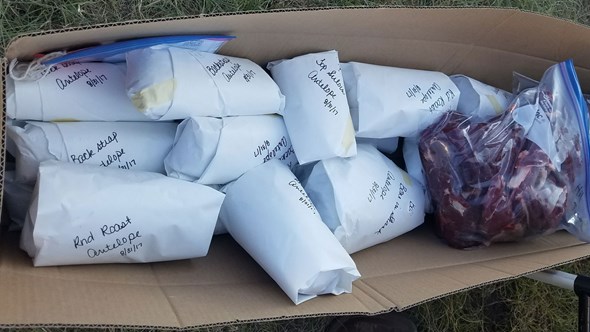
Once you have everything trimmed and cut up the way you want it, you need a way to wrap the meat to protect it from freezer burn. Regular old plastic zip-top bags work for a short time, if you get all the air out of them—try putting one pound of ground meat in a sandwich-size zip-top, then flattening it out like a square pancake that fills the bag. This pushes most of the air out, plus the meat stacks really nicely in the freezer and thaws out quickly when you’re ready to cook it. Still, these aren’t a great long-term solution, and they’re kind of expensive.
Instead, I recommend a combination of plastic wrap and freezer paper. Wrap the meat as tightly as you can in plenty of plastic wrap, pressing out the air bubbles, and then wrap it in a second layer of plastic wrap (this helps keep it from leaking in the fridge when you go to thaw it). Then wrap that in freezer paper and label each package with what it is—Stew Meat, 1 lb., Jo’s PA buck, 2025—and it’s ready for the freezer.
Other Nice-to-Haves
As mentioned before, some people like a gut hook for field dressing, and some even like the semi-controversial Butt Out tool—a plastic barbed thing you stick in a deer’s rectum. You twist it to make it grab the membrane, then pull it out, and with it comes the anal canal and all the unpleasantness that contains. The company who makes it says it’s a cleaner way to deal with poop and it helps avoid puncturing the bladder. I’ve never tried it myself, but some people swear by it.
A bone saw can also be helpful. Some people like to split the pelvic bone to get easier access to removing the bladder and other parts, and you’ll want a bone saw if you plan to do this. You’ll also need a bone saw if you want to cut through the sternum or ribs, say, to get a rib roast or a full rack of ribs for the grill. And if you want to turn the legs into bone-in osso bucco (delicious), a bone saw is required.
One final tool I really like is a vacuum sealer for packaging meat for the freezer. The bags are probably more expensive than buying plastic wrap and freezer paper, but every package is airtight with no air touching the meat. Venison stored this way last almost indefinitely in the freezer.