
My husband and I are both firearms enthusiasts and concealed carriers. We both have a lot of experience shooting; he is a USPSA competitor and I have quite a few defense-oriented training courses under my belt. I always figured we had the bump-in-the-night home-defense situation pretty well handled, right?
Well, maybe not. A few years ago, I took a Team Tactics course at Gunsite Academy and discovered just how much was lacking in our home-defense plan, which was really no plan at all. See if you can find the holes in our setup:
- We live in the country with no close neighbors to worry about, and we live alone, with no kids in the house. Overpenetration is not a concern in our situation. All guns get locked up when we leave town or when guests are visiting.
- We have an alarm system that’s set every night, and we have a small but very loud, barky dog. We would be immediately alerted if a door or window was opened or broken.
- My phone is charging in another room. His phone is on the dresser a few steps away from his side of the bed.
- He sleeps on the side of the bed closest to the door. There is a loaded PCC under the bed on his side.
- The nightstand is on my side of the bed. My concealed-carry 9mm is in the nightstand drawer, loaded but in its holster.
- The primary home-defense firearm is a 12-gauge shotgun loaded with buckshot, on a rack on the wall opposite the door. We are about equidistant from the shotgun.
Early warning system, plenty of firepower and two very competent, safe shooters. It seems like we could handle any bumps in the night without a problem, right?
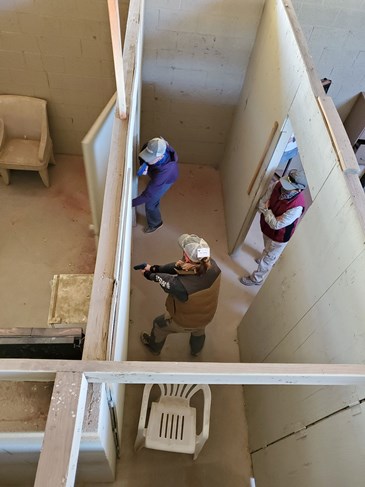
The team tactics course made me rethink the whole plan—or more accurately, it made me realize that we didn’t really HAVE a plan. Who is going to call 9-1-1? I’m not sure I even remember the passcode to his phone, which is the only phone in the room. Who is going to go for the shotgun, or would we both fumble around thinking the other person was going to get it? If I grab my handgun and come around the bed toward the door, how am I going to make sure I don’t bump into him or muzzle him as I move? Will we hunker down in the room or go out into the hallway, and if we do open the bedroom door, how will we stay out of each other’s way so both of us have a clear line of sight to an intruder without muzzling the other person, much less bumping into each other making our way down the hall? If we split up, how will we recognize each other again in the dark and not mistake one another for an intruder? What about lights—will one of us turn the main light on, blinding us both, or will we grab flashlights, and if so, do we have the presence of mind to keep from shining the beam in each other’s faces?
We had never talked about it, much less trained together. The Team Tactics course, which Gunsite still offers, showed me the major flaws in our system. In that course, I learned how to work with a partner (a friend; I still have to get my husband out there to take the course with me) on a self-defense plan at home and out and about. I strongly encourage you to take a course like this with whoever you spend the most time with: a spouse, a roommate, a friend or whoever you’re most likely to find yourself in a self-defense situation with. A couple of the scenarios and lessons I learned:
1. Two Heads Can Be Better Than One …
My partner and I were in a force-on-force (non-lethal Simunitions) shoot-house simulating a restaurant, seated at a table near the door. When a “gunman” held up the register almost right in front of us, we both drew our guns. She was trying to aim at the gunman’s back to stop him while I was grabbing her arm and shoving her right out the door without engaging. We had different approaches to danger—she was fight and I was flight, and my flight response turned out to be the best choice on that particular day.
Lesson: Two people might approach a situation differently, and your partner might save your bacon. Working as a team has all sorts of advantages—if you do it properly.
2. … But Only If They Stay Situationally Aware
In another force-on-force shoot-house, we were simulating a stop at a gas station on a road trip. We both went to the same corner of the “store” as if to grab a soda, when a gunman held up the register. We couldn’t get out the door easily, so we drew our guns and engaged the gunman, only to find ourselves shot by his partner, who was lurking in a corner. Tunnel vision—not looking out for additional threats—was our obvious mistake, but after the simulation, the instructor pointed out another major mistake: We both went to the same place and did the same thing at the same time. If one of us had just gone to a different corner or entered the store 30 seconds later, the second gunman couldn’t have covered us both so easily and one of us might have spotted him sooner.
Lesson learned: Two heads really are better than one when you split up and cover different ground. At home, in my bump-in-the-night scenario, this might mean we designate one of us to stay in the room and call 9-1-1 while the other keeps an eye on the door or clears the hallway if necessary. In most cases, we shouldn’t both be doing the same thing.
3. Communication Is Key
When clearing an outdoor hostage-situation simulation with live fire, my partner and I both had instructors guiding us very closely, but we were moving through a dry creek bed, leapfrogging each other. That meant that one of us was always ahead of the other and off to the side no more than 10 yards or so. In this situation, loud, clear, concise communication is absolutely vital. We would shout in our best command voice things like “MOVING ON YOUR RIGHT,” “HOSTILE DOWN ON YOUR LEFT,” “RELOADING, COVER ME” or “FRIENDLY ON THE RIGHT, DON’T SHOOT.” This helps you know where your partner is at all times and keeps everyone up to date on a rapidly changing situation.
Lesson learned: Be loud and share relevant information, but no more than necessary. You don’t want to be shouting paragraphs of non-vital info. In a home-defense situation, this would help my husband and I keep track of each other if we separated and keep us from bumping into one another if we ever had to move down our hallway together seeking a threat (which, by the way, we wouldn’t do unless there was someone else in the house we had to protect or get to).
4. Team Tactics for Everyone
The advantages of working as a team in a self-defense scenario are obvious: two guns, two sets of eyes and ears gathering intel, the ability to cover two threats at one time, and two brains processing info. The trick is that both people should be processing info toward the same end and with the same structure in place—according to a plan you’ve worked out in advance, at least loosely (if you’re out and about in unfamiliar places). This is high-speed, high-level problem solving, and when the stakes are this high, it’s always better to not be facing the threat alone.
The best way to work on this with your partner is to take a Team Tactics course at a place like Gunsite. You’ll learn all the above-mentioned lessons and more, and more importantly, you’ll discover a lot about yourself and your partner in force-on-force training (spoiler alert: You don’t always react to danger the way you think you will or the way you plan to.) That said, if a professional course is not in your budget right now, the next best thing is to sit down together and come up with a home-defense plan that spells out who does what in which order. Talk about the need to communicate throughout an emergency, and spell out who goes where—something like, “You grab the handgun and turn left out of the doorway to cover me; I’ll grab the shotgun and the phone and turn right to get to the kids’ room.” These conversations extend beyond your home as well, as I learned in the gas-station simulation.
Working as a team can offer you major advantages in a self-defense situation, but two people who are doing their own thing at the same time just leads to chaos, even if both are capable shooters on their own. The trick is to learn to work together and use team tactics to your advantage.