If you are a collector of old rifles, or maybe you inherited some war trophies from your father, grandfather, or a treasured heirloom that has been passed down, a common problem is that you might not have any idea what the correct caliber is. There are several reasons for this.
First, because most countries up until World War II only utilized one standard caliber in the .30 caliber family, many military rifles did not have data stamps. Specifically, rounds like the .30-06 Springfield in the United States or similar cartridges like the British .303 British. Even though these countries only had one standard cartridge, variants started showing up toward the end of the war. Also, many military surplus rifles were re-chambered and re-barreled for more desirable hunting calibers.
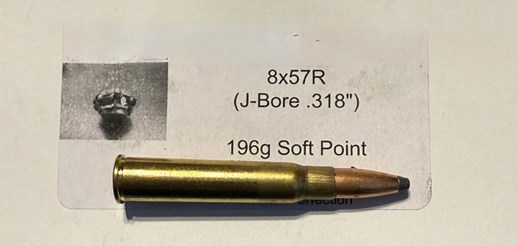
Second, European cartridges were designated in millimeters, not our familiar English designation. Each gunmaker would come up with its own version of established calibers. As such, there are many different cartridges with the same number. For example, early 8X57 Mauser cartridges are so close that the bore of the barrels were given designations such as “J” bore or “S” bore, distinguishing between a .318” bore and a .323” bore. So, a “J” bore is equivalent to .318” and an “S” bore is equivalent to .323”.
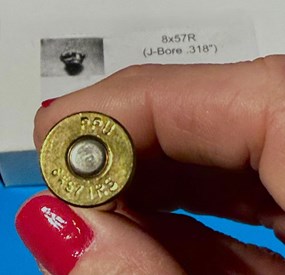
Finally, early American arms as well as European firearms manufacturers did not have a formal set of guidelines or regulations that established uniformity. Because of this there are many mis-marked firearms with proof marks that mean something to one manufacturer and something different to another maker. This means that you can correctly identify a proof mark, but the gun is chambered for a close, but different cartridge.
When faced with one of these dilemmas, you must decide if you are just going to hang it on the wall or find out what the correct cartridge is and shoot it. If you decide that you want to shoot it, you may have to take it to a gunsmith and have him or her cast the chamber. The gunsmith will then take the measurements of the cast and determine the correct ammunition.
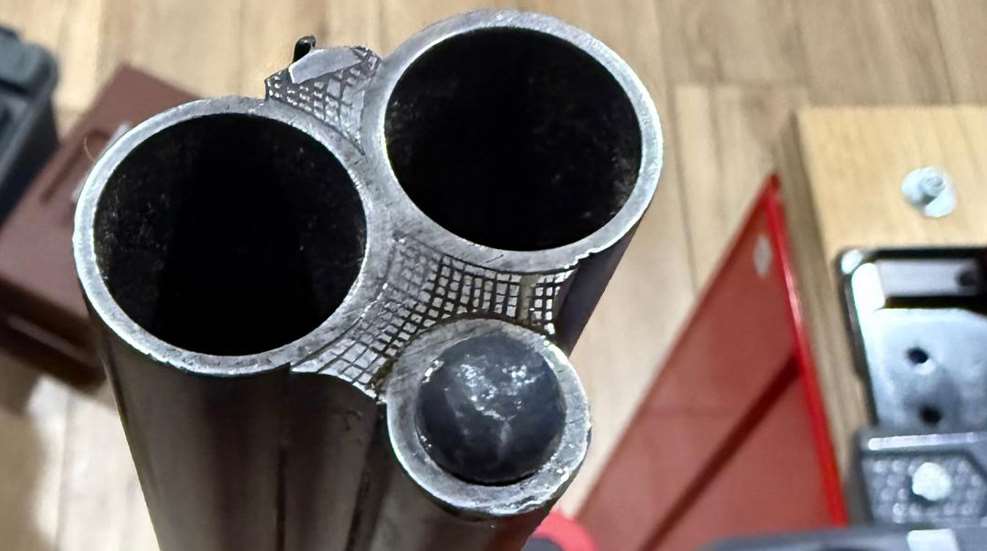
If the firearm you are considering shooting is an early European rifle and it has the cartridge designation on the barrel, you may only have to “slug” the barrel to determine the bore size. This will let you know the correct cartridge to use in your firearm if the only unknown factor is the bore size.
Slugging the bore is quick and easy to do. All you need are a few items you probably already have.
Materials
- Gun Vise
- Gun oil
- Case Lube
- Soft Lead Balls
- Hard Rubber Mallet
- Steel Hammer
- ¼” Brass Rod or Dowell Rod
- Caliper
- Procedure
The first thing that you should do before working on any firearm, including slugging a barrel, is to make sure that it is unloaded.
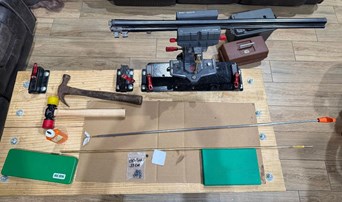
Step 1: Secure the unloaded rifle or barrel in a padded gun vise.
Step 2: Using a cleaning rod and an oiled patch, liberally oil the barrel.
Step 3: Obtain a soft lead ball slightly larger than the muzzle opening. Double Ought (00) and Triple Ought (000) buckshot work great for bore openings less than .36 caliber.
Step 4: Liberally lube the lead ball with case lube.
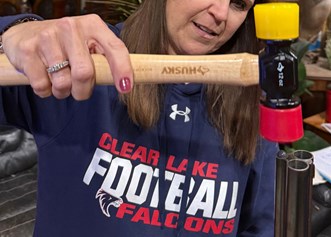
Step 5: Place the lubed lead ball and start it into the muzzle using the hard rubber mallet. The opening of the bore should shave off the excess lead from the ball.
Step 6: Drive the lead ball through the barrel using the ¼” brass rod or wooden dowel rod with the steel hammer. Do not hit the muzzle with the steel hammer because it will damage it. The wooden dowel rod should be cut into six-inch lengths to drive the ball down in sections to prevent the dowel rod from breaking.
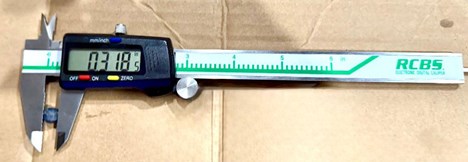
Step 7: The ball will ultimately exit the barrel at the chamber. The diameter of the re-shaped ball is now ready to be measured with the caliber. This will give the exact bore diameter measurement.
In summary, since this German Mauser 8X57 did not have a data stamp, the only way to accurately determine the bore size is to “slug” the barrel. The bore diameter measurement is .318” which means this gun positively identifies as a “J” bore and is chambered for J bore ammunition.
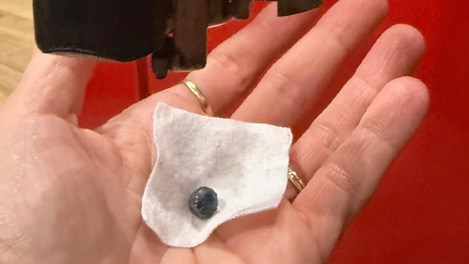
Learning to slug a barrel is a skill that allows you to easily determine the bore diameter of your rifle, so you know which cartridge is safe to use in your firearm. Firearms are meant to be shot and enjoyed. There is no better way to connect with your antique firearm and the individuals who originally shot it.
The best way of appreciating today’s latest technology in firearms is embracing the technology of the past. It was the early firearms that laid the foundation that led to today’s advances. Remember, what we consider antique firearms of today were once the newest technology of their time.
—Heidi Lyn Rao