
When teaching a new shooter, I often see inconsistent shot placement. At first glance, everything looks right. The shooter is following all the fundamentals but he or she cannot hit where they are aiming. Students may lose confidence and get frustrated, but maybe they can’t hit their target because they just cant!
No, I am not saying that the student doesn’t have the ability to properly shoot a firearm; I am saying that they are canting the gun when they shoot. Canting is the deviation from a vertical or horizontal plane. In firearms, canting is holding the firearm at an angle.
The proper hold of a pistol, revolver or rifle is holding the sighting system 90 degrees to the horizon. In other words, the gun should be held so that the sights are straight up and down. There is a natural cant that all shooters possess, but it can be corrected with proper training and practice.
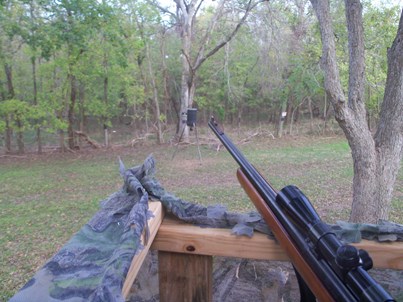
When you cant the firearm, your bullet impacts low and to the side of the canting. Besides natural cant, there are external factors that can cause canting. Factors such as the distance to the target, trajectory of the projectile, the distance your firearm was sighted in at, and in scoped firearms, the height of the scope above the bore. The further from the target and the greater the cant, the further your projectile will impact from the point you are aiming. Depending on all the variables, the deviance of the point of impact can be anywhere from 1 inch to over 12 inches low and to the side of the cant to your target.
Canting causes the line of sight as you are aiming to become misaligned with the target. When your line of sight is level, the projectile hits the target by compensating for the force of gravity, bullet drop, and trajectory. When the firearm is canted, the line of sight is actually rotated. When this occurs, the projectile lands low in the direction of the cant.
As mentioned above, natural cant can be eliminated or minimized by practice. There is no doubt that shooting improves the more you go to the range. One of the reasons “practice makes perfect” is that either consciously or unconsciously, the shooter is correcting his or her natural cant.
Improperly Mounted Optic
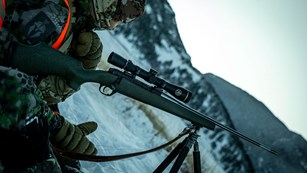
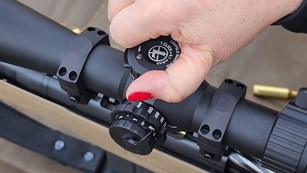
Scoped firearms, such as rifles, can cause canting within the optic itself if improperly mounted. When scopes are mounted on a rifle, the scope must be level before the scope mounts are tightened. Mounted optics can be periodically checked to make sure they are level. If there is a known level object at a distance, the shooter can shoulder the rifle and lay the crosshair on the object to see if it lines up. This known object can be horizontal or vertical.
Uneven Base
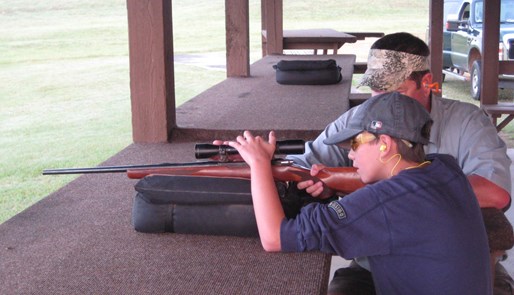
Go to the range halfway through any deer season and it is full of hunters who are there because they missed their target. The excuse is always the same: “I think my scope is off.” Sometimes the scope is off, and the shooter makes the proper adjustments. Other times, everything seems to be “on” yet the shooter walks away scratching his or her head. I would be willing to guess that their shooting base is uneven. This applies to both scoped rifles and open or iron sights. Be ready to adjust your hold of the firearm when shooting from these bases.
Sloped Ground
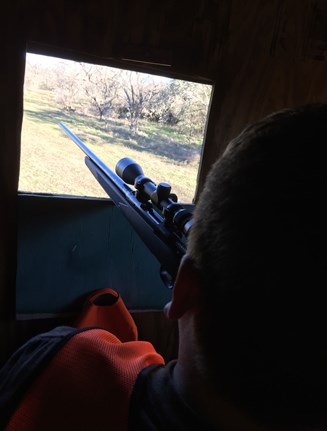
Sloped ground offers another challenge. It does not matter if you are shooting a semi-automatic pistol, revolver or a rifle. We practice shooting with everything in line—feet, back, shoulders and head. When standing on a sloped surface, the shooter needs to have a solid base by planting their feet, but the rest of their body must be perpendicular to a level horizontal line. This can be accomplished by bending the knee on the uphill side or bending at the waist. By adjusting their shooting stance, a shooter can eliminate or minimize the cant of their firearm. While you and your target may be on uneven ground, your firearm still has to be level.
Shooting Around a Barrier
Shooting around a barrier is usually done in self-defense situations, training and competitions. The tendency is to lean out from cover, canting the gun.
When shooting around a barrier, start out with a solid base by planting yourfeet firmly on the ground. The shooter should then shift his or her body at the waist, so the proper grip is maintained while keeping the firearm level. The secret to properly executing this move is to keep your shoulders even. The shoulders must maintain a level horizontal plane. If you do this correctly, the firearm should stay level to the target.
Once you understand how canting affects your bullet placement, you can work to correct it. Correcting your hold to eliminate or minimize canting can start at home with dry practice. Place a small bubble level on top of the slide, frame or receiver and practice holding the firearm level. By maintaining the level, you are creating muscle memory. Eliminating cant can mean the difference between being a good shot and a great shot!
—Heidi Lyn Rao