
Many years ago, I interviewed a very accomplished bowhunter and wildlife biologist. We talked about a lot that day, but one statement he made caught my attention. “I get up in the morning, walk out on the back deck and shoot a single arrow,” he said. “And then I go back inside and drink my coffee.”
It threw me for a loop. One arrow a day? That’s it? What kind of lunacy is it to skip all the training and range time we outdoor writers are always encouraging and just shoot a single shot? Why even bother? So I asked, and his explanation made so much sense that I still think about it a couple decades later.
“When it comes to bowhunting, at my age, I’m about as good as I’m going to get,” he explained. “I can hit the bull’s-eye, so what else do I need? I’m not trying to get stronger. I’m not trying to get faster.”
And then he spit out a quotable piece of wisdom. “The first shot is the only one that counts, anyway.”
He was right, of course. In bowhunting, and often in gun hunting, and sometimes in self-defense, if you can’t get the first shot right, you probably won’t get a second. You have to be able to make the first shot count—and do it cold. We’re not talking about making one good, careful shot after you’ve been practicing for an hour and are nice and warmed up.
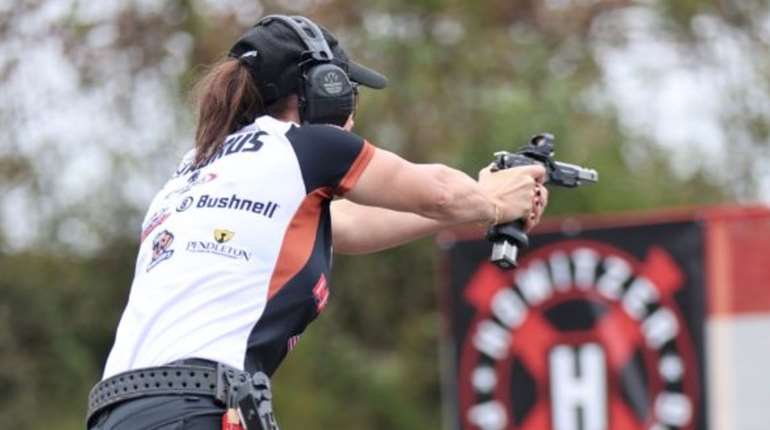
There’s a lot of application here for self-defense training. In a self-defense scenario, your first shot really matters. You might have time for a second and a third, but you might not, especially if you’re facing an armed opponent who didn’tmiss their first shot. And you won’t have the luxury of warming up before you take that all-important first shot, either.
I admit I’m guilty of the warm-up thing. If it’s been a while since I’ve fired a rifle, I have a tendency to flinch on my first shot—even with a low-recoil rimfire. I have incorporated a mantra (“slow down, smooth pull, eyes open”) into my rifle shooting to combat this. I’m particularly bad about it when shooting sporting clays. I don’t shoot shotguns frequently enough to maintain any momentum, and it takes me about three or four stations to get back in the groove. By the end of the round I’m finally shooting pretty well, but I didn’t start out that way.
That doesn’t cut it when it counts—in hunting and in defensive shooting. That buck of a lifetime probably isn’t going to stick around if you flinch and miss him with your first shot (I have seen some do that, but it’s not the norm). And I don’t need to explain to you what could go wrong if you can’t make a good shot in self-defense.
So take this as a neat training tip. Most of us aren’t able to safely fire a single live round every day off our back porch, but a dry-fire training aid like those from Mantis can be a great tool here. Walk into your dry-fire setup cold and fire a single shot. If you can do it drawing from your concealed-carry holster, even better. Evaluate your shot using the app data—did it go where you wanted it to? Was it as fast as you wanted? Did you sacrifice accuracy because you were trying to go too fast? If you shanked it, too bad. Try again tomorrow.
Now, certainly this kind of training does not take the place of range sessions. It’s not real training for speed or accuracy—you’ll still need plenty of live-fire work for that, because unlike the bowhunter in the beginning of this story, you aretrying to get faster, continually. But what the single-shot-a-day training does is teach your brain that there’s no room for laziness; it absolutely has to make its best shot, every time, but especially the first time. It’s as much mental training as it is physical training.
If you want to do some more dry-fire practice after you fire your single shot, that’s great, but take a break in between. Go drink your coffee or throw in a load of laundry or walk the dog—anything to give your brain enough of a break that over time, it will register the impact of the “one and done” training. Then you can go back and dry-fire to your heart’s content.