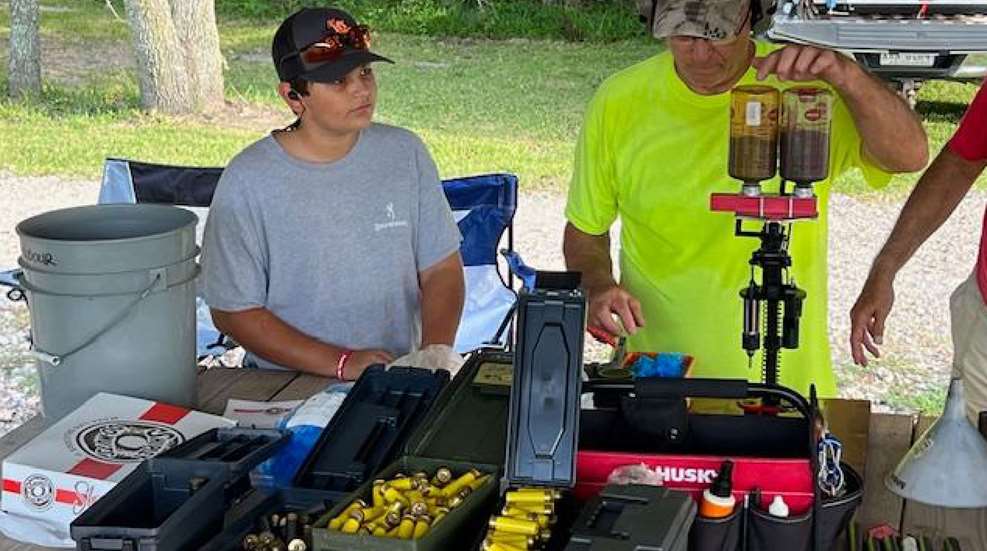
The most important piece of equipment in reloading metallic cartridges or shotshells is a reloading press, because it is what puts all the pieces that make up a cartridge together. The type of press you choose depends on the type of shooter you are.
The reloading press is what is used to perform the necessary processes on a prepared case. Reloading a cartridge involves resizing and decapping (removing the spent primer), priming, adding powder charge, flaring (on straight wall cases), bullet seating, and crimping (on some calibers). These functions are performed with dies. Depending on the caliber, there are usually two or three dies to perform these functions.
If you are thinking of getting into reloading, there are three types of presses: single-stage presses; turret presses; and progressive presses. The type of press that you choose depends on what caliber you are reloading, how much you plan on reloading, and how simplistic you want the press to be.
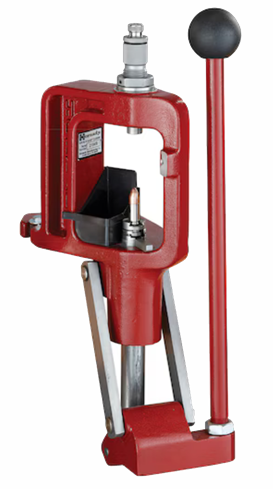
Single Stage Press
A single-stage press is the most common reloading press, and is the easiest type of press to use because it can be used to load any rifle or handgun caliber. Because single-stage presses are the strongest type of reloading press, many large-bore rifle and revolver calibers are reloaded on single-stage presses.
Implied in its name, a single-stage press performs only one function at a time. Because this type of press only holds one die at a time, it makes the single-stage press the most time-consuming of all the presses, because each die must be switched out to perform the required function.
Single-stage presses have very strong and rigid frames. When using a single-stage reloading press, a die is screwed into an opening in the top of the unit. Then the appropriate case holder is attached to the ram. When the ram is lowered, it raises the case into the die to perform the required function. Reloaders usually prime the cases with a hand primer, but some single-stage presses have primer attachments.
Single-stage presses include hand, C-type, H-type, and O-type presses. Hand presses are the cheapest type of press. The hand press is by far the slowest type available to reloaders. This type of press can be difficult to use, especially for older reloaders and those that do not have the strength to operate it.
The C-type is a common press because it is the least expensive of the bench-mounted reloading devices. Of the bench-mounted presses, the C-type press is the weakest, and are usually used to reload pistol and small rifle cartridges.
The strongest bench-mounted presses are the H-type and O-type reloading presses—which are also the most expensive of the single-stage presses. The benefit of H-type and O-type presses is that most of them accept attachments that make reloading cartridges easier and faster, including auto-priming and adding powder loads.
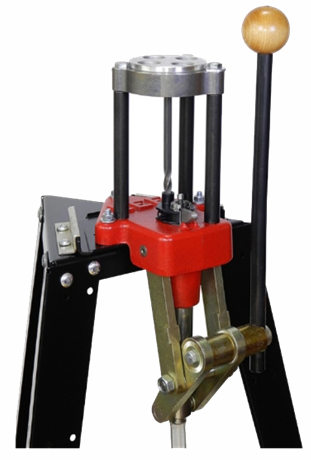
Turret Press
Turret presses are similar to single-stage presses with the exception that the top of the press has a rotating plate that can hold multiple dies. This eliminates the time it takes to screw in, remove and screw in other dies. All the dies needed to reload a specific cartridge are mounted on top. When the correct die is positioned above the ram, it is called indexing. Some turret rings are indexed manually, and some feature auto-indexing. Auto-indexing turns the turret putting the next die in position when the ram is lowered and raised.
Some turret presses have removable turret plates, which allows the reloader to remove the plate with the dies in the correct adjusted position for a specific caliber and put another plate with dies adjusted for another caliber. This accelerates the set-up process with different calibers. For example, if someone is switching from 9 mm to .45 auto, all he or she needs to do is replace the die-loaded plates, as opposed to removing each 9 mm die and screwing in and adjusting .45 auto dies.
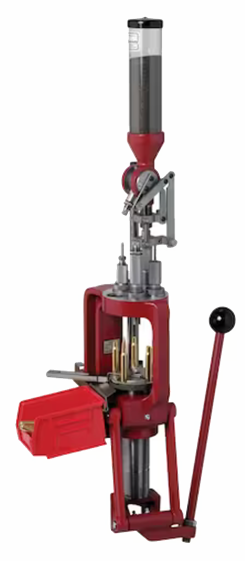
Progressive Press
Progressive presses are used for reloading large quantities of ammunition. These presses have a threaded opening for all the dies necessary for reloading a specific caliber as well as openings for powder drops. The case plate at the bottom has multiple shell holders for loading multiple cases at a time. Each pull of the ram rotates the cases around, and each case goes through the dies, primed, and ejected into a bin when the cartridge is completely reloaded.
A progressive press also accepts multiple attachments, which makes the whole reloading process hands-free. This means that more cartridges can be reloaded per hour. Some progressive presses are motorized, and that speeds up the reloading process even faster. Motorized progressive presses are typically used for bulk commercial operations, and are generally used to reload pistol, revolver and small rifle calibers such as 5.56 NATO and .223 Rem. Larger rifle calibers and large revolver calibers over .45 caliber, such as .460 S&W and .500 S&W, are usually reloaded on a single-stage press.
Many people started with the simple single-stage press, which can reload just about any caliber, including obsolete calibers. There is no downside to reloading if you take your time and stay within the published minimum and maximum load pressures.
It is important to choose a reloading press that you can easily operate—which might mean not purchasing the least expensive press. If it is too difficult to manipulate, or if it takes too much strength to operate, you might give up on the idea of reloading and move on to a new hobby.
There are many reasons and benefits to reloading. Reloading cartridges and shotshells is fun as well as economical. What was once an exclusively male activity is now seeing increased participation by more women. Reloading cartridges is the next level for avid shooters, for both men and women.
—Heidi Lyn Rao