
Exact numbers are hard to come by, but there’s no doubt that the 9 mm Luger is by far the most popular chambering for self-defense handguns today, with one estimate stating that up to 3.5 billion—with a B—rounds are sold each year. This is partly because it’s the round of choice for most military and law enforcement use, and partly because it’s wildly popular for civilian self-defense. Of course, that’s a bit of a perpetuating cycle.
It wasn’t always so. In the 1980s, many police departments were still issuing revolvers, and among semi-automatic shooters, the .45 ACP reigned supreme, as the 1911 in that chambering was the standard-issue military sidearm. As tends to happen through the course of firearms history, what happens in the military trickles down to civilian use, and the big, powerful .45 ACP was a very popular round for self-defense use. “If it doesn’t start with a 4, it’s not good enough for me” was a common refrain in gun-nut circles.
Then in 1985, the military went to the Beretta M9 in 9 mm as the standard-issue sidearm, although some units kept the .45 ACP and still use it today. (Today’s standard issue is the SIG Sauer M17/M18, adopted in 2017, still in 9 mm.) Shortly afterward, one of the deadliest shootouts in FBI history occurred in 1986 in Miami, in which FBI agents, most of whom were armed with revolvers, were seriously outgunned by criminals with semi-automatic firearms. One of the criminals involved was shot with a 9 mm from one of the few agents who had one, and he continued to fight despite his wound, leading to the death of two agents and injuries to five others. The shootout became one of the most-studied cases in law enforcement, and after analysis of what happened that day, the FBI moved away from revolvers, switching to 10 mm semi-auto handguns and then, shortly after, to the newly developed .40 S&W. The 9 mm was deemed “unsatisfactory” due to the time the 9 mm wound took to incapacitate the criminal during the shootout—probably an unfair assumption, given that the bullet first passed through the criminal’s arm before penetrating the chest cavity and stopping short of the heart.
Following the FBI’s lead, law enforcement agencies around the nation began to or continued to abandon revolvers in favor of semi-automatic handguns throughout the late 1980s and early ’90s. As the trend grew and expanded to civilian carry, two camps emerged: Shooters who followed the military to the 9 mm, and shooters who followed law enforcement and the FBI to the .40 S&W, .45 ACP and other large rounds.
All the while, ammunition manufacturers continued to innovate, introducing better projectiles with improved ballistics. Ammo just kept getting better and better, and it still is. Today’s 9 mm ammo is vastly superior to what was available in 1986. With that in mind, the FBI took a new look at the 9 mm in the early 2010s and conducted plenty of ballistics testing, and ultimately announced in 2014 that it was switching from the .40 S&W to the 9 mm.
The reasons for this were numerous but pretty simple. As mentioned, ammo is better than it used to be, so the performance of 9 mm ammo improved greatly between 1986 and 2014. “9 mm Luger now offers select projectiles which are, under identical testing conditions, outperforming most of the premium line .40 S&W and .45 Auto projectiles tested by the FBI,” the agency stated in its 2014 white paper on the subject. Additionally, the study found that “there is little to no noticeable difference in the wound tracks between premium line law Auto enforcement projectiles from 9 mm Luger through the .45 Auto.” In other words, the 9 mm performed just as well if not better.
On top of that, the FBI stated that “Handgun stopping power is simply a myth. Studies of so‐called ‘one shot stops’ being used as a tool to define the effectiveness of one handgun cartridge, as opposed to another, are irrelevant due to the inability to account for psychological influences and due to the lack of reporting specific shot placement.” In other words, all those people who were arguing that a .40-caliber round could stop a person with a single shot and the 9 mm could not were simply wrong. There are too many other factors at play.
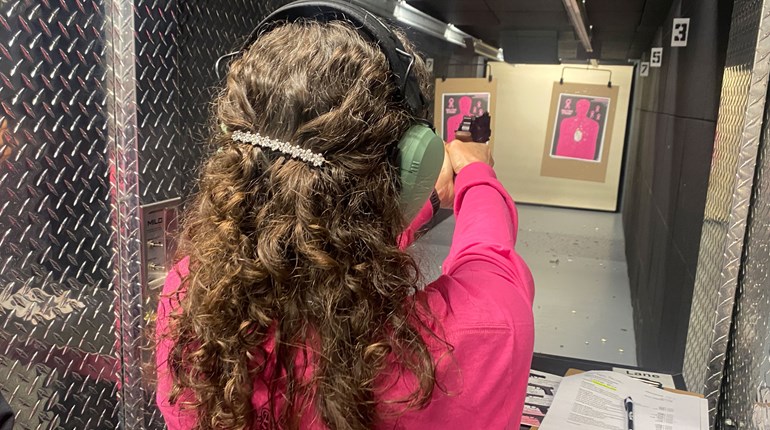
Recoil is one. Larger rounds recoil more, which degrades accuracy and slows down follow-up shots. The lower-recoiling 9 mm was simply easier for officers and agents to handle and to shoot accurately. “To date, the majority of the study participants have shot more quickly and more accurately with 9 mm caliber Glock pistols,” the study states. “The 9 mm provides struggling shooters the best chance of success while improving the speed and accuracy of the most skilled shooters.”
Capacity is another factor. In general, 9 mm handguns have a higher capacity than pistols chambered for a larger round. You can just fit more of the rounds in a magazine because the rounds themselves are smaller.
Put together, accuracy, speed and capacity are of vital importance given that, according to the study, LEOs miss between 70 and 80 percent of the shots they take during a shooting incident. If you’re going to miss 80 percent of the time, you’d better do so quickly so you have a better chance of getting at least one round on target, and you want plenty of rounds at your disposal.
In light of all those factors, the FBI switched to 9 mm and suggested it would be appropriate for other law enforcement agencies to do the same if they hadn’t already.
With the military and the vast majority of law enforcement agencies on board with the 9 mm, there was no further doubt in the mind of most civilians. We still have some holdouts who like to carry the .45 ACP or other larger calibers, and more power to them, but the 9 mm is far and away the most common self-defense chambering today. It was on a steady rise to dominance and had probably already achieved it by the mid 2010s, but the FBI study showing that 9 mm is more effective and easier to shoot quickly and accurately really sealed the deal and propelled the 9 mm to its place as the undisputed king of the hill.