
I personally know at least two people who have admitted to shooting a hole in their own truck. I’d wager the number would be a lot higher if I actually took a poll and directly asked everyone I know. If you’ve never done this, it sounds like an absolute bonehead move (OK, it sort of is) and you’re probably guessing one of the major rules of gun safety was broken. Well, kind of, but not exactly.
To give you a clue as to how this happened, I’ll share the details. Both guys were firing their rifles using their truck as a rest. One was propped up on the hood shooting across it, and the other was using one side of the bed as a rest, standing by the tire and shooting across the bed at a target somewhere on the other side.
Got it yet? I’ll give you another story that illustrates the same problem.
I was at Gunsite Academy taking an AR-15 course. We were running an urban combat simulation that required us to crouch down behind a piece of plywood with a window (hole) in it that we were supposed to shoot through without getting too close to the window or sticking our barrel out of the hole, thus revealing our position. It was in the middle of the course, so I was already pumped full of adrenaline and moving quickly. I crouched behind the plywood and lined up a shot in my scope, but before I could shoot, the instructor called “CEASE FIRE! Don’t move.”
I froze, and she calmly told me to lift my head off the stock and look at where my barrel was. It was a couple of inches in front of the plywood below the window. If I’d fired, I would have blown a hole in the wood rather than shot out of the window as I was intending.
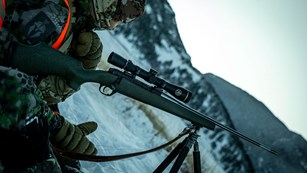
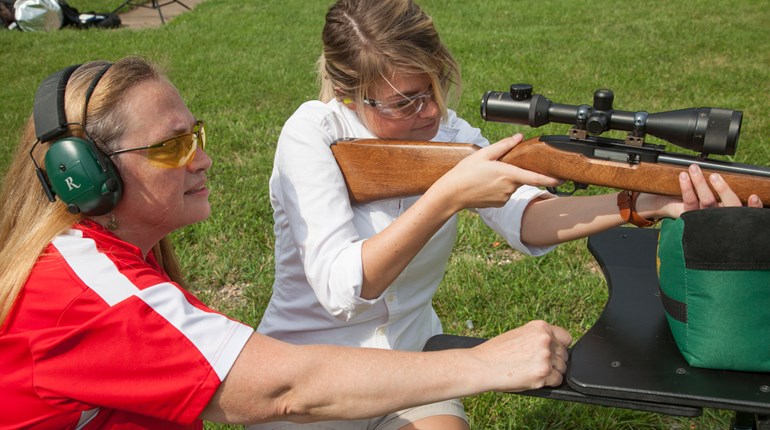
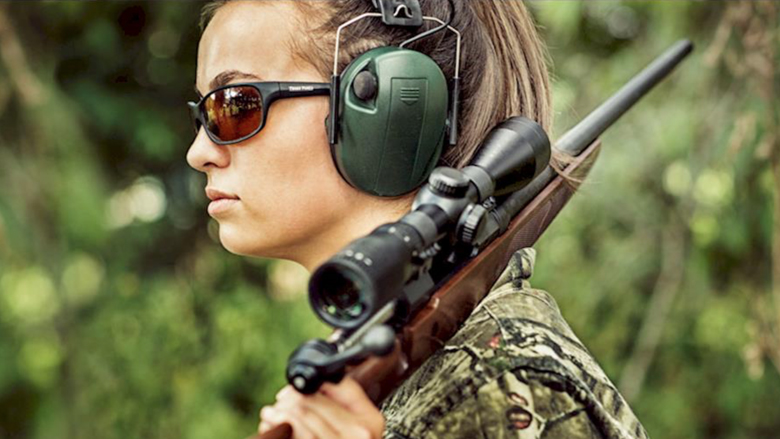
What went wrong? I had forgotten the same thing that the truck-shooters forgot: What you see through your scope doesn’t reflect the exact line of the barrel/the trajectory of the bullet. This height-over-bore problem is really obvious when you stop to think about it—just look at a rifle and you can clearly see how much higher the scope sits than the barrel. You won’t be able to see something that’s right in front of your barrel (like a wall under a window) through the scope because it’s just too close and too low. The same thing happens when you brace your rifle on the hood of your truck: The little rise in the middle of the hood might actually come up high enough to get in the way of your barrel, and you’ll never be able to tell that through your scope. Similarly, if you shoot straight across your truck bed at a target that’s on the same level, the far side of your truck bed might be lined up with your barrel—but it won’t be lined up with your scope, so you won’t know until you miss the target and discover a new hole in your truck.
You can read more about this here and here, and the “Elements of a trajectory” graphic in that second article is particularly helpful. The bottom line is that when you mount a scope on a rifle and you sight it in at a particular distance, what you’re actually doing is making sure that the line of the scope and the line of the bullet trajectory cross each other at a determined point of your choosing—often 100 yards.
Now, to accomplish that, your scope is mounted pointed ever so slightly down, or to think of it another way, your rifle is pointed ever so slightly up in relation to the scope. This makes the bullet fly in an arc shape—it’s not rising, but you’re shooting it slightly up in the air, so it seems like it’s rising before it begins falling, forming an arc-shaped trajectory. This trajectory crosses the sightline of your scope in just two places: the second is the distance you sighted in at, and the first is usually somewhere before that. Exactly where before that depends on a lot of ballistic factors, but the point is, it’s past a few inches or feet, which means anything in the way of the barrel—a truck bed wall, a plywood window, a branch in the woods—is in danger of being hit if it’s close enough that you can’t see it through the scope.
If this sounds like a potential safety problem, it’s because it can be, if the object is close enough and if it’s not something the bullet will pass through cleanly. The simple solution is to just pay better attention to where your barrel is and remind yourself that what you see through the scope isn’t the full picture. If you’re in an unconventional shooting position, take a minute to imagine a straight line from your muzzle and make sure nothing is in the way of that bullet.
I know what you’re thinking—this still sounds idiotic and super obvious. While it might feel that way, I know enough people who have made the mistake, myself included, to know that everyone can use the reminder.