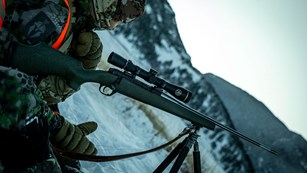
The firearm industry is seeing an influx of sales, meaning many folks will be hitting the range with their new firearms in hand. Many shops offer to bore sight rifles; however, that will only get you hitting paper and not necessarily the bullseye. In order to minimize your time at the shop and maximize your time on the range, I suggest taking your rifle to the range and sighting it in yourself. Not only will this get you familiar with your firearm, but it will also give you the confidence to make any necessary adjustments down the line.
Set Up the Target. 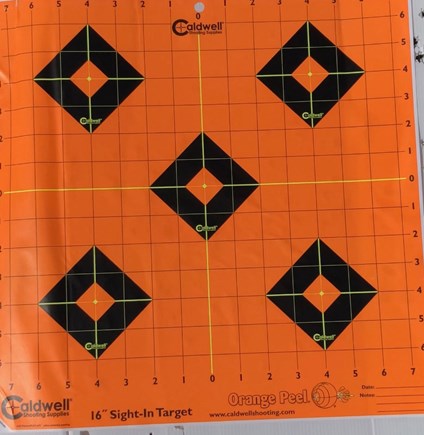
After you have securely mounted the scope, it is time to bore sight your rifle. Step one is easy: set a target up at 25 yards, preferably a large target that has 1” grid lines. Using a target with gridlines makes it easier to calculate the distance between the shot and bullseye which makes adjusting the scope simple.
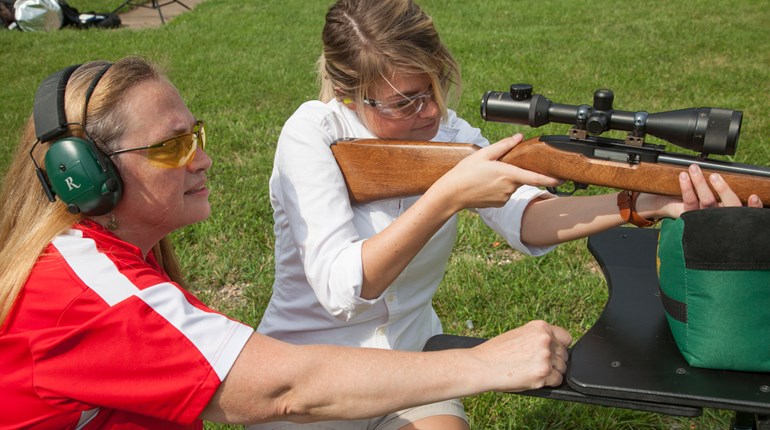
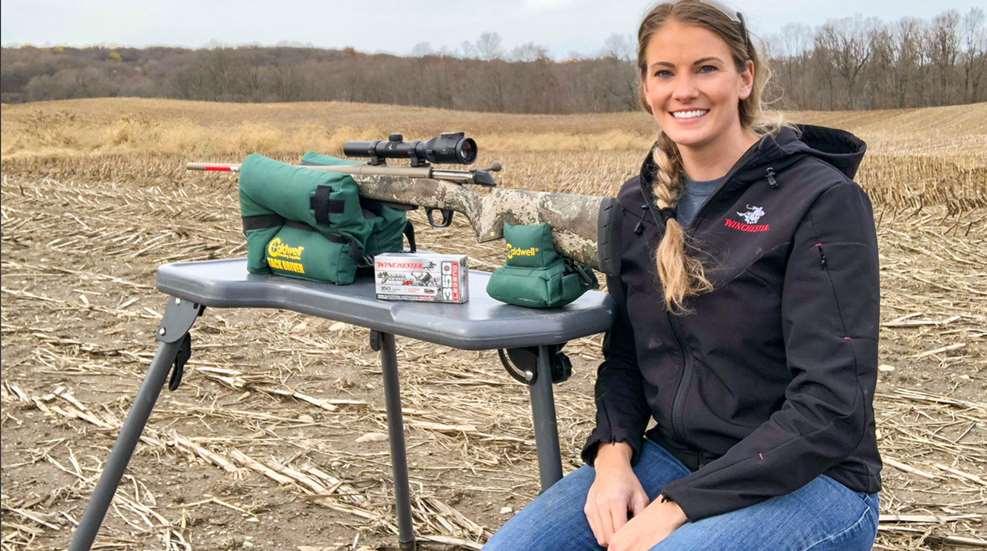
Now, set up on the shooting bench. Be sure the firearm has a sturdy rest that will hold the firearm in place so there is no movement.
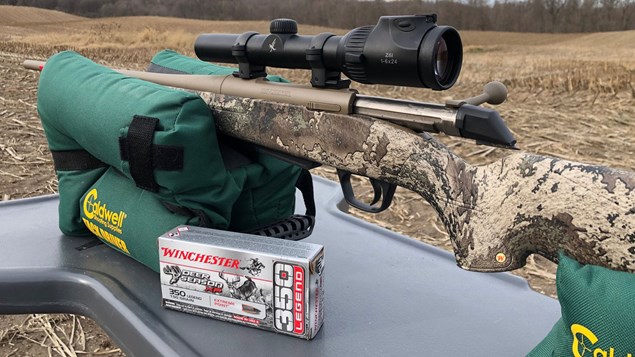
Remove the Bolt.
Removing the bolt will allow you to look down the bore and align the bullseye in its center. Carefully dial the crosshair into the center of the bullseye without moving the gun. Bore sighting won’t get you hitting the bullseye, but it should get you hitting paper, which means the bullseye is just a few adjustments away.
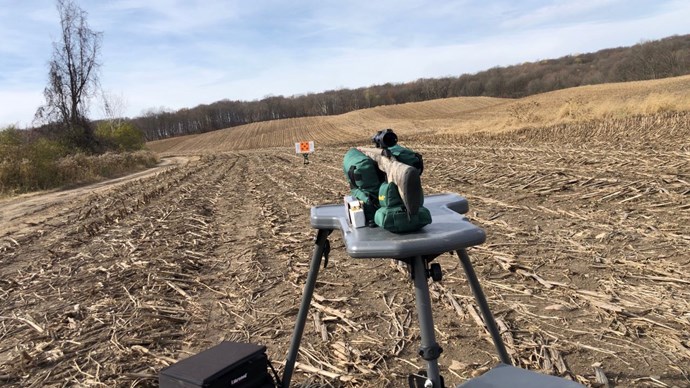
Steady. Aim. Fire.
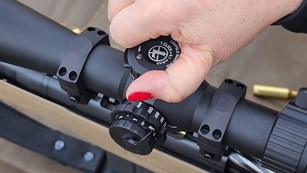
Once you replace the bolt, you are ready to shoot. Remember that at 25 yards, you will need four times the number of clicks that you would at 100 yards. Be sure to look at the minute-of-angle (MOA) on your sight—most are 0.25” but can vary, so be sure to look. For example: If you have a 0.25” MOA and you are hitting an inch to the left at 25 yards, you will need to turn the scope windage knob 16 clicks to the left.
Pro Tip:
Barrels tend to heat up as they are shot which usually results in inaccurate shots. Therefore, allow adequate time for the barrel to cool between shots.
Back to 100.
After you hit the bullseye at 25 yards, you are now ready to move the target back to 100 yards. It is likely that a few more adjustments will be needed to zero your rifle at 100 yards.
Once you feel confident and are done adjusting your scope, begin by firing 3 shots per group. This will allow you to see the tightness and consistency of your group.
Also, as an important reminder, it is also necessary to take the time to shoot your older firearms as sometimes scopes may get knocked (i.e. a gun being accidentally dropped, bumped during transport, etc.) which will impact your accuracy.
Don't have a bolt-action rifle? For good beginner options, check out these 6 Bargain Bolt-Action Rifles.