
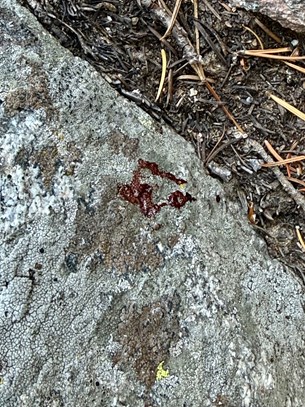
Ethical hunters strive to quickly recover game animals and avoid “wounding loss,” when an animal is hit but not recovered, going on to survive somewhere or expire. As most hunters know, game animals do not always fall immediately in the location where they were hit. They may run off, requiring the hunter to track the animal, often by following a blood trail. Sometimes, such as when hunting in Africa, this requires professional trackers, who look for evidence the animal is heading in a certain direction. But if the animal is still alive when it is discovered, it’s possible to startle it and cause it to jump up and take off running again, forcing tracking efforts to continue.
When this happens, a good tracking gun allows a hunter to quickly acquire a target and get a round off with the goal of putting the animal down, preventing wounding loss by recovering the animal before it gets away or having the blood trail to come to an end. It also prevents the game from crossing property boundaries where the animal may not be recovered.
Having a tracking gun means that you might need two rifles when in the field hunting. It is also possible that your primary hunting gun can serve as the tracking gun if it is setup properly.
What Makes a Good Tracking Gun
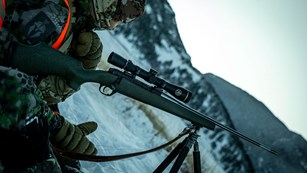
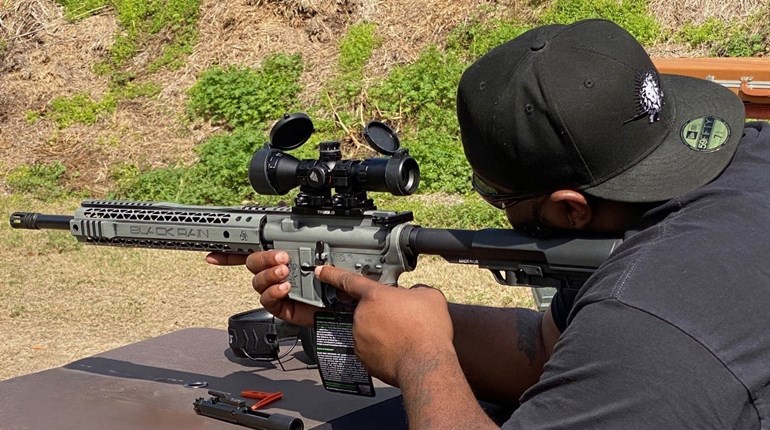
Tracking guns should be relatively short for easy shouldering and swinging on target. The gun should be well-balanced, and when shouldered the sights should automatically line up with the eye. Ideally, the tracking rifle should not be scoped, or if scoped, have one that is low powered with a wide view for quick target acquisition. These firearm attributes were common for rifles prior to the 1970s.
Scopes on firearms were not commonplace prior to the 1970s, designed with the assumption that the hunter would be using open sights. Think about your father’s or grandfather’s favorite rifle. The have a totally different “feel” than the rifles of today. Their firearms were made for quick target acquisition because their type of hunting involved stalking up on game animals.
Today’s rifles are made with the assumption that the firearm is going to be scoped, and hunters will be hunting from a stand, shooting sticks, or some other type of support. Today’s firearms are not balanced like older guns, making a snapshot much harder. In fact, many high-end guns leave the factory with no sights at all.
There are two types of tracking guns: One for tracking deer or other ungulates; the other for tracking dangerous game.
Tracking Guns for Ungulates
These guns usually have a barrel length of 24 inches or shorter. They are also relatively lightweight and shoot a smaller caliber cartridge. These characteristics are a necessity because most deer-sized animals take off into the brush when shot. In this environment a short-barreled rifle is easier to maneuver in the brush. Additionally, the smaller caliber allows the tracker to quickly get back on target for a fast follow-up shot.
I use several of my firearms as tracking guns when hunting for medium-sized game animals. My go-to in thicker brush is the Ruger American Scout rifle, utilizing the great open sights with which it is furnished. The Ruger that I use has a 16.1” barrel and is chambered in 5.56 NATO (MSRP $929.00). This combination has worked very well for me in dropping a “jumped” deer.
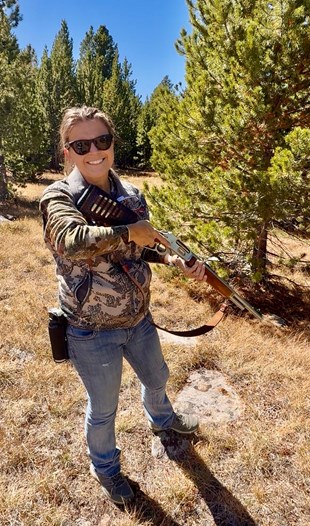
Tracking Dangerous Game
Because they needs to stop a charging animal in its tracks, tracking guns for dangerous game animals are much stouter. When an ungulate or other herbivore is shot, it usually runs away to hide and bed down. When a dangerous game animal is shot, it will often charge at the hunter. This is why many professional hunters or guides carry large-bore, short rifles.
Marlin’s Guide Gun Series (shown) make excellent tracking guns for dangerous game. The barrel lengths of these guns range from 18.63 inches for the .357 Rem. Magnum; 19.10 inches for the .45-70 Govt.; and 20.25 inches for the .44 Rem. Magnum. (MSRP of $1,359) The Guide Gun Series was designed for quick target acquisition with a lot of stopping power.
A separate tracking gun suited for your terrain and game is ideal, but that means that you must carry more equipment, including matching ammunition. A more convenient solution is to be able to convert your primary rifle to a tracking gun. The easiest way to do this is to Talley your firearm!
Talley Base and Rings
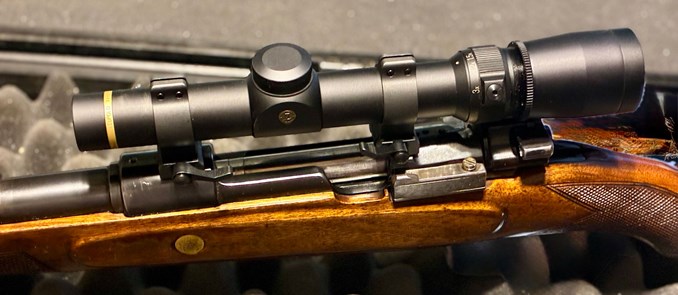
The ability to convert your primary rifle into a tracking gun is a huge comfort if you must track your game. This is accomplished utilizing quick-release scope rings on your optics. A good quick release system should allow a hunter to quickly remove his or her scope without the need for tools and quickly reattach while maintaining a zero on your scope.
Many companies offer quick-release scope mounts, but options are very limited. Most companies only offer these types of mounts with picatinny rail systems, which I believe make it more difficult to load in the average bolt-action rifle. Two-piece bases seem to work much better on bolt-action rifles. Talley Manufacturing is the only company I know of that gives the hunter a choice of picatinny as well as standard bases systems for their quick-release scope systems.
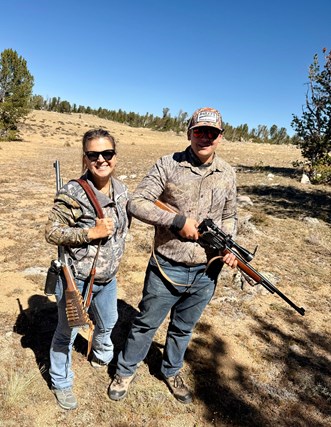
On a recent black bear hunt I outfitted my rifle with Talley quick-release base and rings. The bear ran a short distance into some thick brush, forcing me to follow it for recovery. I cannot express the relief I had in being able to remove my scope in case I needed to take a quick close-up shot when in thick cover.
Talley Manufacturing is based out of South Carolina, so you get that southern hospitality when you call them. Their customer service will help you find the right mounts for your gun and your scope. Their quick release scope rings have an MSRP starting around $140 and their bases for these rings have an MSRP starting around $41.
I have been on many hunts where a tracked deer was “jumped” and the hunter shoulders his rifle and declares, “I didn’t have a shot!” This is because the hunter was carrying his hunting rifle with a high-powered scope mounted on it. If the hunter was able to remove his or her scope, he or she probably could have taken that desired shot.
It is important to remember that hunters should have the right equipment for the game they are hunting for a quick, clean and ethical kill. Ethical hunters carry the right tools for the job—including the right equipment even after the animal is shot.
—Heidi Lyn Rao