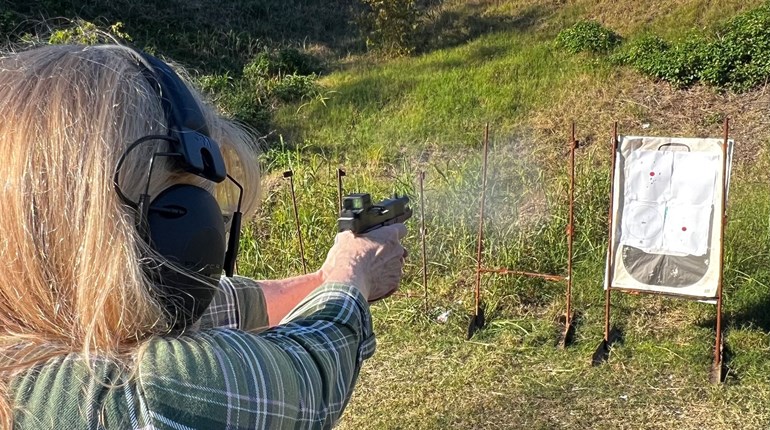

One of the simplest ways to learn about what you’re doing, right or wrong, while shooting a firearm, is to use a video camera and a timer. Capture video of specific skills and break down where improvements can be made. This process allows you to see progression over time. You can also share with others who might have feedback for you.
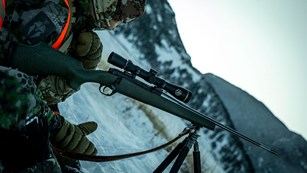
Drone cameras are a great option for assessing movement. (Photo by author)
Progression Over Time—Video Doesn’t Lie
Sometimes it can feel overwhelming to learn the specific skills needed for competition or concealed carry. A great example is the draw. There are different components that might vary, depending on your holster or your firearm, your body or method of carry. Capturing what happens from the instant the timer goes off, through all the parts of the draw, is a valuable tool! A draw starts with the beep, and continues until your hand begins to move, through your grasp of the gun, continuing to where your hands meet and form your grip, through the point at which you press out and begin to get a sight picture, to when your finger moves to the trigger, to the actual firing of the gun. There is also data to study after the draw and firing a gun, such as recovering from recoil, re-holstering, and looking at the body movement in reverse. There’s so much information that can be gained from videoing this (or any) skill. You can even slow down video to see the smallest of pieces of how you perform a skill.
And you do not have to be an expert to break these things down. You can do an online search and find abundant information on drawing a firearm. Whether it’s for competition or for concealed carry, there's an abundance of info on the pros and cons of particular methods. Some information will be subjective, but there are hard truths, such as, “Do not flag yourself on your draw.”
Put it on a Timer
Another way that you can gain information about your training with your firearm is by using a timer.
A timer isn’t just to see if you’re getting faster, you need to use it to look at areas where you can make progress. Continuing to look at the draw, combine your video and a timer. You can see things like: reaction time, when your hand actually grasps the gun, when you start to press out and align the sights on target. The timer gives you data for things like: When do you break the shot after the timer goes off? When do you recover and take your next shot? What method of draw is fastest?
By combining a timer and a camera, you can pick apart smaller portions of a skill. Think of it like “thin slicing.” You’re trying to look at the smallest piece of what you’re doing and see ways to perfect or improve it.
The expert competitive shooters will tell you that success isn’t about how fast you pull the trigger, it’s about doing everything in between the shooting faster. If you listen to someone very accomplished with a pistol shoot a series of paper and steel targets, what you should hear is a continual cadence, less than an interrupted, “bop-bop, ping, bop-bop, ping, bop-bop, ping.” The very advanced competitor will turn that entire string of fire into something with shorter periods of time between every shot (as opposed to being able to hear every target that’s being shot based on cadence). The cadence will even out. And what that tells you is that they are making up time in between pulls of the trigger to obtain a faster time. They are transitioning faster; their splits on target are approaching the same speed as a transition to a new target.
Going back to the draw, this is one place where many competitive shooters spend time working to have as efficient a draw as possible. One “low hanging fruit” is reaction time, and for someone brand new to the concept, you can simply think about it as reacting to the “B” in beep, as opposed to waiting for the timer to finish its beep, and then draw. It sounds silly to some people to discuss this, but for those brand new to working on speed, they tend to focus on being safe. This is good, however, if you want to learn to go faster, you must learn to react faster.
Another place to use a camera would be in movement and transitions. When do you begin moving the gun, when do you begin moving your eyes, when do you begin moving your feet? Video yourself doing these things and start to tease it apart.
Using a timer to give yourself a point from which to react and set baseline times. Use video to pick apart what you’re doing, and when. Getting this info will help you make improvements in your shooting skills, without needing input from anyone but yourself.
Here are three ways that a novice shooter can use a camera and timer to improve shooting skills:
1. Start with dry fire. Ensure that you have no ammunition, no loaded magazines, just an empty gun and your holster. Film yourself performing a draw. Whether that’s for competition or for concealed carry, it does not matter. But if it is for concealed carry, be realistic about what you would wear and how you would carry the gun.
Then, using the baseline time that you gathered from the video you took, set yourself a reasonable goal. Maybe that’s a quarter of a second faster or a half a second faster. Whatever it is, set yourself a par time, for example a two second draw from concealment. Then film yourself doing 10 to 20 reps at that par time. Aim for consistency.
You can do this with any skill in dry fire. It is a very useful tool for cementing your fundamental movements, such as a draw or a magazine change.
2. Practice one skill with live fire using the par time that you worked on in dry fire. Set a target at a reasonable distance for the skill. Set up your camera and film yourself practicing 10 to 20 repetitions of the skill.
Compare your times from dry fire to live fire and see if these are reasonable par times to work with. If you find that you are missing the target or not shooting a good group, you probably need to increase your par time.
3. Set up several different drills and compare times. This could mean the same targets, but switch up the shooting order, change the condition of the firearm (for example loaded vs. empty chamber), or change the start position (facing the target vs. seated, or hands relaxed vs. above shoulders). Comparing the times and video can help you understand where to focus your training. Comparing a set of say 5 reps of one drill to 5 reps of a similar drill can give helpful data.
Do you tend to improve with time and repetitions? What does your first versus your last attempt look like? Does this hold across different skills?
It can be informative to learn where you have a breakdown, as well as where you make progress. Does the first attempt seem one of your best? Is there a general number of reps that just fatigues you?
These are just a few ways to use two simple tools, a timer and a camera, to understand what you are doing, and where you can improve. The only cost is the effort you are willing to put in.