
This year marks the 250th anniversary of America’s official Declaration of Independence from the British empire. While stories and tributes paid to the battles fought and heroes abound, here is one woman who endured hardships to fight in the Revolutionary War. Anna Maria Lane
Not much information survives or is known of Anna Maria Lane’s early life. She followed her husband during the onset of the Revolutionary War, but not in the capacity of a “camp follower” wife. Wanting to fight alongside her husband, Anna Maria was “the only documented woman veteran of the Revolutionary War to reside in Virginia” as noted on a historical marker.
Anna Maria’s husband, John Lane, enlisted with the Continental Army in 1776, first serving with the Connecticut Line. Many wives performed duties around military camps such as cooking, mending and washing clothes. Gen. George Washington decried that women “camp followers” were forbidden to accompany men to the battlefield. How was she able to enlist despite this edict? It is assumed that she swapped her skirts for a uniform and outfitted herself like her fellow soldiers.
According to Joyce Henry, an American historian and former Colonial Williamsburg interpreter, it would not have been hard for a woman to serve and not be recognized.
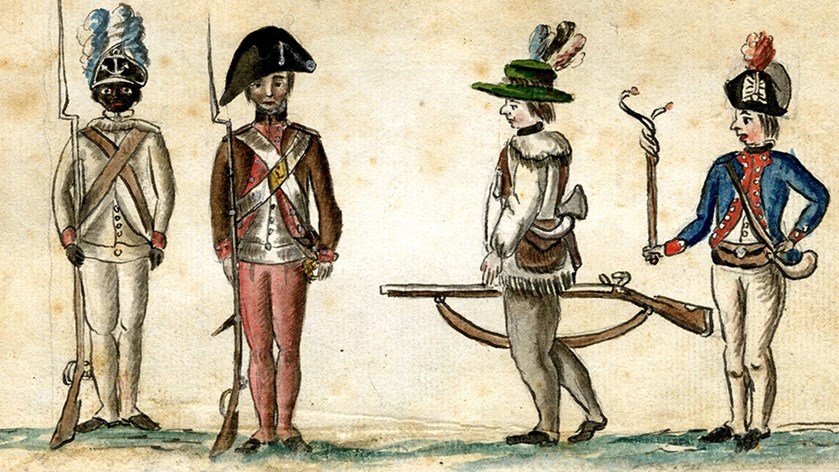
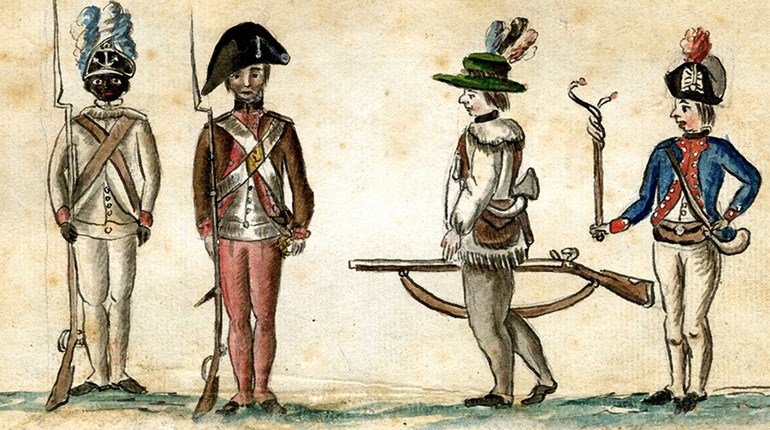
An eyewitness sketch of soldiers in the Continental Army Four soldiers by a French Army officer who participated in the Yorktown Campaign in 1781. (Public Domain)
“As far as enlistment, there are no physicals when one enters the Army in the 18th century. One must have front teeth and an operating thumb and forefinger so one may be able to reach in, grab a cartridge, tear off the paper, and be able to successfully load your musket,” Henry pointed out.
In October of 1777 Anna Maria fought in the Battle of Germantown in Pennsylvania and was wounded. Her injury left her lame for the rest of her life, perhaps because she did not seek treatment to remain undetected as some historians speculate. In 1779, her husband John was wounded in battle and taken prisoner during the Siege of Savannah. Pension records list that she and her husband served in the Continental Army until 1781.
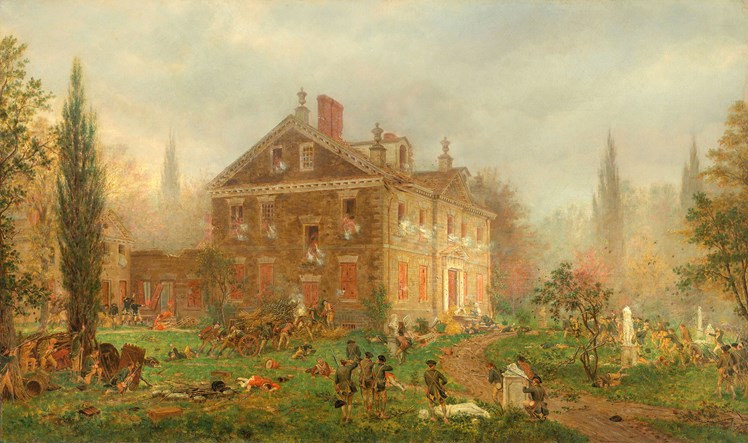
A painting by Edward Lamson Henry titled “The Attack on Chew's House during the Battle of Germantown, 1777.” Heavy fog created confusion throughout the battle and American troops tried to re-take the house that British troops had barricaded themselves in. The battle ended up as a loss for American troops. They suffered 152 casualties, 521 wounded and 438 were taken prisoner. (Public Domain)
After the war, Anna Maria and John joined Virginia’s Public Guard based in Point of Fork in Fluvanna County. When the guard disbanded they moved to Richmond in 1801 to retain employment and John served with the city’s Public Guard at the Virginia Manufactory of Arms. Anna Maria volunteered in a military hospital. Aging out of their duties, in 1808 an appeal was written by Virginia Gov. William H. Cabell to the House of Delegates on behalf of several elderly and infirmed Revolutionary War veterans, requesting that the General Assembly grant them pensions:
“Under this provision some old soldiers who had fought our battles in the Revolutionary contest, were received as members of the Guard in the City, altho’ from their age and infirmities, they were not capable of performing very effective duty. When entirely unable to perform military duty, they were employed as artificers on cleaning the arms—It is not believed that they can no longer be employed to advantage now in that way—It may be literally & truly said that they have been worn out in the public service; and now, without property or money, and their age and infirmities rendering them unable to procure either, they must be sent forth to beg or starve, unless the humanity of the Legislature shall interfere—Their names are John Hays, William Hipkins, & John Lane—The wife of the last Anna Maria Lane is also very infirm having been disabled by a severe wound which she received while fighting, as a common soldier, in one of our Revolutionary battles, from which she never has recovered and perhaps never will recover.”

A letter written by Virginia Gov. William H. Cabell in 1808 asking the House of Delegates to grant pensions for several Revolutionary War veterans, specifically naming Anna Maria Lane. (Public Domain)
A General Assembly pension record from 1808 shows that the Lanes were granted pensions, and Anna Maria received more than double that of a common soldier (standard was $40), at $100 a year. The document listed her accomplishment that earned her the pension: “In the Revolutionary War, in the garb, and with the courage of a soldier, performed extraordinary military services at the Battle of Germantown.” She only lived two more years, dying in 1810 at approximately 75 years of age. John lived until 1823.
There are no known portraits of Anna Maria Lane (photography wasn’t invented until the mid-1800s), but John’s military records and her granted pension are testaments that this woman spent over thirty years serving her country and caring for those that fought alongside her.
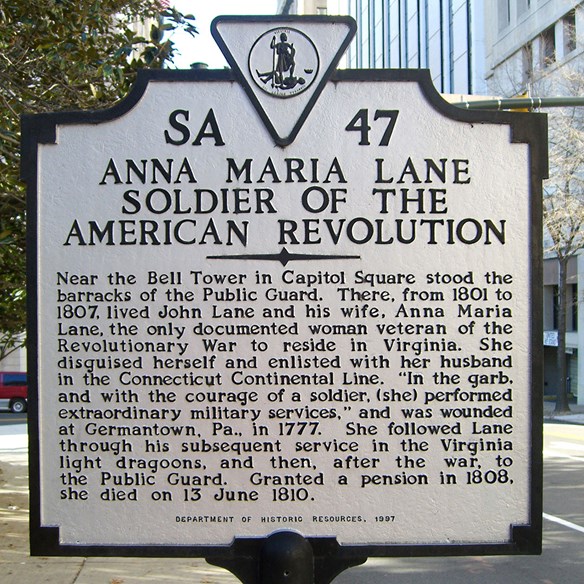
A historical marker pays tribute to Anna Maria Lane in Richmond, Va. near where she and her husband lived in the barracks and served with Virginia’s Public Guard. (Historical Marker Database)
Most Popular