
When punching holes in paper starts to get a little stale, many of us enjoy shooting steel targets instead. They’re just more fun—you get instant feedback from that “ping” noise and sometimes, depending on the kind of target, the swing or spin of the steel. The targets last forever and you don’t have to keep going downrange to replace paper targets. Steel is especially fun when it’s set up at super long ranges, so the sound comes seconds after the gunshot has faded, or when it’s set up close-range as a course, with multiple targets you shoot in sequence with a timer, Steel Challenge-style. It’s also great for one-on-one competition when set up as a dueling tree or poppers.
That said, shooting steel isn’t exactly the same as shooting paper, and there are a few safety guidelines to keep in mind.
1. Always Use Protection
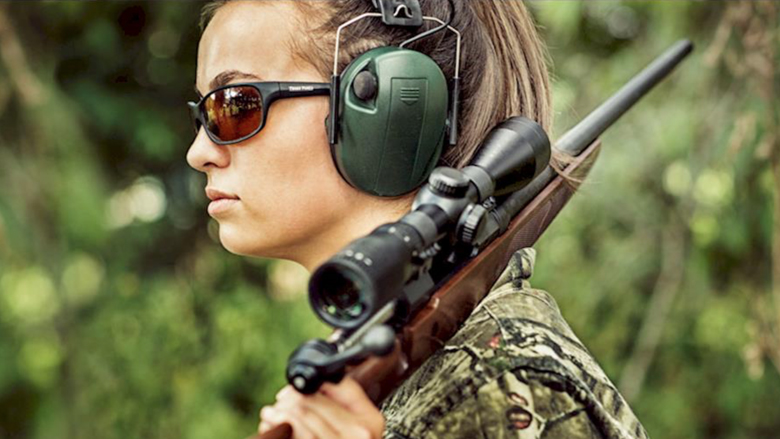
As always when you’re shooting any firearms, you must wear ear and eye protection when you’re shooting steel. Hitting a steel target causes the projectile to basically break into a bunch of tiny pieces, and some of those pieces occasionally fly back toward the shooter. This is called bullet splatter or spalling, and I’ve personally seen it draw blood on many occasions, although they have always been very minor, superficial wounds that a Band-Aid would fix. But a tiny piece of metal hitting your arm is no big deal; it’s an entirely different matter if it lands in your eye. Wear protection!
2. Use the Right Steel
You can’t just make your own steel targets from random scrap metal. Only certain grades of steel are safe to shoot—if the steel is too soft, it can pock and deform as it’s shot, and that less-than-flat surface can cause spalling to splatter in unpredictable directions. If the steel is too hard, it becomes brittle and doesn’t work well. AR500 and AR550 steel are ideal for shooting.
You must also mount your steel correctly. You want a totally flat steel surface; no brackets, bolts or welding lumps should be visible on the front of the steel. Again, those create uneven surfaces that cause unpredictable ricochets or splatter. All mounting hardware should be on the back of the target so the front remains a completely flat surface. Movement built into the hanging mechanism is good—it allows the target to swing, flip or fall, which helps absorb energy and minimize ricochets.
3. Mind the Angles
This rule works in two ways. First, you always want to shoot steel targets straight-on, not from a side angle. This keeps the bullet splatter predictable. In some games, like Steel Challenge, you will engage a number of steel targets from one spot, but the targets are all close enough together that the angles remain relatively straight-on and safe. In sanctioned games like this, the target angles and distances are strictly regulated for consistency as well as safety.
You also must ensure the steel itself is mounted at a slight forward/downward angle, which will help direct the spalling to the ground rather than out in all directions. The Scholastic Shooting Sports Foundation has a great set of guidelines on how to shoot steel safely, and they recommend a 15-degree angle. You can hang it at a more extreme angle if you like, but that quickly begins to shrink the hittable target surface, so it requires larger targets (more steel).
4. Maintain a Safe Distance
For safety’s sake, stay at least 10 yards back from the target when shooting handguns, 15 yards when shooting birdshot or buckshot out of a shotgun, 50 yards when shooting shotgun slugs, and at least 100 yards when shooting rifle ammunition. This keeps you mostly out of the splatter zone, although as mentioned, you should always wear eye protection anyway, as you never know.
5. Select the Right Ammo
You want ammunition that deforms easily and will splatter—not hold together—once it hits the target. Lead is great at this, so regular full-metal jacket handgun ammo is fine to shoot on properly hung steel, and it’s usually the most affordable option. Non-jacketed bullets are fine, hollowpoint bullets are fine, soft points are fine. Frangible bullets are designed to basically disintegrate into powder when they impact steel, which makes them very safe for shooting at steel targets. The downside is that they are typically a good bit more expensive than FMJ ammo.
What you don’t want is excess velocity or any form of hard bullet that won’t break up upon impact. Do not use solid copper bullets, steel core bullets or armor-piercing rounds.
Shooting steel targets is a fun way to spice up your training, and they lend themselves really well to friendly or formal competition. Steel is perfectly safe provided the guidelines are followed about building and setting up the targets correctly, maintaining a safe distance, and using the right ammo.