
If you grew up in a hunting family that extends for several generations, there is one thing we all have in common: the admiration of our forefathers’ shooting skills and abilities, both men and women. It does not take long to hear someone who came from a long line of shooters to hear them say, “My grandfather (or grandmother, uncle, aunt) was one heck of a shot!”
Have you ever wondered why past generations were such great shots? The answer is simple. They grew up shooting with open or iron sights. The skills that are learned from shooting iron sights transfers to shooting with optics. Many of today’s new shooters begin their shooting journeys utilizing optics, never learning how to use iron sights. This reminds me of the adage, “learning to run before he or she can walk.” It is not uncommon for many of my firearm students to have never shot a rifle or a handgun using only iron sights.
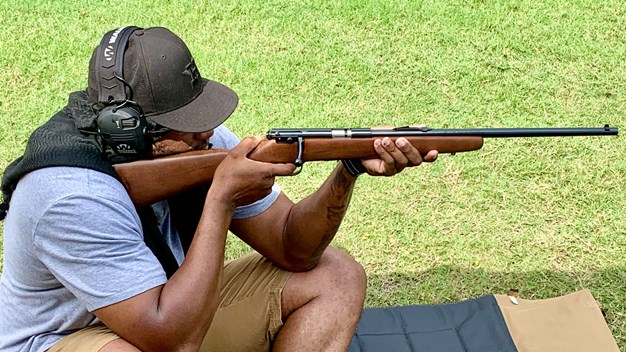
There are two basic types of open or iron sights: blade and post sights, and aperture sights, also known as peep sights or military sights. It is important to remember that your eyes can focus only on one thing at a time. Because of this, you should always focus on the front sight. Your target should be a little “fuzzy,” and your rear sight should be a little “fuzzy.”
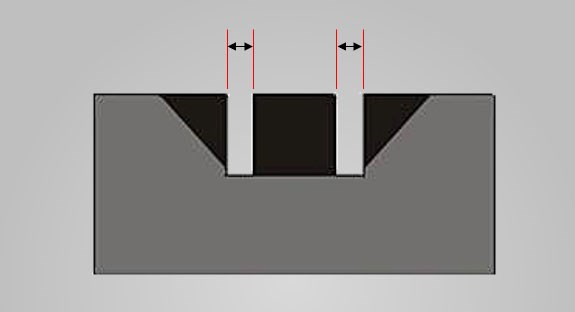
Blade and Post Sights
Proper sight alignment and sight picture when using blade and post sights is acquired by placing the front sight in the notch of the rear sight. Usually, the front sight is positioned inside the opening of the rear sight so that it is equal on both sides of the rear sight and level with the top of the rear sight. This is easy to remember with the saying, “Equal Height and Equal Light.”
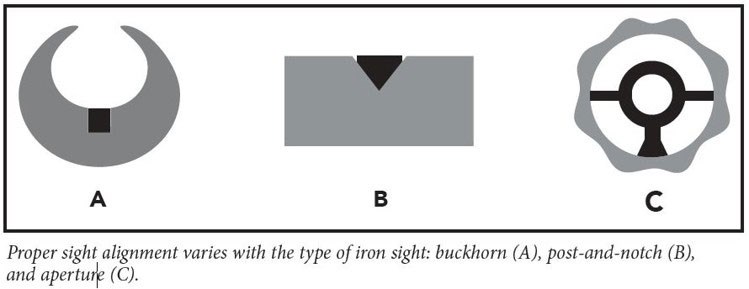
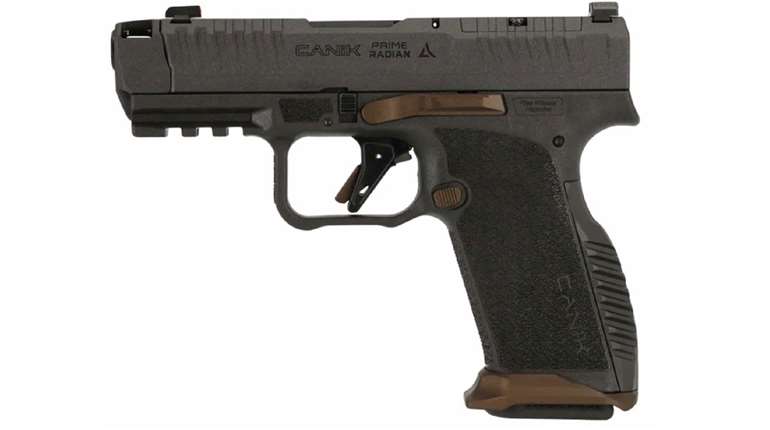
There are five common types of open or blade and post sights. These include square notch (partridge sights), u-notch, v-notch, trapezoidal, and buckhorn or semi-buckhorn sights.
Square Notch (Partridge Sights). Square notch is probably the most common type of sights, especially on handguns. Square Notch Sights are “boxy” with a flat, horizontal base and sides that go up at a 90-degree angle. This type of rear sight is used for target shooting when precision is important. This type of sight is perfect when telling yourself, “Equal Height and Equal Light.”
U-Notch Sights. U-Notch Sights are used when fast acquisition is needed. They are used for speed of target acquisition instead of pinpoint accuracy. The rear sight of a U-Notch Sight is curved or rounded, and the front sight is usually bright, fiber optic, or tritium night sights.
V-Notch Sights. V-Notch Sights are designed for the shooter to quickly acquire the proper sight picture and sight alignment. The “V” gives the shooter a wide view of the target area, especially in low light conditions. V-Notch Sights are found on defensive handguns and hunting rifles.
Trapezoidal Sights. Trapezoidal Sights are not as common as other sights and are usually found on competition guns. The rear sight is triangular, or a trapezoid shape and the front sight is triangular or a simple dot. The proper sight alignment and sight picture is acquired by placing the front sight in the triangle rear sight forming a pyramid image. This type of sight is designed to naturally draw the eye to the center of the sight.
Buckhorn or Semi-Buckhorn Sights. Buckhorn or Semi-Buckhorn Sights are not as common as the other blade and post sights. These sights are usually found on older guns or older designs such as lever-action rifles. The rear sight of the buckhorn looks like a set of horns that arch toward each other like a pincher. There is also a small “V” at the bottom of the sight located in the middle.
The buckhorn is an interesting type of sight, and shooters tend to either like them or hate them. The design of the rear sight is such that it can be aimed at different distances. For example, if you are shooting a close target, the front sight is placed in the “V” and for targets further away, the front sight is placed at the top of the pincher.
Aperture Sights. Aperture or peep sights usually consist of a front post and a round disc with a hole in the middle for the rear sight. It is similar to looking through a peep hole. Some of these sights have two different size holes to look through, one for longer distances and one for closer targets. Aperture sights with two different size holes work by flipping the sight up or down depending on what size you are looking for. Competition aperture sights have different size discs that can be changed out for the proper size hole for the distance being shot.
The proper sight alignment for an aperture sight is acquired by looking through the rear sight (disc) and lining up the front post. While looking through the disc, line up the front post at the 6-o’clock position. When the front post is in the 6-o’clock position, raise or lower the muzzle of the firearm until the front post is in the middle of the sight picture.
Aperture sights are usually found on rifles although they can be found on handguns, especially those handguns used for precision shooting. The four types of aperture sight configurations are receiver mounted sights, tang-mounted sights, ghost ring sights and diopter sights.
Receiver Mounted Aperture Sights. Receiver Mounted Sights are the most common configuration of aperture sights. These sights are mounted directly on top of the receiver. Receiver mounted aperture sights are commonly found on modern sporting arms, Ruger Mini-14s, and older military firearms such as M1 Garands.
Tang-Mounted Aperture Sights. Tang-Mounted Sights are usually found on older type guns and/or action. These include lever-action rifles, falling block action rifles, rolling block action rifles, and trapdoor rifles. The rear sight (disc) of these types of sights is located behind the action, on the tang where it meets the stock of the gun. This places the rear sight close to the eye and provides a long sight radius for accuracy and precision.
Ghost Ring Aperture Sights. Ghost Ring Sights are used for very quick target acquisition. A ghost ring aperture has a very thin rear ring and a high-visibility front post. When the firearm is quickly shouldered, as long as the front post falls in the sight picture of the rear sight, the rear ring “disappears” and the shooter focuses on the highly visible front post. This type of aperture sight is usually found on tactical firearms, including shotguns for close quarter target acquisition.
Diopter Aperture Sights. Diopter Sights are usually found on competition firearms or advanced target shooting, such as many firearms used in Olympic competitions and match shooting. The rear sight (disc) of diopter sights could have colored lenses, micrometer, or Vernier adjustments for precision.
The most difficult part of shooting is properly lining up the sights. The first step in lining up the sights is to understand what type of sight you have and how to use them. Remember, according to the NRA Education and Training Department, the two most important fundamentals of shooting are trigger control and sight alignment/sight picture. Learning the different types of sights and how to use them is half the battle. The rest is easy.