
In civil society, it is considered good manners to be kind to others and follow the golden rule and “Do unto others... .” Sadly, in the world we live in, there are situations where kindness toward others is taken advantage of and where criminals prey on those who act out of good intention. Here’s why you should re-evaluate the golden rule when it comes to street smarts.
 Good Humans Are Targets
From a young age, children are taught that it is kind to help others. While true, kindness can leave a person open to being taken advantage of. For girls and women, the habit of kindness could be especially dangerous. Willingness to help strangers or give directions have been used by serial killers to target women.
Parents train their children that if they are approached by a stranger asking for help, perhaps to help with finding their lost puppy, to “run away!” There is absolutely nothing wrong with heeding that same advice as an adult. If someone asks you for directions, they could be lost, but consider the entire situation. Is there anything else “off” about things? Are you a mother with children and approached outside your car for directions? What if a woman asks you for help and to come with her to her car? (perhaps she has accomplices). Ask yourself if the situation is a variant of the “lost puppy,” and take action to secure your own safety first.
Accepting the fact that you are not responsible to help a stranger find their lost dog does not make you bad or unkind, but it might just make you safe.
Targeted Areas
We should teach our families that there are places where social expectations of kindness stop.
Understanding that not all social settings are equal is an important aspect of street smarts. In discussions of personal safety, we call these transition zones: parking lots and garages, bus stops, the exit of a store, the metro station, etc.. These are all places that “do unto others” should cease being your moral imperative and it should switch to “safety first.”
If you’re in a parking lot and a stranger approaches you, they’re definitely not selling Girl Scout cookies. They’re just a random person (potentially malevolent) and you have no obligation to engage with them. Absolutely zero!
If you’re in an elevator in a parking structure and a strange guy gets in, you have no obligation to stay in that elevator. Get out and go where there are more people. Whether that offends the person is not for you to worry about; your safety comes first.
Whether you look at it as moral philosophy (that being kind to others creates a society with empathy), or from a religious standpoint (that God or the Bible directs you to be kind to others), being kind to others is a belief that is used against people, no matter how you mesh this idea with your personal beliefs.
Moral Philosophy in Action
In a survival situation, your job is to take care of yourself. For those of us who are parents, our job is to take care of our families. For those in law enforcement, the job is to care for the community. But as an individual female, your job is to take care of your own safety, not to be kind to others and do everything you can to help them. This is important to recognize.
If I am alone and see somebody seemingly stranded on the side of the road, I don’t feel compelled to stop to help. Now, if it is a mother with small children, I would feel drawn to them. But I would probably assess the situation and make sure there’s no set-up happening. Depending on the situation, I might help from my car by calling the police and watching until they arrive.
It’s no secret that the news is full of random violent crime, murders of innocent people on trains, women grabbed while out for a run, and so on. So it is absolutely necessary that you consider your safety first while out in the world. Your job is not to consider what’s nice, not to consider what’s polite; you need to consider what is safe—that’s it.
This does not mean you cannot offer your seat to a mother on the bus. And it is OK to return the grocery cart for the elderly person who looks like she or he needs help. Use your head and really be aware as you navigate your daily life. Being concerned with your own safety doesn’t mean that you turn into a jerk.
But when you are in situations where offering kindness to someone who you don’t perceive as needy for help (for example, the random guy approaching you in the middle of a parking lot), it’s best to turn away from those situations and not engage. Because if they are a criminal, they are banking on you being nice. They are making a bet that you’re going to be polite and answer them, talk to them, you’re going to “do unto others”... And the truth is that you don’t have to be polite to anybody.
Are there times this might make you come across as a jerk? Absolutely! But better that a stranger thinks you’re rude than a random criminal attacks you.
Three Strategies to Navigate Transition Areas
1. Be Aware.
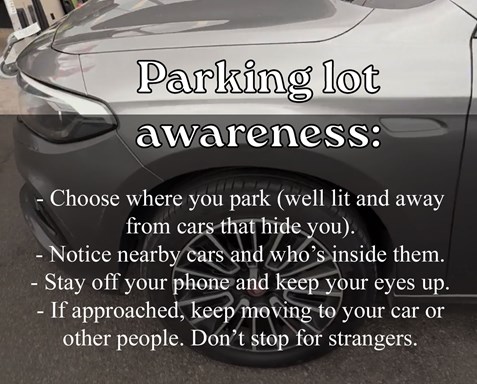
Stay off your phone and keep your eyes scanning your surroundings - the people, vehicles, and structures you are passing through. Seeing a suspicious person hanging out in a parking lot might change where you park, if you go to another store, or if you wait to exit your vehicle. You can’t see what you’re not looking for.
2. Carry concealed if you can.
Carry some sort of personal protection tool, whether that’s a legal firearm or non-lethal device, being prepared to defend yourself implies that you are already doing No. 1 above.
3. If approached, don’t offer help from an unsafe area.
If you are approached and cannot immediately get into your car or into a place where other people are. Just keep moving toward safety—don’t stop. Tell the person to go inside and ask for help or move into the place you’re going and directly to other people and bring them into the conversation. If the person really needs help, it will become apparent.