
While driving is an everyday activity, some drivers could use perspective on driving strategy. Some sage advice to heed is, “the best defense is a good offense.” Here are some offensive tactics you can incorporate to focus less on defense while lowering your stress level while driving.
 Offense to Prevent Defense
No one wants to defend himself or herself from reckless drivers. By thinking offensively, you can put your vehicle into positions that are more secure, giving you the ability to make decisions with intention rather than being forced to react to the decisions of others. Offensive thinking means you must make decisions earlier.
Here are a few specific examples to help you get into the right frame of mind:
- When approaching a traffic jam on the interstate, give yourself an ”out.” This could mean staying in an outside lane, so that if there was a problem behind you, you could maneuver your vehicle to the shoulder or even completely off the roadway.
- Look at patterns in others’ driving. If a driver near you is making bad decisions like moving erratically or not reacting quickly enough, it’s probably a proper assumption that he or she is distracted. Move to a different lane, or at least put more space between your two vehicles.
- Before you drive, turn on your mapping program’s traffic overlay. The traffic overlay on can alert you to accidents or weather-related road closures. Alerts that traffic is stopped ahead can prepare you to make decisions earlier.
Think of driving like a self-defense scenario: You don’t want to be taken by surprise. Maps and navigation are tools to help you drive with more control.
Concealed Carry and Driving
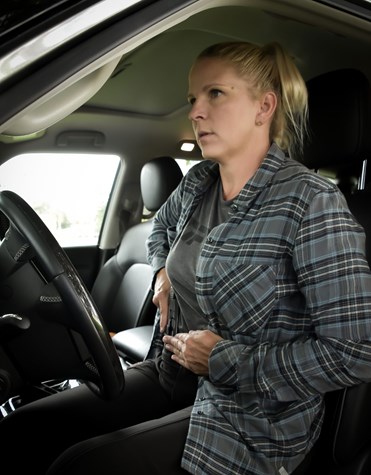
Another consideration in your driving, especially for those who carry concealed, involves properly stowing and maintaining your firearm. Your local commute might not take you to a place where laws change, but road trips or hunting trips can take you out of state or into areas with different laws. Do a search and find out what legal considerations you must consider on your route.
If you are pulled over by law enforcement, many states require that you notify the officer as to whether you have a firearm. An officer might even ask to look at the firearm. Learn what is required where you live and in the areas through which you drive.
For your daily commute, it is worth understanding what the law says about your ability to store your firearm in your personal vehicle, even if you work in, say, a place where firearms are prohibited. Most places allow for storage in your vehicle, and your vehicle can be an asset for personal safety.
Defense is not Aggression
The term defensive driving can conjure some ideas about how a person ought to drive, especially in heavy traffic or busy times of day. What it should mean is that you’re not thinking about how you drive as a means of defending yourself for your vehicle from others, but how you handle your vehicle in a more offensive posture.
A few items to pay attention to with how you position your vehicle are:
- Blind spots: Take action so that you don’t position yourself in someone’s blind spot, especially on the interstate.
- Visibility: Take action to make your car visible to other drivers. Turn your lights on, especially if it is raining.
- Move predictably. Don’t be erratic. Set your cruise control when appropriate, but don’t sit in the left lane if people need to pass you.
Strategies to Adopt
Some specific strategies you may have never thought of before can level up your driving.
- Learn to position your mirrors the way police officers often do — they’re not adjusted to see the side of your car, rather, they're angled outward to see your actual blind spot. If you position your sideview mirrors this way, combined with your rearview mirror, you can see across three lanes at once. This is one of the primary strategies our family has adopted and in the last decade of heavy travel across the country and driving in other countries. I always set up my mirrors so that I do not have a blind spot when I have a rental car. This is especially helpful in unfamiliar areas where you might need to change lanes quickly or make a correction on your route.
- Use your hazard lights. In some countries, you are required to use hazard lights, if you are at a standstill or below the speed limit. In a time where we see horrific crashes involving cars at a standstill, and someone crashing into them, unaware, using hazards at slow speeds is a good strategy to incorporate. The visual flashing of the hazard lights might be enough to alert a distracted driver to the fact that there are cars stopped in front of them!
There are times where defensive driving is a must. For example, my police officer husband has told our sons for years that after about 11 p.m., they should assume that there are people on the road who have been drinking. It is a time to be extremely vigilant about your driving and keeping your distance from other vehicles.
This is also why many people will not get out of their vehicle in the night hours, if there is an accident. They don’t want to deal with a potentially violent person, especially someone who is inebriated. Would it perhaps be more prudent to stay in your car and wait for police — absolutely! And furthermore, if you were involved in an accident and carrying concealed, it might be further reason to wait until law-enforcement arrives.
Driving defensively is about more than just awareness, it’s about thinking and seeing ahead and using all the tools available to you.